What Inflation? Pandemic Leaves Emerging Asia's Consumer Recovery Behind
Asia's once fast-growing economies are struggling with weak domestic demand that is keeping a lid on inflation in contrast to some developed markets, heightening the chance many central banks will forgo interest rate hikes this year.
For investors and policymakers in Asian emerging markets, high and sometimes destabilising inflation has always gone hand in hand with strong growth underpinning their development.
That has changed markedly, as slow vaccinations and a new wave of coronavirus infections delay economic recoveries in countries like Thailand, Indonesia, the Philippines and India.
While some Asian nations have seen inflation perk up, reflating growth remains a higher priority for them even as rising inflation draws increasing attention in western nations like the United States, Britain and Canada.
To be sure, higher commodity prices are affecting Asia, as with the rest of the world, by raising the cost of raw materials. South Korea is also preparing for rate hikes as soon as this year as its economy and the housing market run hot.
But soft demand will keep inflation distant from red zones and take immediate pressure off most Asian central banks to respond with tighter monetary policy, analysts say.
"Resurgence in infections is forcing some Asian nations to reimpose curbs on activity that are weighing on inflation, a trend that will continue for some time," said Makoto Saito, an economist at Japan's NLI Research Institute.
"Given weak domestic demand, many Asian economies won't see inflation accelerate sustainably. That means their central banks likely won't hike interest rates until next year," he said.
Thailand's central bank maintained record low interest rates this month and projected headline inflation of just 1.2 per cent this year, as the tourism-dependent country struggles with a third wave of coronavirus infections.
Headline inflation in the Philippines hit 4.5 per cent in May from a year earlier, though its central bank kept record low rates this month and projected inflation to return to within its 2 per cent-4 per cent target band by the second half of the year.
Indonesia's annual inflation accelerated to 1.68 per cent in May from 1.42 per cent in April to mark its highest level since December, but remained below the central bank's 2 per cent-4 per cent target range.
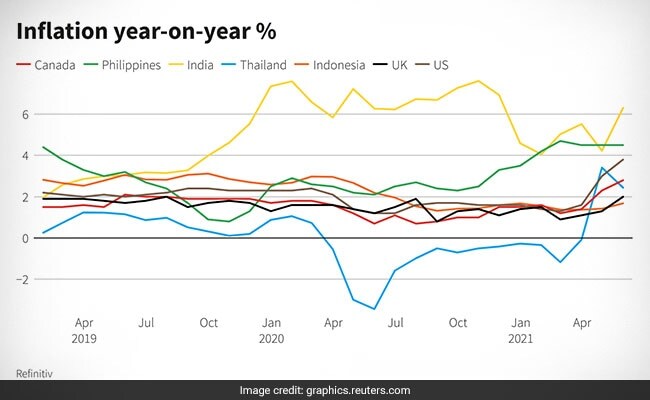
Inflation year-on-year %
Photo Credit: Reuters
Even in India, where retail inflation spiked to 6.3 per cent in May, the central bank is unlikely to react with tighter policy to cushion the blow to growth from a deadly second wave of the pandemic, sources have told Reuters.
Asia's situation contrasts with emerging markets in other regions such as Latin America, where inflation and capital flight risks have triggered rate hikes or talk of tightening.
Fed Tightening
While a U.S. tightening remains a risk for Asia central banks, the lessons of the region's financial crisis in 1998 and the 2013 "taper tantrum" have made them more resilient to the risk of a huge capital outflow triggered by the Fed.
"Asia's foreign exchange reserves, outside of China, have hit another record high so there's definitely a lot more of a buffer that Asian central banks have to manage volatility," said Khoon Goh, head of Asia research at ANZ Bank in Singapore.
Soft domestic demand shrank imports even as exports to other parts of the world rose, narrowing current account deficits and making countries like Indonesia less vulnerable to the risk of a capital flight, analysts say.
While the pandemic's scars may begin to heal next year, prospects of benign inflation may mean Fed policy is likely to have a bigger impact on Asian monetary policy than inflation.
The real test for Asian central banks could come next year, when the Fed may deliver clearer signals on rate hike prospects and put more upward pressure on the region's bond yields.
"If you have rising bond yields in the U.S., you could actually see rising bond yields in Asia coming back quite strongly, so we are not disconnected in that aspect," said DBS investment strategist Joanne Goh.
HSBC said it was staying away from the long end of the yield curve for high-yielding Asian economies, as their central banks could be in a tight spot once the Fed actually raises rates.
"I do think it will become much more uncomfortable, maybe not this year but into next year especially when you see the whites in the eyes of actual tapering," said Andre de Silva, head of global emerging-markets rates research at HSBC.

-
Signature Play: The Classic Cocktail Is Dead. Or Is It?

Classic cocktails are disappearing from India's cocktail menus. But they're still being ordered, taught to bartenders and borrowed from. So, who's really having the last drink?
-
A New Samvat Wishlist: Inclusive Prosperity And Human Development
India has strengthened its economic foundations through infrastructure, digital access and enterprise. Its next growth chapter must deepen productivity, create better livelihoods and widen participation in prosperity.
-
Love, Sex Aur Dhokha: The Audacious Plot To Spy On Jensen Huang
A Taipei dinner, a Singapore chip buyer and a suspected Chinese asset: inside the alleged spy operation that got close to NVIDIA's Jensen Huang.
-
Ten Things I Learnt This Samvat
Patience can be a trap. Cheap stocks can stay cheap. Leverage can wipe you out. What did Samvat 2082 teach us? Niraj Shah writes on 10 lessons from the year gone by.
-
Talking Points This Week: Tech Nerves, FII Buying, And A Faraway Banking Shock
The global markets are not shining this Diwali. The exception in the large markets is, India.
-
Midterm Rally Lasted A Day. The Hard Reality Of A Divided US May Last Two Years | Opinion
Between a contested AI boom, a debt ceiling that arrives in 2027 and a president with every incentive to act alone, the next two years may prove more volatile than the first day's rally suggests.
-
Blue Wave Will Derail the AI Trade but Won't Dismantle the AI Era | Unhedged Position
The Democrats' sweep of the US Congress will see politics collide with economic forces both over the long and short term.
-
It's Time To Take The GST Council's Bet On Trust Global
Payment records can prove India's services exports, and clear, proportionate rules can bring foreign digital sellers into the tax net.
-
Opinion | India at 38: From Innovation Overperformer to Innovation Powerhouse
India now has 453 VC-backed deep science startups, 18 of them late-stage, after 117 percent growth since 2020. Laurus Labs, at USD 9.3 billion, is the most valuable deep science company in any middle-income economy outside China.









