What Ching's Owner Capital Foods Could Bring To Nestle?
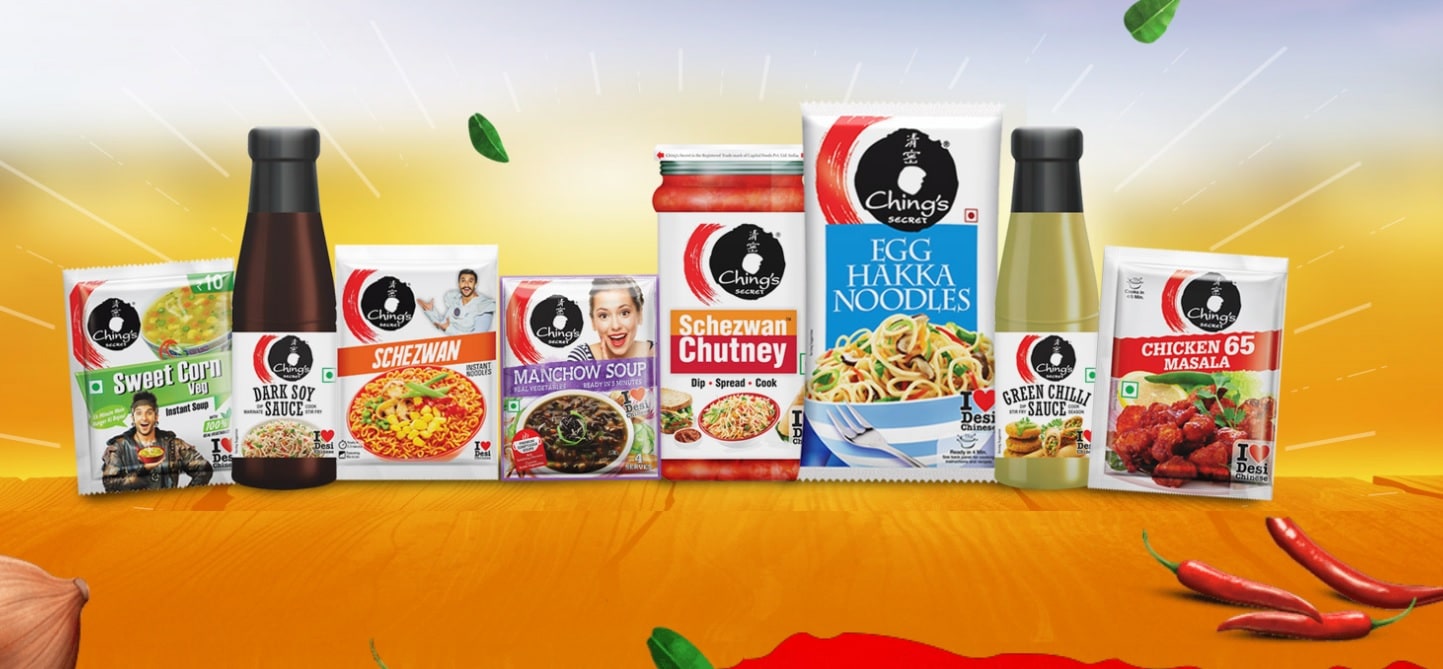
Shares of Nestle India Ltd. gained as much as 3.3% on the back of news that the consumer goods maker's parent is among the final bidders competing to acquire established Ching's sauces and noodles maker Capital Foods Pvt.
The deal, if it fructifies, could turn out to be one of the largest buyouts of a homegrown consumer brand, since the owner of the Ching's Secret and Smith & Jones brands is likely to be valued up to Rs 8,000 crore, according to reports.
"We can't comment anything on this now," said S Raghunandan, chief executive officer at Capital Foods, when BQ Prime contacted him on Friday. Nestle India declined to comment as well.
Capital Foods has projected a top line of Rs 837 crore for FY23, with an Ebitda of Rs 118.59 crore and Ebitda margin of 14.17%. That works out to an enterprise value-sales multiple of 3.83 times, and enterprise value-Ebitda multiple of 27 times, showed a valuation report prepared by Ranka & Associates as on March 31, 2022. The current revenue run rate of Capital Foods is estimated at Rs 1,000 crore.
The deal looks expensive by any standard, and I will be surprised if Nestle gives even $1 billion... Capital Foods over the years had a volatile financial performance, according to Nitin Jain, founder of Candid Capital.
The current run rate is estimated at Rs 1000 cr. so around 8x of sales. Originally, Capital Foods was looking at $ 1.5-2bn
March 31, 2023
I agree - expensive by any standards and will be surprised if Nestle gives even $1 bn
Company over the years had a volatile financial performanceAccording to Deepak Shahdadpuri, founder and managing director of DSG Consumer Partners, concurred. "$1 billion is Rs 8,200 crore, which is 10x revenue if you consider FY23 revenue. Why would anyone pay 10x revenue?. The best case is 5x revenue," he tweeted.
4/n $1b is 8,200 Cr which is 1x revenue if you use 800Cr as Fy23 revenue (average of 750-850Cr). Why would anyone pay 10x revenue? The best case imho is 5x revenue. That translates to 4,100Cr. So what am I missing??
March 31, 2023As on March 31, 2022, the Mumbai-based company posted a revenue of Rs 580 crore, a 14% decline from a year earlier, according to its latest disclosure with the Registrar of Companies. It also slipped into losses at Rs 7.4 crore in FY22 against a net profit of Rs 68.7 crore in FY21. Its business was impacted as Covid-19 forced hotels and restaurants to shut.
Moreover, it is not clear if Nestle SA plans to acquire the company via its Indian subsidiary or chooses to charge royalty from Nestle India for using Capital Foods' brands. Nestle India currently pays 4.5% of its net sales as royalty towards its parent company.
Royalty payment typically means shareholders will be left with lower cash, and this might be unfair to minority shareholders.
Capital Foods has an authorised capital of Rs 40.7 crore and a paid-up capital of Rs 3.5 crore, according to the Ministry of Corporate Affairs. It's jointly owned by U.S. private equity group General Atlantic (35.43%), Artal Asia Pte. (39.94%)— a European family office and investment arm, Wildflower Family Trust (22.08%) and founder chairman Ajay Gupta (2.55%).
The company appointed Raghunandan as CEO last year in February. He had served leadership positions in several consumer goods companies including Hindustan Unilever Ltd., Dabur India Ltd., Paras Pharmaceuticals Ltd., Jyothy Labs Ltd. and Reckitt Benckiser India Pvt.
In 2006, Kishore Biyani's investment vehicle Future Ventures pumped in Rs 13 crore for a minority 33% stake in Capital Foods.
The company's top line growth has jumped over four times from Rs 145 crore in FY13, when Biyani exited the company.
For Nestle, the potential deal will also boost its market leadership further, analysts said.
"Nestle India has not been active in terms of M&A, while most other listed players have done several acquisitions in past five to six years," said Abneesh Roy, executive director, Nuvama Institutional Equities, "If this happens, Nestle's total addressable market will expand."
Capital foods has been the first to identify and label the unique cuisine "desi Chinese", which is native to India and loved across the U.S., Canada, Australia, the U.K., and Singapore. Some of Capital Foods' marquee products are Ching's Secret schezwan chutney, instant soups, Chinese masalas, Chinese sauces, hakka noodles, flavoured noodles and Smith & Jones ketchup, pasta, paneer masala, and ginger-garlic paste.
Nestle, the maker of Maggi, is already No.1 in the instant noodles category. It enjoys a 60% market share of India's Rs 11,600-crore instant noodles segment. By 2035, the market is likely to grow four times its current size, according to Sharekhan.
The cooking paste and condiments categories are largely unorganised and Capital Foods competes with the likes of Mother's Recipe, Dabur Ltd. and ITC Ltd. in the branded segment.
Capital Foods also has well-established co-manufacturers and its own manufacturing plants in Vapi, Nashik, and Gandhidham. The brand is endorsed by Bollywood actor Ranveer Singh.
Several other companies have also expressed interest in buying Capital Foods.
Nestle India shares ended 3.29% higher on Friday, at Rs 19,680 apiece on the BSE, as compared with a 1.63% gain in the Nifty 50. The impact of the potential acquisition on the company's stock will, however, be clear only when the deal structure is disclosed.
According to Motilal Oswal, Nestle India valuations are already expensive at 54.4 times earnings for 2024, preventing the brokerage from "turning constructive" on the stock.
Of the 38 analysts tracking the company, 22 maintain a 'buy' rating, 10 recommend a 'hold' and six suggest to 'sell', according to the Bloomberg data. The average of 12-month price targets implies an upside potential of 6.4%.

-
The Economic Imperative: Analysing The Material Driving Force Behind India-Canada Strategic Reset

This economic complementarity is further reinforced by deep institutional investment ties and talent mobility, which form the bedrock of the bilateral framework.
-
Medicine Pricing: Where Must Profit Stop?
India must confront excessive margins, hidden incentives and regulatory gaps that threaten the integrity of medicine.
-
Why Amazon And Flipkart Are Struggling To Beat Meesho In India's Smaller Cities
With 274 million users and lowest-cost logistics, Meesho is defending its value commerce crown against giants like Amazon and Flipkart.
-
High US Salaries, No Green Card Certainty: The Financial Calculation Facing Indian H-1B Families
The suspension of PERM processing at eight technology employers does not cancel existing H-1B visas. What it does is force a question many Indian families have been avoiding: is the US salary worth tying your career and family plans to one employer?
-
Swiggy vs Eternal: Food Delivery's Two Rivals Are No Longer In The Same Race
Eternal is building a private AI assistant, dark.ai. Swiggy is still working out how to make Instamart pay, with an operating loss of Rs 895 crore in the July-September quarter while Blinkit stayed profitable.
-
Where You Live Shapes How You Get To Work | The Reason Why
Two-wheelers are the most popular way to get to work in India, accounting for nearly 43% of workplace commutes.
-
Unhedged Position: Can India See An Indonesia-Style Time Correction?
The Nifty is trading below levels it first clocked in 2024. Is there, then, as I have suggested in the headline, potential that the current time correction drags on painfully for the next three-five, even ten years?
-
Navigating Friction And Energy Realities: An Analysis Of Marco Rubio's October Visit To India
Occurring at a critical juncture marked by stalled trade negotiations and escalating geopolitical pressures over global energy supplies, the visit offers a profound window into modern US-India relations.
-
India Exports Capital. Why Not Export Trusteeship?
The big question, then, is whether India can build an institution that global borrowers, investors, banks, and lawyers can trust, even without an Indian connection.
-
France's Economy & Politics Are In Crisis | The Reason Why
Let's look at how the French economy and politics evolved under Nicolas Sarkozy, Franois Hollande and Emmanuel Macron.










