What Air India’s Potential Buyer Will (And Won’t) Get
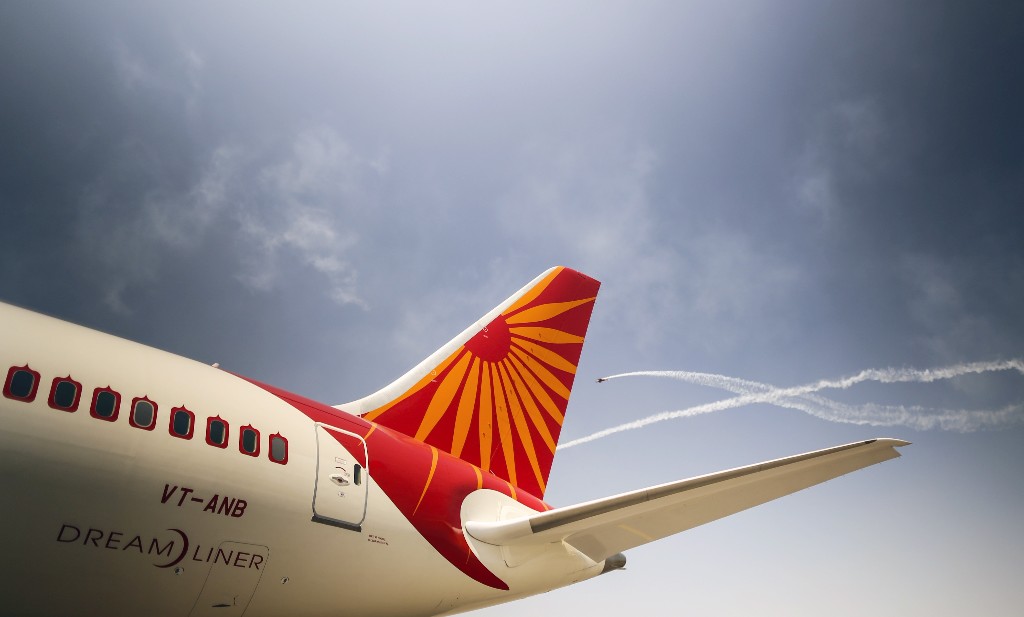
India plans to sell 76 percent stake in Air India even as debt and employee benefits could become a deal-breaker in the government's efforts to privatise the struggling carrier.
The offer includes the budget carrier Air India Express, according to the document inviting expression of interest put out by the Civil Aviation Ministry. Here's what a potential buyer will get in the national carrier surviving on a government bailout:
International Routes
Air India has a 42.8 percent market share of international routes from India, providing a gateway to any buyer to service 43 cities globally from India.
Rs 33,392-Crore Debt
A potential buyer will have to take over more than half or Rs 33,392 crore worth of the total debt that will remain with Air India and Air India Express. This includes contingent or expected liabilities provided in the balance sheet of the airline and Rs 1,765 crore statutory dues like income tax, customs duty, service tax, and guarantee fee/penal charges due to the government.
Here's a break-up of the airline's debt, according to the document.
- Air India had a total debt of Rs 48,781.3 crore as of March 2017 and the government hasn't disclosed any addition in the financial year ended that ended last month.
- Air India has a contingent liability of Rs 3,035 crore.
- Air India Express has a debt of Rs 2,598 crore and contingent liability of Rs 91 crore.
- Together, both the airlines have a debt and liability of over Rs 54,400 crore.
11,214 Employees
Air India has 11,214 permanent employees. Nearly 37.6 percent of these will retire in the next five years. In addition, the national carrier also has 8,278 employees either on contract, deputation or are casual workers. Air India Express has only 96 permanent employees.
The government has committed to paying arrears worth Rs 1,298 crore from wage revisions ahead of the proposed divestment.
The company is also in the process to estimate the cost of employee benefits like pension, gratuity, etc. There's no clarity yet if the government will either make good on this liability or factor it in the valuations.
Also Read: Air India Finally Has a Chance to Lose the Baggage
Chance To Reduce Future Tax Outgo
A buyer of Air India will also get close to Rs 31,806 crore of unabsorbed depreciation, according to the document. That may provide “benefit of reduced tax liability going forward”.
Unabsorbed depreciation is what couldn't be claimed as expenditure in profit and loss account due to lack of sufficient income. It can be carried forward for any number of years. The company buying stake in Air India can offset its profits against the unabsorbed depreciation, reducing the tax liability. The benefit will be available as long as Air India stays as a separate entity.
What A Buyer Won't Get
No Guarantee On Debt
A large part of the carrier's debt is guaranteed by the government. In addition, it also guaranteed aircraft lease rentals for 21 Boeing 787-8 aircraft.
A bidder won't get this guarantee.
A government guarantee allows the airline to borrow at lower rate of interest, which is crucial given that it has been making losses for the past five years. Air India paid Rs 4,236 crore in financial costs in 12 months to March 2017.
No Land, Artefacts
The government proposes to transfer over Rs 21,000 crore of debt to Air India Asset Holding Ltd., a special purpose vehicle that that will look to raise money through divestment of the non-core assets like land and properties, and art and artefact. The buyer won't get these assets.
Who's Eligible To Bid
A bidder should have a net worth of over Rs 5,000 crore and profits in three out of the last five years of operations. There is a concession of Indian carriers servicing the domestic market. They are exempted from the condition as long as they hold at least 51 percent in the consortium and its partners adhere to the net worth requirement.
Also Read: New Owners of Air India to Get Planes And $5 Billion of Debt

-
The Economic Imperative: Analysing The Material Driving Force Behind India-Canada Strategic Reset

This economic complementarity is further reinforced by deep institutional investment ties and talent mobility, which form the bedrock of the bilateral framework.
-
Medicine Pricing: Where Must Profit Stop?
India must confront excessive margins, hidden incentives and regulatory gaps that threaten the integrity of medicine.
-
Why Amazon And Flipkart Are Struggling To Beat Meesho In India's Smaller Cities
With 274 million users and lowest-cost logistics, Meesho is defending its value commerce crown against giants like Amazon and Flipkart.
-
High US Salaries, No Green Card Certainty: The Financial Calculation Facing Indian H-1B Families
The suspension of PERM processing at eight technology employers does not cancel existing H-1B visas. What it does is force a question many Indian families have been avoiding: is the US salary worth tying your career and family plans to one employer?
-
Swiggy vs Eternal: Food Delivery's Two Rivals Are No Longer In The Same Race
Eternal is building a private AI assistant, dark.ai. Swiggy is still working out how to make Instamart pay, with an operating loss of Rs 895 crore in the July-September quarter while Blinkit stayed profitable.
-
Where You Live Shapes How You Get To Work | The Reason Why
Two-wheelers are the most popular way to get to work in India, accounting for nearly 43% of workplace commutes.
-
Unhedged Position: Can India See An Indonesia-Style Time Correction?
The Nifty is trading below levels it first clocked in 2024. Is there, then, as I have suggested in the headline, potential that the current time correction drags on painfully for the next three-five, even ten years?
-
Navigating Friction And Energy Realities: An Analysis Of Marco Rubio's October Visit To India
Occurring at a critical juncture marked by stalled trade negotiations and escalating geopolitical pressures over global energy supplies, the visit offers a profound window into modern US-India relations.
-
India Exports Capital. Why Not Export Trusteeship?
The big question, then, is whether India can build an institution that global borrowers, investors, banks, and lawyers can trust, even without an Indian connection.
-
France's Economy & Politics Are In Crisis | The Reason Why
Let's look at how the French economy and politics evolved under Nicolas Sarkozy, Franois Hollande and Emmanuel Macron.










