Weak Public Sector Banks Can’t Increase Headcount For Three Years
Weak state-run lenders seeking capital infusion from the government won't be allowed to increase their headcount over the next three years, senior officials at three public sector banks told BloombergQuint requesting anonymity.
Eleven banks that have signed a memorandum of understanding with the government for funds can hire only to replace the employees who retire, the bankers quoted above said. The MoU is a tripartite pact, drafted by SBI Capital Markets Ltd. and the finance ministry, between lenders, employee unions and the government. At least one large union is yet to agree.
To be sure, hiring in public sector banks does not necessarily happen in a exponential fashion. Many a times, these banks hire people in one go and don't add any major strength in certain years.
The pact is part of a broader turnaround plan as most state-run lenders struggle with mounting bad loans and require capital to meet Basel-III norms. The government will infuse Rs 20,000 crore in two years to March 2019 under its Indradhanush plan. Yet, that may not be enough. Moody's Investor Service, in a report released in June, had estimated that the 11 of the 23 public sector banks it rates will need Rs 95,000-core equity capital over two years.
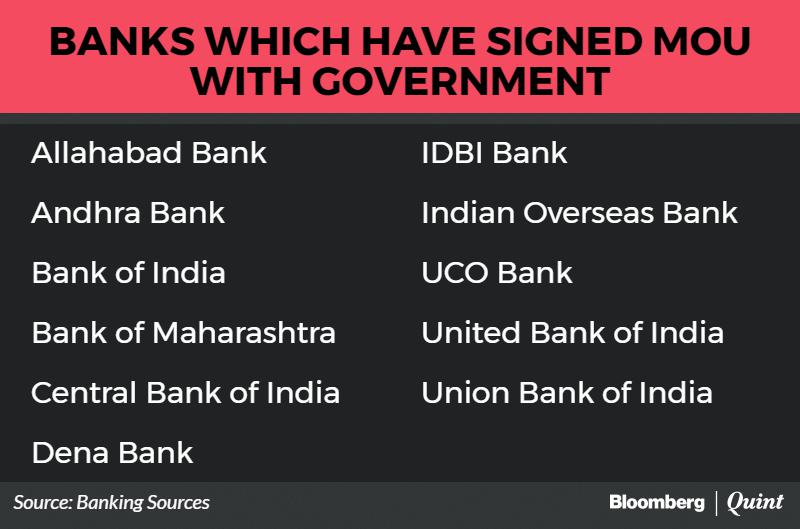
The lenders that have signed the MoU for capital infusion include Allahabad Bank, Andhra Bank, Bank of India, Bank of Maharashtra, Central Bank of India, Dena Bank, IDBI Bank, Indian Overseas Bank, UCO Bank, United Bank of India and Union Bank of India. The agreement mandates them to reduce their overall costs by 25 percent over three financial years without touching employee benefits.
BloombergQuint's emails to each of the 11 banks and the finance ministry remained unanswered. SBI Caps said “we do not comment on speculation”.
Cost Cuts
The banks have been asked to merge or close their non-performing branches. IDBI Bank on Wednesday said it has moved its zonal office in New Delhi to trim operation costs by Rs 25 crore. The state-owned lender will take more such measures across the country, it said in a statement.
Lenders also have to increase the level of small-value loans on their books, especially advances to individuals and small and medium businesses. This is to reduce risk on bank books and deploy capital in segments where the government wants to see more credit flow to, the bankers quoted earlier said.
Union Opposes
Bank Employees Federation of India, a bank staff union representing about 100,000 employees, is opposed to the MoU and has asked its affiliates not to support it. On April 26, the union wrote a letter to Finance Minister Arun Jaitley, seeking changes in the turnaround plan.
BloombergQuint has obtained a copy of the letter.
Pradip Biswas, general secretary at the federation, raised questions in the letter about how the banks are expected to reduce costs. He demanded that non-performing branches be given some time to turn around rather than being shut down or merged.
Biswas pointed out that the federation is not in favour of outsourcing any bank jobs, as mentioned in the MoU. BloombergQuint was not able to independently verify the clause.
The federation has not given its nod to the MoU, he said over the phone.

-
The Economic Imperative: Analysing The Material Driving Force Behind India-Canada Strategic Reset

This economic complementarity is further reinforced by deep institutional investment ties and talent mobility, which form the bedrock of the bilateral framework.
-
Medicine Pricing: Where Must Profit Stop?
India must confront excessive margins, hidden incentives and regulatory gaps that threaten the integrity of medicine.
-
Why Amazon And Flipkart Are Struggling To Beat Meesho In India's Smaller Cities
With 274 million users and lowest-cost logistics, Meesho is defending its value commerce crown against giants like Amazon and Flipkart.
-
High US Salaries, No Green Card Certainty: The Financial Calculation Facing Indian H-1B Families
The suspension of PERM processing at eight technology employers does not cancel existing H-1B visas. What it does is force a question many Indian families have been avoiding: is the US salary worth tying your career and family plans to one employer?
-
Swiggy vs Eternal: Food Delivery's Two Rivals Are No Longer In The Same Race
Eternal is building a private AI assistant, dark.ai. Swiggy is still working out how to make Instamart pay, with an operating loss of Rs 895 crore in the July-September quarter while Blinkit stayed profitable.
-
Where You Live Shapes How You Get To Work | The Reason Why
Two-wheelers are the most popular way to get to work in India, accounting for nearly 43% of workplace commutes.
-
Unhedged Position: Can India See An Indonesia-Style Time Correction?
The Nifty is trading below levels it first clocked in 2024. Is there, then, as I have suggested in the headline, potential that the current time correction drags on painfully for the next three-five, even ten years?
-
Navigating Friction And Energy Realities: An Analysis Of Marco Rubio's October Visit To India
Occurring at a critical juncture marked by stalled trade negotiations and escalating geopolitical pressures over global energy supplies, the visit offers a profound window into modern US-India relations.
-
India Exports Capital. Why Not Export Trusteeship?
The big question, then, is whether India can build an institution that global borrowers, investors, banks, and lawyers can trust, even without an Indian connection.
-
France's Economy & Politics Are In Crisis | The Reason Why
Let's look at how the French economy and politics evolved under Nicolas Sarkozy, Franois Hollande and Emmanuel Macron.










