Bengaluru Reads Your X-Ray. Chennai May Train Your Doctor
(Bloomberg Opinion) -- “Prick the patient's index finger,” said the voice in my ear. As the lancet in my hand was about to make contact with flesh, it cautioned me: “Avoid pricking the pad of the finger because it contains more nerve endings which will be more painful.”
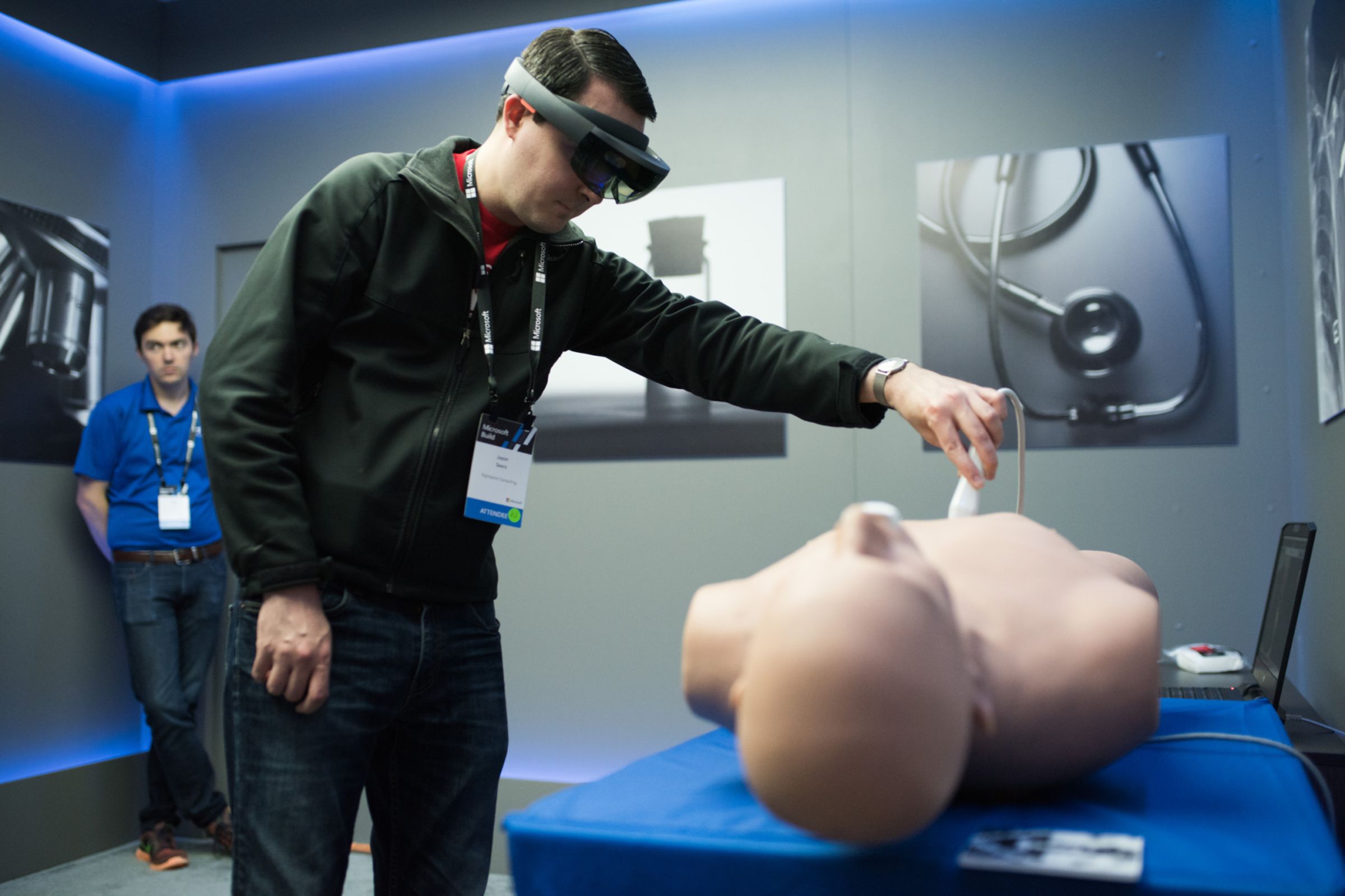
Using Meta Platforms Inc.'s Quest 2 headset, I was conducting the first nursing procedure of my life in a highly authentic virtual-reality setting, complete with gloves, cotton swabs, disposal bins and, yes, a patient waiting for me to draw blood to check its glucose level. The VR training program, which helped even a novice like me get it right the first time, has been designed by young techno-entrepreneurs from Chennai, in India's south.
Their firm is one of the 200-plus startups incubated by the city's Indian Institute of Technology Research Park, a venture supported by the government but funded by alumni and companies. The five-year-old MediSim VR has moved beyond the hatching phase: With 2,000 students training currently in the labs it has set up in medical and nursing schools, it's emerging as a serious player.
Recently, MediSim VR roped in Harvard Medical School's simulation guru Gianluca De Novi as an adviser, and tied up with Hartford HealthCare Corp.'s Center for Education, Simulation and Innovation, or CESI. The goal is to crack large and lucrative medical education markets like the US, UK and Australia.
India's capabilities in software are entering a new phase. The industry that came into its own at the turn of the millennium — initially to help fix the Y2K bug — has remained fixated on providing outsourced services at a fraction of code-writing cost in the West. Yet that prowess in labor arbitrage has failed to reach the next level of sophistication. With some exceptions, such as the privately held Vembu Technologies' disaster-recovery suite, the country is yet to spawn well-known successes in software products.
Expect this to change. While many Indians write code for Silicon Valley firms, some, like Sundar Pichai of Alphabet Inc. and Satya Nadella of Microsoft Corp., run global tech behemoths. That is now kindling a desire among entrepreneurs to create niche software products at home and take them global — as on-demand services on the cloud. After all, if X-ray plates from the West can be read in Bengaluru, why can't future doctors in advanced nations learn how to conduct a surgery on a virtual training module written thousands of miles away in Chennai?
Mannequins, on which medical and nursing students traditionally learn their craft, are often inadequate for a large class, need intensive — and expensive — instructor resources, and yet their impact on learning is hard to assess. Virtual reality solves these problems. It also gives health-care professionals a better understanding of what to expect in the real world. Sharmila Anand, a doctor and educator advising MediSim VR's cofounders, told me that the first time she encountered Code Blue — hospital shorthand for when an adult is having a medical emergency such as cardiac or respiratory arrest — was on a live patient.
It doesn't have to be like this. MediSim VR cofounder and Chief Technology Officer Jeno Manickam Durairaj comes from the world of computer games, while Sabarish Chandrasekaran, the chief executive officer, is an engineer and MBA. They were dabbling in outsourced virtual-reality-based solutions for everything from new tractor models to upcoming real estate projects when they decided that rather than end up as a software services firm, they should build a product. When Adith Chinnaswami, a trained laparoscopic surgeon, came on board, the founders knew that their specialization was going to be medical education.
Initially, they focused on surgical procedures, but soon realized that training hospital staff in everything that goes on inside or outside the operating theater is an even bigger market. That's when they landed at the Healthcare Technology Innovation Center at IIT Madras. (The prestigious engineering college still uses the old name for Chennai.)
Medical schools are receptive to the idea because they simply host the VR labs free of charge. MediSim bills Indian students an affordable annual license fee of about $300 to use its stations that cost $12,000 apiece to build. I spoke to Sivasri and Tamilselvi, third-year students at Puducherry Medical College. In addition to mannequin-based practice, their institution already allots time for VR lab. Now they want more virtual-reality-based training modules and more testing to check their proficiency. MediSim VR has three patents in medical simulation. Once it's able to include haptic feedback — where students will get a sensory reaction from the patient's body during simulated surgery — learning outcomes will improve further, Chinnaswami told me.
Before going global, India's services outsourcing business cut its teeth on massive domestic projects such as computerization of the railway ticketing system. Product companies might follow the same route. Since the pandemic, the Indian government has become painfully aware that the country's health-care resources need an upgrade, both quantitative and qualitative. The more affluent southern region is doing relatively better, but access to quality health care in smaller cities in north India is almost non-existent. Firms like MediSim are crucial to integrate VR-based medical learning into the core curriculum.
Globally, VR-based health-care training is a $3.8 billion-a-year industry. “It's just the tip of the iceberg,” says MediSim VR's CEO Chandrasekaran, who expects the market to grow eightfold by 2030. The market leader is San Francisco-based Osso VR.
Every seventh doctor in the US is of Indian origin. Nurses from Kerala have a long tradition of tending to patients in hospitals around the world, especially in the Persian Gulf. Now it's the turn of Indian-made medical software to go global, armed with training data on thousands of students in the home market. Indian medical education follows the UK system, but adjusting training modules to American standards won't be too hard. The catheter is the same everywhere, even though what's known as urobag in India is called a closed-circuit bag in America. That's hardly a bridge too far.
More from Bloomberg Opinion:
- Fed Reset Doesn't Mean Inflation Fight Is Over Yet: John Authers
- UK Does Better Than the US on SVB Intervention: Mohamed El-Erian
- Matt Levine's Money Stuff: SVB Couldn't Ignore Its Losses
This column does not necessarily reflect the opinion of the editorial board or Bloomberg LP and its owners.
Andy Mukherjee is a Bloomberg Opinion columnist covering industrial companies and financial services in Asia. Previously, he worked for Reuters, the Straits Times and Bloomberg News.
More stories like this are available on bloomberg.com/opinion
©2023 Bloomberg L.P.

-
The Economic Imperative: Analysing The Material Driving Force Behind India-Canada Strategic Reset

This economic complementarity is further reinforced by deep institutional investment ties and talent mobility, which form the bedrock of the bilateral framework.
-
Medicine Pricing: Where Must Profit Stop?
India must confront excessive margins, hidden incentives and regulatory gaps that threaten the integrity of medicine.
-
Why Amazon And Flipkart Are Struggling To Beat Meesho In India's Smaller Cities
With 274 million users and lowest-cost logistics, Meesho is defending its value commerce crown against giants like Amazon and Flipkart.
-
High US Salaries, No Green Card Certainty: The Financial Calculation Facing Indian H-1B Families
The suspension of PERM processing at eight technology employers does not cancel existing H-1B visas. What it does is force a question many Indian families have been avoiding: is the US salary worth tying your career and family plans to one employer?
-
Swiggy vs Eternal: Food Delivery's Two Rivals Are No Longer In The Same Race
Eternal is building a private AI assistant, dark.ai. Swiggy is still working out how to make Instamart pay, with an operating loss of Rs 895 crore in the July-September quarter while Blinkit stayed profitable.
-
Where You Live Shapes How You Get To Work | The Reason Why
Two-wheelers are the most popular way to get to work in India, accounting for nearly 43% of workplace commutes.
-
Unhedged Position: Can India See An Indonesia-Style Time Correction?
The Nifty is trading below levels it first clocked in 2024. Is there, then, as I have suggested in the headline, potential that the current time correction drags on painfully for the next three-five, even ten years?
-
Navigating Friction And Energy Realities: An Analysis Of Marco Rubio's October Visit To India
Occurring at a critical juncture marked by stalled trade negotiations and escalating geopolitical pressures over global energy supplies, the visit offers a profound window into modern US-India relations.
-
India Exports Capital. Why Not Export Trusteeship?
The big question, then, is whether India can build an institution that global borrowers, investors, banks, and lawyers can trust, even without an Indian connection.
-
France's Economy & Politics Are In Crisis | The Reason Why
Let's look at how the French economy and politics evolved under Nicolas Sarkozy, Franois Hollande and Emmanuel Macron.










