Viral Acharya Exits RBI Job With A -Sense of Unfinished Business-
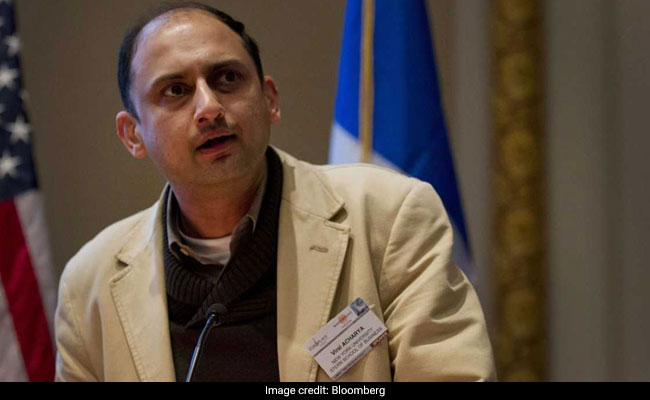
Viral Acharya will be ending his stint as deputy governor at the Reserve Bank of India with a sense of unfinished business, particularly involving the central bank's autonomy and the health of lenders.
References to these are littered across half of Mr Acharya's 14 speeches as a central banker, where he uses the word "capital" more than 150 times to drive home his point: against the government's attempts to dip into the RBI's capital reserves, and to urge Prime Minister Narendra Modi to hasten recapitalization of country's struggling state-run lenders.
So far, his calls have gone largely unheeded. A central bank-appointed panel is set to recommend that the RBI transfer some of its surplus reserves to the government over time, while public-sector banks are likely to receive a gradual injection of $10 billion in capital amid a push to merge weak lenders with stronger ones.
In one of his latest speeches in October last year, Mr Acharya, who declined to be interviewed for this story, suggested that that may be a wrong approach. He cited evidence from abroad to show that weak banks remained vulnerable to future shocks. Moreover, merging them with strong lenders risks weakening the acquirers, he warned.
True Test'
Mr Acharya's boss at the central bank, Governor Shaktikanta Das, says a continuous and prolonged dependence on the government's capital infusion into banks can breed inefficiency.
"The true test of efficiency of a public sector bank is whether they are able to access capital markets to raise additional capital," Das said in an interview to Bloomberg News.
Mr Acharya, who had requested to leave the central bank by July 23, will return to the New York University Stern School of Business, where his main research interest is financial risk and its genesis in government-induced distortions.
Government's Ire
Toward the end of his tenure, Mr Acharya was at the receiving end of the government's ire. That came after he delivered a hard-hitting speech on October 26 where he brought bare the differences between government, which wants a greater share of the central bank's capital reserves, and the RBI. Soon after, Urjit Patel who had encouraged Mr Acharya to speak on central bank autonomy, resigned and was replaced by Mr Das, an ex-bureaucrat.
With India preparing its first-ever overseas sovereign bond issue, upholding central bank independence might be even more paramount than ever before.
"Governments that do not respect central bank independence will sooner or later incur the wrath of financial markets, ignite economic fire, and come to rue the day they undermined an important regulatory institution," Mr Acharya said in the October speech. "Their wiser counterparts who invest in central bank independence will enjoy lower costs of borrowing, the love of international investors, and longer life spans."

-
We May Need Another Tukaram Mundhe To Fight Air Pollution | The Reason Why

Developers may install basic measures such as sprinklers and green nets, resume work, and continue violating rules when this equipment stops working.
-
Extracting Value From Battery Scrap Could Be Challenging For India | The Reason Why
A discarded lithium-ion battery still contains valuable materials such as lithium, nickel and cobalt. These can be recovered and reused. When such batteries are crushed and shredded, they produce a dark powder called black mass.
-
One El Nino, India Can Handle. Two Could Break The Granary
India's grain stocks can absorb one bad year, but a second El Nino could drain the buffer in two to three years, economists say.
-
India's Troika Of Good Luck | Joining The Dots
As Jensen Huang's exit drags Nvidia down, a cooling AI trade and resilient earnings have revived investor interest in India. A likely RBI rate hike looms.
-
Talking Points This Week: Leadership Shock At Nvidia, Earnings Strength, And The Fog Over Hormuz
The Anthropic IPO pricing and first trading day, Nvidia's upcoming earnings, and any fresh signals from Iran will set the tone for the following week.
-
Signature Play: The Classic Cocktail Is Dead. Or Is It?
Classic cocktails are disappearing from India's cocktail menus. But they're still being ordered, taught to bartenders and borrowed from. So, who's really having the last drink?
-
A New Samvat Wishlist: Inclusive Prosperity And Human Development
India has strengthened its economic foundations through infrastructure, digital access and enterprise. Its next growth chapter must deepen productivity, create better livelihoods and widen participation in prosperity.
-
Love, Sex Aur Dhokha: The Audacious Plot To Spy On Jensen Huang
A Taipei dinner, a Singapore chip buyer and a suspected Chinese asset: inside the alleged spy operation that got close to NVIDIA's Jensen Huang.
-
Ten Things I Learnt This Samvat
Patience can be a trap. Cheap stocks can stay cheap. Leverage can wipe you out. What did Samvat 2082 teach us? Niraj Shah writes on 10 lessons from the year gone by.
-
Talking Points This Week: Tech Nerves, FII Buying, And A Faraway Banking Shock
The global markets are not shining this Diwali. The exception in the large markets is, India.









