With UP Rajya Sabha Win, BJP May Have Pushed SP, BSP Closer

The Bahujan Samaj Party (BSP) candidate's loss in the Rajya Sabha polls in Uttar Pradesh is Amit Shah's revenge for the Bharatiya Janata Party's (BJP) losses in the recent bypolls. Shah employed all tools of ‘saam daam dand bhed' to undo the BSP's efforts to grab the 10th seat, by scraping through BJP's 9th candidate in a nerve-racking election decided on the basis of second preference votes.
While some strategists hail it as a masterstroke, it will actually turn out to be a ‘shooting oneself in the foot' moment for Shah. It will strengthen the resolve of Mayawati to take revenge in the general elections and brighten the prospects of a ‘Mahagathbandhan' in Uttar Pradesh. In a drama which was enacted in a similar manner in Gujarat Rajya Sabha polls last year, both parties approached the Election Commission and vote-counting had to be halted for a few hours.
How it Played Out?
- Elections were held for 10 Rajya Sabha seats. Each candidate required 37 votes to win.
- The BSP candidate was expected to win on the back of its 19 votes, the SP's surplus 10 votes, the Congress' seven votes, the RLD's one vote and the NISHAD party's one vote – in all 38 votes.
- The BJP won nine, the SP one seat.
- BSP candidate BR Ambedkar got 32 first preference votes, while BJP candidate Anil Agrawal got 16.
- Votes of one MLA each of the BSP as well as the SP were declared invalid.
Amit Shah's Strikes
- 1st strike – Shah roped in Naresh Agarwal and his son, an SP MLA, into the BJP. This reduced one vote for the BSP.
- 2nd strike – The NISHAD Party MLA declares support to the BJP. The same party's candidate defeated BJP in the Gorakhpur bypoll recently.
- 3rd strike – Court prevents two jailed MLAs – one from SP and another from BSP each – from participating in the election process. (A disclaimer: BJP had no role in this, it came as a bonus.)
- 4th strike – BSP MLA Anil Singh cross votes for the BJP.
Akhilesh Yadav's Strike
- After Raja Bhaiyya (Independent MLA) who claims support of another MLA Vinod Kumar, refused to vote for Mayawati because she had put him in jail, Akhilesh convinced him to vote for SP candidate Jaya Bachchan instead to enable transfer of two surplus votes of SP to BSP.
Loss May Bring SP-BSP Closer
Despite the loss, everybody saw how the Bhatija worked to get victory for Bua's candidate, even risking the seat for the SP. Raja Bhaiyya and Vinod Kumar were the last to vote, and had they not supported Jaya, the SP candidate could have lost.
This shows Akhilesh has matured as a leader. By winning the seat for BSP, Akhilesh wanted to thank Maya for her role in his party's victory in bypolls, and return the favour. This win has increased the confidence and trust among Akhilesh and Maya.
The loss will only strengthen the resolve of the SP and the BSP to get back at the BJP by forming a ‘Mahagathbandhan' for 2019 elections. This alliance has the potential to negate BJP's social engineering by forming a broad coalition of Dalits, Muslims, Yadavs and Backward Classes.
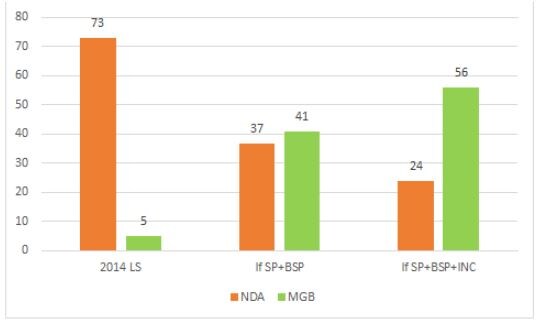
While people think BJP's stupendous performance in UP was due to the ‘Modi factor' and his decision of contesting from Varanasi, it is actually the split of anti-BJP votes between SP, BSP and Congress which helped the BJP. If SP, BSP and Congress would have contested together, BJP tally would have been only 24, almost down by 50. The ability to transfer votes without a formal alliance has already been proved in the bypolls.
Performance in Lok Sabha Elections
Mayawati knew that BJP will ensure the BSP candidate loses the elections and that's why she didn't contest herself. Now, BSP will play up the dirty tricks employed by BJP to defeat the Dalit candidate in the elections.
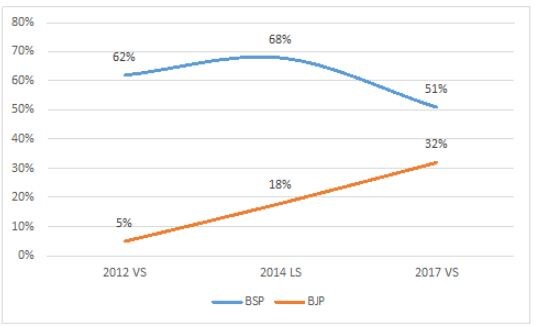
She will accuse BJP of pushing a rich industrialist ahead of simple Dalit man. She will harp on the fact that BJP is anti-Dalit and try to get back a section of Dalits, especially non-Jatavs, who have moved to BJP. Dalit support for BJP has increased significantly from a paltry 5% in 2012 to 18% in 2014 and 32% in 2017.
Among the 85 reserved seats in the state, BJP outflanked all other parties by getting 40% of the votes with BSP a distant second at 24 percent. She will exploit the anger amongst Dalits on account of poor handling of Saharanpur riots by BJP and reluctance to share power.
A section of Dalits seem to have abandoned BJP in the recently held Gorakhpur and Phulpur bypolls as both these seats had 20 percent Dalit population.
To conclude, in its zeal to avenge the loss in the bypolls and stop the BSP candidate from entering the Rajya Sabha, BJP risks facing a united opposition in Uttar Pradesh and losing the larger Dalit vote bank.
The loss of Dalit votes could potentially shave off 3 percent from BJP's vote share. The bigger threat – a united opposition – could thwart Modi's chances of returning to power in 2019.
(Amitabh Tiwari is a corporate and investment banker turned political commentator, strategist and consultant. He can be reached @politicalbaaba. This is an opinion piece and the views expressed above are the author's own. The Quint neither endorses nor is responsible for the same.)

-
'Never Seen This Level Of Negativity': Sandeep Tandon Says The Next Rally May Be Closer Than You Think

Veteran investor Sandeep Tandon says foreign selling is easing, large-caps are due a comeback and mid-caps are crowded, while he turns positive on gold, power and pharma this Diwali.
-
Indians Stay With Family, Not In Hotels | The Reason Why
India still lacks enough clean, reliable and affordable hotels for budget-conscious travellers.
-
The Economic Imperative: Analysing The Material Driving Force Behind India-Canada Strategic Reset
This economic complementarity is further reinforced by deep institutional investment ties and talent mobility, which form the bedrock of the bilateral framework.
-
Medicine Pricing: Where Must Profit Stop?
India must confront excessive margins, hidden incentives and regulatory gaps that threaten the integrity of medicine.
-
Why Amazon And Flipkart Are Struggling To Beat Meesho In India's Smaller Cities
With 274 million users and lowest-cost logistics, Meesho is defending its value commerce crown against giants like Amazon and Flipkart.
-
High US Salaries, No Green Card Certainty: The Financial Calculation Facing Indian H-1B Families
The suspension of PERM processing at eight technology employers does not cancel existing H-1B visas. What it does is force a question many Indian families have been avoiding: is the US salary worth tying your career and family plans to one employer?
-
Swiggy vs Eternal: Food Delivery's Two Rivals Are No Longer In The Same Race
Eternal is building a private AI assistant, dark.ai. Swiggy is still working out how to make Instamart pay, with an operating loss of Rs 895 crore in the July-September quarter while Blinkit stayed profitable.
-
Where You Live Shapes How You Get To Work | The Reason Why
Two-wheelers are the most popular way to get to work in India, accounting for nearly 43% of workplace commutes.
-
Unhedged Position: Can India See An Indonesia-Style Time Correction?
The Nifty is trading below levels it first clocked in 2024. Is there, then, as I have suggested in the headline, potential that the current time correction drags on painfully for the next three-five, even ten years?
-
Navigating Friction And Energy Realities: An Analysis Of Marco Rubio's October Visit To India
Occurring at a critical juncture marked by stalled trade negotiations and escalating geopolitical pressures over global energy supplies, the visit offers a profound window into modern US-India relations.










