US Plan For Electric Vehicles Tax Breaks May Breach WTO Rules: European Union, South Korea
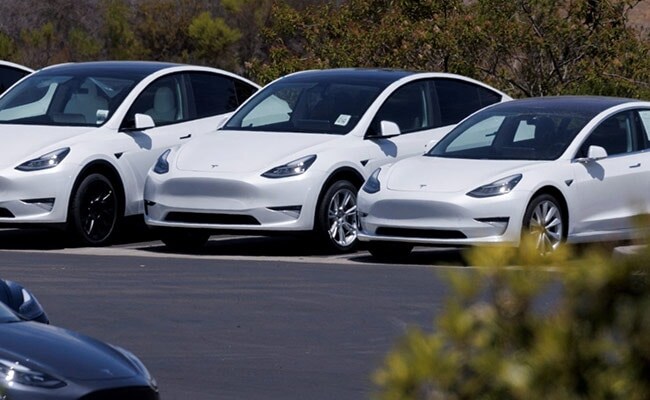
The European Union and South Korea have raised concerns about proposed U.S. tax credits for purchases of electric vehicles, saying they may discriminate against foreign-made vehicles and breach World Trade Organization (WTO) rules.
Under the $430 billion climate and energy bill passed by the U.S. Senate on Sunday, Congress would lift the cap on the existing $7,500 tax credit for electric vehicle purchasers but impose restrictions, including barring vehicles not assembled in North America from receiving the credit.
The ban on tax credits for vehicles assembled outside of North America would take effect as soon as President Joe Biden signs the legislation.
The proposed legislation also includes provisions aimed at preventing use of battery components or critical minerals derived from China.
"We think it's discriminatory, that it is discriminating against foreign producers in relation to U.S. producers," said European Commission spokesperson Miriam Garcia Ferrer. "Of course this would mean that it would be incompatible with the WTO."
Garcia Ferrer told a news briefing the EU agreed with Washington that tax credits are an important incentive to drive demand for EVs and promote the transition to sustainable transport and a reduction in greenhouse gas emissions.
"But we need to ensure that the measures introduced are fair and ... non-discriminatory," she said. "So we continue to urge the United States to remove these discriminatory elements from the bill and ensure that it is fully compliant with the WTO."
South Korea also said on Thursday that it has expressed concerns to the United States that the bill could potentially violate WTO rules and a bilateral free trade deal. South Korea's trade ministry said in a statement that it has asked U.S. trade authorities to ease battery component and final vehicle assembly requirements.
South Korea's trade ministry held a meeting with automaker Hyundai Motor Co and battery makers LG Energy Solution, Samsung SDI and SK. The companies asked Seoul to support them so that the bill would not put them at a competitive disadvantage in the U.S. market, according to the statement.
South Korea's auto industry group on Friday said it had sent a letter to the U.S. House of Representatives, requesting that the United States includes EVs and battery components manufactured or assembled in South Korea as eligible for U.S. tax benefits, citing the U.S.-Korea Free Trade Agreement.
"Korea is deeply concerned that the recent U.S. Senate's EV tax incentive bill includes provisions for providing tax incentives discriminating between North American-made and imported EVs and batteries," the Korea Automobile Manufacturers Association (KAMA) said in a statement. It said South Korea has been offering subsidies for EVs made in the United States.
Hyundai said it is "disappointed that the current legislation severely limits EV access and options for Americans and may dramatically slow the transition to sustainable mobility in this market."
Hyundai, which imports its flagship electric vehicles from Korea, has recently announced U.S. investments of $10 billion including EV manufacturing in Alabama and Georgia.
A group of major automakers said last week that most EV models would be ineligible for tax credits because of requirements for battery parts and critical minerals to be sourced from North America.
The EV tax break is part of the Inflation Reduction Act, which is likely to be passed by the House of Representatives on Friday and then sent to Biden for his signature.
(This story has not been edited by NDTV staff and is auto-generated from a syndicated feed.)

-
Indians Are Travelling, But Not Every Journey Is A Holiday | The Week In Whys

Pilgrims, patients and working women are the real travellers, and the system hasn't quite caught up with them.
-
Getting To Work Costs Women More | The Reason Why
It is not just about women paying more than men. It is about women paying much more in cities than in villages.
-
AI Bias In Investing Cannot Be Eliminated, But It Can Be Governed
Framing is a particularly important example as identical financial information presented in terms of gains rather than losses can lead an LLM to reach a different assessment.
-
Joining The Dots | Dark Skies, Steady Diya: Why Hope Holds This Diwali
With war, a weak rupee and foreign outflows weighing on sentiment, policymakers at the NDTV World Summit and market veterans at NDTV Profit Ignite: Diwali Edition offered the same advice: stay invested and filter out the noise.
-
The Curious Case of Equitas Small Finance Bank And A CEO Who Quit For Stock
PN Vasudevan believes persistent investor concerns over a perceived conflict of interest had become a governance overhang on Equitas Small Finance Bank's stock, even as the lender improved profitability and asset quality.
-
Talking Points This Week: AI Cash Burn, A Tiger Comeback And An India That Still Finds Its Own Path
India is not immune to higher oil or tighter global liquidity, yet its earnings base is broader, its domestic policy levers are still available.
-
Foreign Investors Own Half Of HDFC Bank and ICICI Bank. An LTCG Cut Could Matter Most Here
Foreign portfolio investors have US$115 billion parked in HDFC Bank, ICICI Bank. If the government cuts long-term capital gains tax, Jefferies says returning foreign money could land here first.
-
'Never Seen This Level Of Negativity': Sandeep Tandon Says The Next Rally May Be Closer Than You Think
Veteran investor Sandeep Tandon says foreign selling is easing, large-caps are due a comeback and mid-caps are crowded, while he turns positive on gold, power and pharma this Diwali.
-
Indians Stay With Family, Not In Hotels | The Reason Why
India still lacks enough clean, reliable and affordable hotels for budget-conscious travellers.
-
The Economic Imperative: Analysing The Material Driving Force Behind India-Canada Strategic Reset
This economic complementarity is further reinforced by deep institutional investment ties and talent mobility, which form the bedrock of the bilateral framework.










