U.S. Manufacturing Gauge Contracts At Fastest Pace In Three Months
(Bloomberg) -- A measure of US factory activity stumbled to a three-month low as sagging orders and scant production growth undercut hopes that manufacturing is turning the corner after an extended retreat.
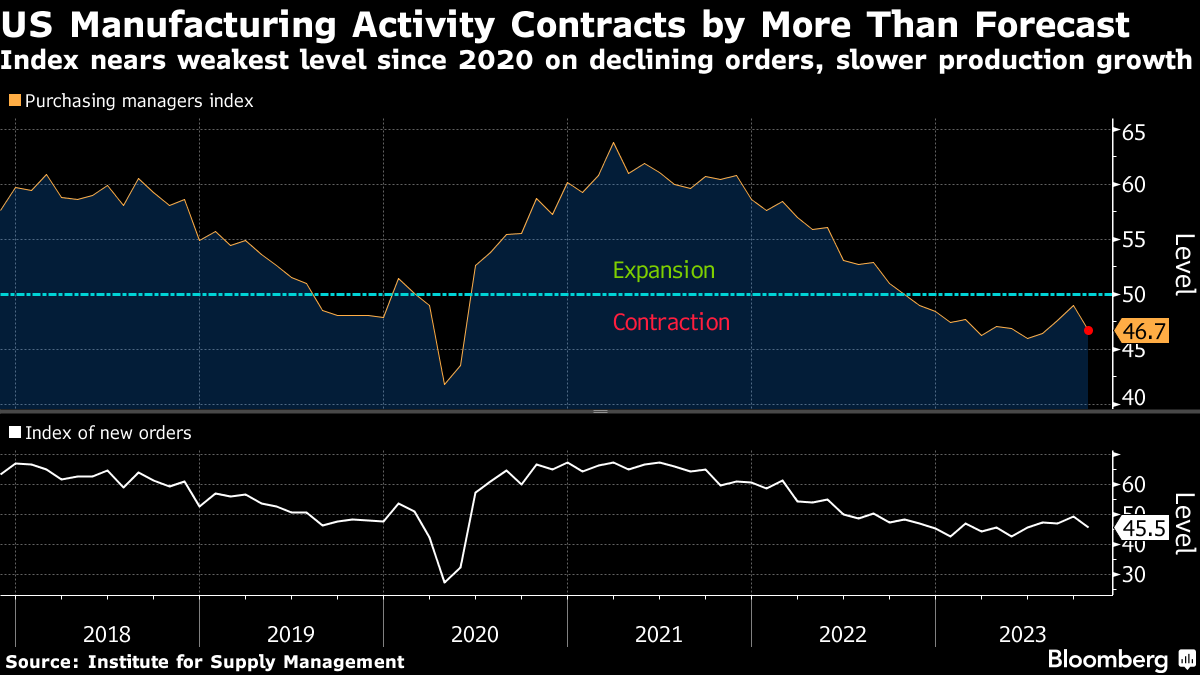
The Institute for Supply Management's manufacturing gauge fell 2.3 points, the biggest monthly decrease in more than a year, to 46.7. Readings below 50 indicate contraction, and the October index trailed all estimates in a Bloomberg survey of economists.
While the pullback likely reflected the impact of a strike at the nation's automakers that idled many vehicle plants, 13 industries reported contracting activity and just two indicated growth.
“Demand remains soft, but production execution is stable compared to September as panelists' companies continue to manage outputs, material inputs and — more aggressively — labor costs,” Timothy Fiore, chair of the ISM Manufacturing Business Survey Committee, said in a statement.
The October decline wiped out much of the progress in the prior three months, leaving the ISM index close to its lowest level since the aftermath of the pandemic. The gauge may well snap back after labor deals were reached between the United Auto Workers union and Big Three automakers.
The group's orders index dropped to a five-month low of 45.5 in October, indicating demand is shrinking at a faster pace, Wednesday's report showed. The ISM production gauge moved closer to stagnation.
A measure of factory payrolls slipped back into contraction territory to the lowest level in three months.
Select ISM Industry Comments
“Economy absolutely slowing down. Less optimism regarding the first quarter of 2024.” — Chemical Products
“Backlog is starting to dip a bit. We're hearing of cutbacks in 2024 ordering, but it's still very strong compared to historical averages.” — Transportation Equipment
“Markets appear to have slightly slowed. Certain commodities remain high.” — Food, Beverage & Tobacco Products
“Seeing a slowdown on bookings, and our backlog is down to five days from 15 weeks earlier this year.” — Machinery
“A slow fourth quarter, and we're clearly in a mild industry recession. However, demand is down less than 5 percent, and customer confidence of a recovery in the second half of 2024 is solid.” — Fabricated Metals
“Business is decent — not great, but steady and solid.” — Furniture
“Demand for raw materials/chemicals appears to be stable heading into the fourth quarter.” — Petroleum Products
“Despite the ongoing United Auto Workers (UAW) strike, there's a firmness and pickup in orders for the rest of the fourth quarter.” — Primary Metals
Inventories shrank at the fastest pace since June 2012. That measure may also have been affected by the walkout as the production slowdown forced automakers to sell existing stock.
The ISM report also showed prices paid for materials shrank at a slower pace, suggesting some stabilization in input costs.
What Bloomberg Economics Says...
“A pullback in demand in October helped push manufacturing activity deeper into contraction... Firms will struggle to pass along cost pressures because demand has weakened and consumers have grown more sensitive to prices.”
— Eliza Winger. To read the full note, click here
--With assistance from Kristy Scheuble.
(Adds graphic and industry comments)
More stories like this are available on bloomberg.com
©2023 Bloomberg L.P.

-
Talking Points This Week: Leadership Shock At Nvidia, Earnings Strength, And The Fog Over Hormuz

The Anthropic IPO pricing and first trading day, Nvidia's upcoming earnings, and any fresh signals from Iran will set the tone for the following week.
-
Signature Play: The Classic Cocktail Is Dead. Or Is It?
Classic cocktails are disappearing from India's cocktail menus. But they're still being ordered, taught to bartenders and borrowed from. So, who's really having the last drink?
-
A New Samvat Wishlist: Inclusive Prosperity And Human Development
India has strengthened its economic foundations through infrastructure, digital access and enterprise. Its next growth chapter must deepen productivity, create better livelihoods and widen participation in prosperity.
-
Love, Sex Aur Dhokha: The Audacious Plot To Spy On Jensen Huang
A Taipei dinner, a Singapore chip buyer and a suspected Chinese asset: inside the alleged spy operation that got close to NVIDIA's Jensen Huang.
-
Ten Things I Learnt This Samvat
Patience can be a trap. Cheap stocks can stay cheap. Leverage can wipe you out. What did Samvat 2082 teach us? Niraj Shah writes on 10 lessons from the year gone by.
-
Talking Points This Week: Tech Nerves, FII Buying, And A Faraway Banking Shock
The global markets are not shining this Diwali. The exception in the large markets is, India.
-
Midterm Rally Lasted A Day. The Hard Reality Of A Divided US May Last Two Years | Opinion
Between a contested AI boom, a debt ceiling that arrives in 2027 and a president with every incentive to act alone, the next two years may prove more volatile than the first day's rally suggests.
-
Blue Wave Will Derail the AI Trade but Won't Dismantle the AI Era | Unhedged Position
The Democrats' sweep of the US Congress will see politics collide with economic forces both over the long and short term.
-
It's Time To Take The GST Council's Bet On Trust Global
Payment records can prove India's services exports, and clear, proportionate rules can bring foreign digital sellers into the tax net.
-
Opinion | India at 38: From Innovation Overperformer to Innovation Powerhouse
India now has 453 VC-backed deep science startups, 18 of them late-stage, after 117 percent growth since 2020. Laurus Labs, at USD 9.3 billion, is the most valuable deep science company in any middle-income economy outside China.









