U.S. Job Openings Decline From Record While Remaining Elevated

(Bloomberg) -- US job openings fell in April from a record in the prior month though remained elevated at roughly double the number of unemployed Americans, suggesting little relief for employers struggling to attract and retain workers.
The number of available positions decreased to 11.4 million in the month from an upwardly revised 11.9 million in March, the Labor Department's Job Openings and Labor Turnover Survey, or JOLTS, showed Wednesday. The median forecast in a Bloomberg survey of economists called for 11.35 million openings.
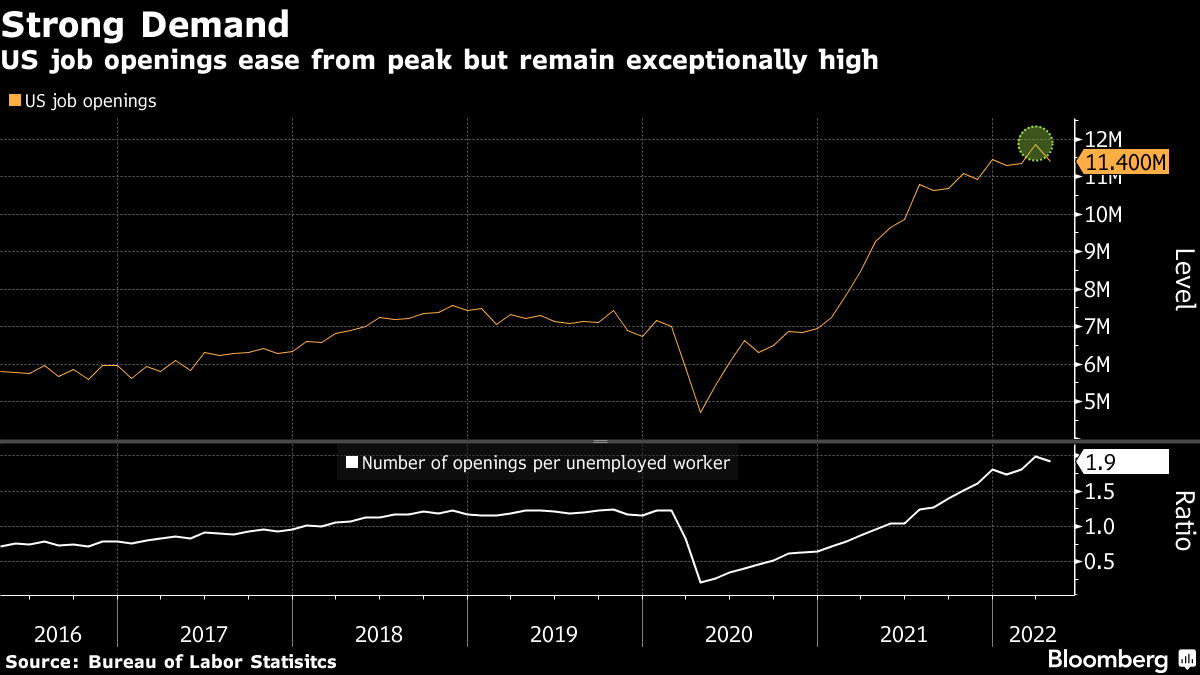
The JOLTS report has become one of the key markers of the tightness of the US labor market, often referenced by Federal Reserve officials like Chair Jerome Powell as a sign the economy can withstand higher interest rates without a significant jump in unemployment. Policy makers are aiming to reduce demand for labor, in turn cooling wage growth and helping lower inflation, without tipping the economy into recession.
The somewhat improved, though still-elevated number of vacancies shows labor demand remains strong. Firms are struggling to hire from a limited pool of workers, highlighting the mismatch in labor supply and demand that's kept wage growth high. However, there are signs such gains may be peaking, a heartening development for the Fed if not for American workers.
Some 4.4 million Americans quit their jobs in April, little changed from the prior month. The quits rate, a measure of voluntary job leavers as a share of total employment, was unchanged at 2.9%.
There were about 1.9 jobs for every unemployed person in April, down slightly from March. Fed Governor Christopher Waller referenced the closely watched ratio in a speech earlier this week, in which he also said that tighter policy won't lead to much of an increase in unemployment since demand for workers will still be strong, just less so.
Layoffs Low
Layoffs fell to a fresh record low in April, but separate data from the Labor Department has shown an uptick in applications for unemployment insurance in recent weeks. Hires held steady at an elevated level.
The decrease in job openings reflected drops in health care and social assistance, retail trade and accommodation and food services. Industries such as transportation, warehousing, and utilities as well as manufacturing posted notable increases.
A separate report Wednesday showed a measure of factory employment contracted in May for the first time since November 2020. The JOLTS figures showed hiring in manufacturing eased in April despite openings rising.
The data precede Friday's monthly jobs report, which is currently forecast to show the US added 325,000 payrolls in May and the unemployment rate fell to 3.5%, which would match the lowest since 1969.
(Adds graphic)
More stories like this are available on bloomberg.com
©2022 Bloomberg L.P.

-
Talking Points This Week: Leadership Shock At Nvidia, Earnings Strength, And The Fog Over Hormuz

The Anthropic IPO pricing and first trading day, Nvidia's upcoming earnings, and any fresh signals from Iran will set the tone for the following week.
-
Signature Play: The Classic Cocktail Is Dead. Or Is It?
Classic cocktails are disappearing from India's cocktail menus. But they're still being ordered, taught to bartenders and borrowed from. So, who's really having the last drink?
-
A New Samvat Wishlist: Inclusive Prosperity And Human Development
India has strengthened its economic foundations through infrastructure, digital access and enterprise. Its next growth chapter must deepen productivity, create better livelihoods and widen participation in prosperity.
-
Love, Sex Aur Dhokha: The Audacious Plot To Spy On Jensen Huang
A Taipei dinner, a Singapore chip buyer and a suspected Chinese asset: inside the alleged spy operation that got close to NVIDIA's Jensen Huang.
-
Ten Things I Learnt This Samvat
Patience can be a trap. Cheap stocks can stay cheap. Leverage can wipe you out. What did Samvat 2082 teach us? Niraj Shah writes on 10 lessons from the year gone by.
-
Talking Points This Week: Tech Nerves, FII Buying, And A Faraway Banking Shock
The global markets are not shining this Diwali. The exception in the large markets is, India.
-
Midterm Rally Lasted A Day. The Hard Reality Of A Divided US May Last Two Years | Opinion
Between a contested AI boom, a debt ceiling that arrives in 2027 and a president with every incentive to act alone, the next two years may prove more volatile than the first day's rally suggests.
-
Blue Wave Will Derail the AI Trade but Won't Dismantle the AI Era | Unhedged Position
The Democrats' sweep of the US Congress will see politics collide with economic forces both over the long and short term.
-
It's Time To Take The GST Council's Bet On Trust Global
Payment records can prove India's services exports, and clear, proportionate rules can bring foreign digital sellers into the tax net.
-
Opinion | India at 38: From Innovation Overperformer to Innovation Powerhouse
India now has 453 VC-backed deep science startups, 18 of them late-stage, after 117 percent growth since 2020. Laurus Labs, at USD 9.3 billion, is the most valuable deep science company in any middle-income economy outside China.









