US Economy Shows Signs of Slowing as Fed Hikes Filter Through
(Bloomberg) -- Fresh evidence Wednesday pointed to a slowing US economy and a cooling labor market that suggests steep interest-rate hikes by the Federal Reserve are starting to have a broader impact.
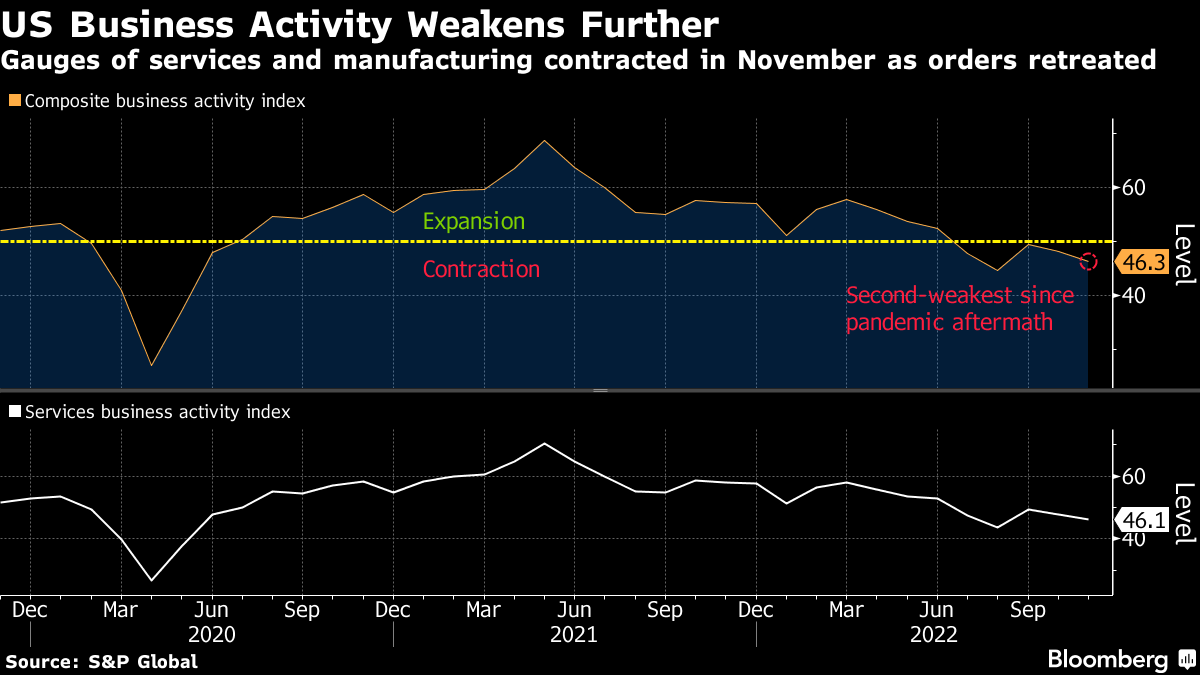
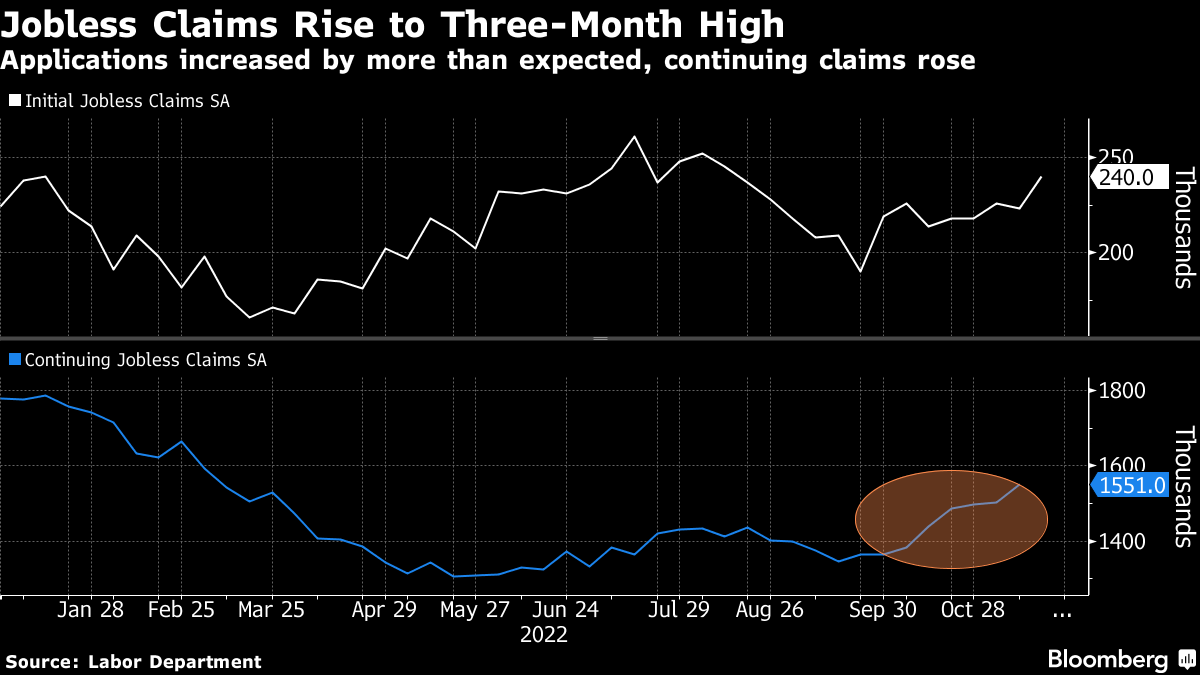
Business activity contracted for a fifth month in November and applications for unemployment benefits rose last week to a three-month high. While consumer sentiment and new-home sales improved, both remain depressed and indicate a weaker spending appetite and subdued housing demand.
At the same time, a separate report showed a solid rebound in capital goods orders and shipments that will help feed through into what's projected to be firm fourth-quarter growth.
“We see signs of cooling in the labor market, and business surveys generally have pointed to weakening momentum for the economy,” Daniel Silver, economist at JPMorgan Chase & Co., said in a note. “But GDP source data have been surprising to the upside in recent weeks.”
The Fed's most aggressive monetary tightening campaign since the 1980s has so far had a fairly limited effect on demand overall, but Wednesday's data show early signs that some of the more resilient parts of the economy are starting to soften.
That could persuade some policymakers that it's not only appropriate to soon slow the pace of tightening, but also add a wrinkle to the debate as to how high interest rates will go -- minutes of the Fed's policy meeting earlier this month may shed light on that when released later Wednesday.
Read More: Black Friday Seen Kicking Off a Bumpy Holiday Shopping Season
The labor market has so far proved resilient to the effects of higher interest rates, underscored by historically low unemployment. But the number of unemployed who have received benefits for a week or more jumped to the highest level since March, supporting many economists' expectations that joblessness will rise in the coming year.
Americans are starting to feel the same way. Unemployment expectations are at the worst level since 2011, according to the final November reading of University of Michigan's consumer survey.
“If expectations over labor markets continue to deteriorate, consumer demand is likely to follow, particularly as consumers draw down their savings and express reluctance to borrow under rising costs of credit,” Joanne Hsu, director of the survey, said in a statement.
Read more: As Job Cuts Roil Big Tech, Workers Confront ‘Pit of Despair'
Businesses are showing continued signs of slowing momentum. S&P Global's measure of activity dropped to the second-lowest level since the immediate aftermath of the pandemic.
That's at odds with a Commerce Department report that showed orders for business equipment rebounded sharply last month. Shipments of so-called core capital goods, a proxy for business investment in the GDP report, climbed by the most since the start of the year.
When taken with October retail sales, which advanced by the most in eight months, that still bodes well for economic growth for now. But the cumulative effects of rising interest rates are expected to weigh on future investment.
“The growth trajectory for the fourth quarter is slowing but not contracting,” Jeffrey Roach, chief economist for LPL Financial, said in a note. “However, the slowdown in global economic activity increases the risk of recession in 2023 but as of today, the economy is not in recession.”
The housing market, however, is in recession. Even though new-home sales unexpectedly rose last month, the data is extremely volatile and the increase was driven primarily by the South. Otherwise, the market has been deteriorating all year due to a steep run-up in mortgage rates, which have retreated somewhat in recent weeks.
“We expect sales to remain under pressure going forward as the erosion in affordability this year keeps many buyers on the sidelines,” Nancy Vanden Houten and Ryan Sweet of Oxford Economics said in a note. “However, the more recent decline in mortgage rates, if sustained, will boost affordability at the margin.”
--With assistance from and .
More stories like this are available on bloomberg.com
©2022 Bloomberg L.P.

-
Rs 50-Lakh Gold In Bank Locker, Rs 3 Lakh Of Protection: The Gap Most Families Don't Know About

The RBI ties a bank's liability to the annual locker rent and families who want to insure their jewellery face a separate question about how to prove what was inside.
-
The More Food Turns Into Fuel, The Harder It Is To Read Agricultural Markets | The Reason Why
A policy designed to reduce dependence on imported fuel can create new pressures elsewhere in the food economy.
-
Your iPhone Costs 12 Grams Of Gold, A Car About 100. What Does Your Life Weigh?
Measured in rupees, almost everything looks more expensive than it did a generation ago. Measured in grams of gold, a lot of it has become cheaper.
-
Gold Is Rs 22,000 Cheaper Than A Month Ago. Should You Buy Amid The Wedding Season?
Gold's potential slide to $3,500 could save around Rs 4,700 per 10 grams, but a soft inflation print could just as easily push prices back up. One way to split the risk is to buy in parts, some now and the rest after the Fed's Dec. 9 decision.
-
AI Agents Are Gaining Power. Who Governs Them?
Artificial intelligence agents promise to transform productivity by moving machines from assisting decisions to executing them. But as organisations delegate greater authority to these AI-agents, they must first establish who controls that authority and who remains accountable when things go wrong.
-
Why Swapping Your Old Gold Can Trigger A Rs 5 Lakh Tax Bill, And How You Can Avoid It Legally
Swapping old gold for new is taxed as a sale and a fresh purchase. Getting your own gold remade can cut most of that bill, though it has its own costs.
-
The AI Trade is Done. The Real Opportunity for Investors Starts in 2027 | Unhedged Position
As pureplay AI stocks plunge and circular, capex-led financing unwinds, 2027 is set to be a year of reckoning for AI companies. Yet the bust clears the way for a better opportunity for investors in 2027 -- shifting the spotlight from AI builders to the companies using AI.
-
Leadership As Mission: Why The Age Of AI Demands More Human Leadership
Debjani Ghosh examines how AI is changing leadership, arguing that its success must be measured by its impact on people and the accountability of those guiding its use.
-
We May Need Another Tukaram Mundhe To Fight Air Pollution | The Reason Why
Developers may install basic measures such as sprinklers and green nets, resume work, and continue violating rules when this equipment stops working.
-
Extracting Value From Battery Scrap Could Be Challenging For India | The Reason Why
A discarded lithium-ion battery still contains valuable materials such as lithium, nickel and cobalt. These can be recovered and reused. When such batteries are crushed and shredded, they produce a dark powder called black mass.









