US Core CPI Tops Estimates, Pressuring Fed As It Weighs Hike

(Bloomberg) -- Underlying US consumer prices rose in February by the most in five months, forcing a tough choice for Federal Reserve officials weighing still-rapid inflation against banking turmoil in their next interest-rate decision.
The consumer price index, excluding food and energy, increased 0.5% last month and 5.5% from a year earlier, according to Bureau of Labor Statistics data out Tuesday. Economists see the gauge — known as the core CPI — as a better indicator of underlying inflation than the headline measure.
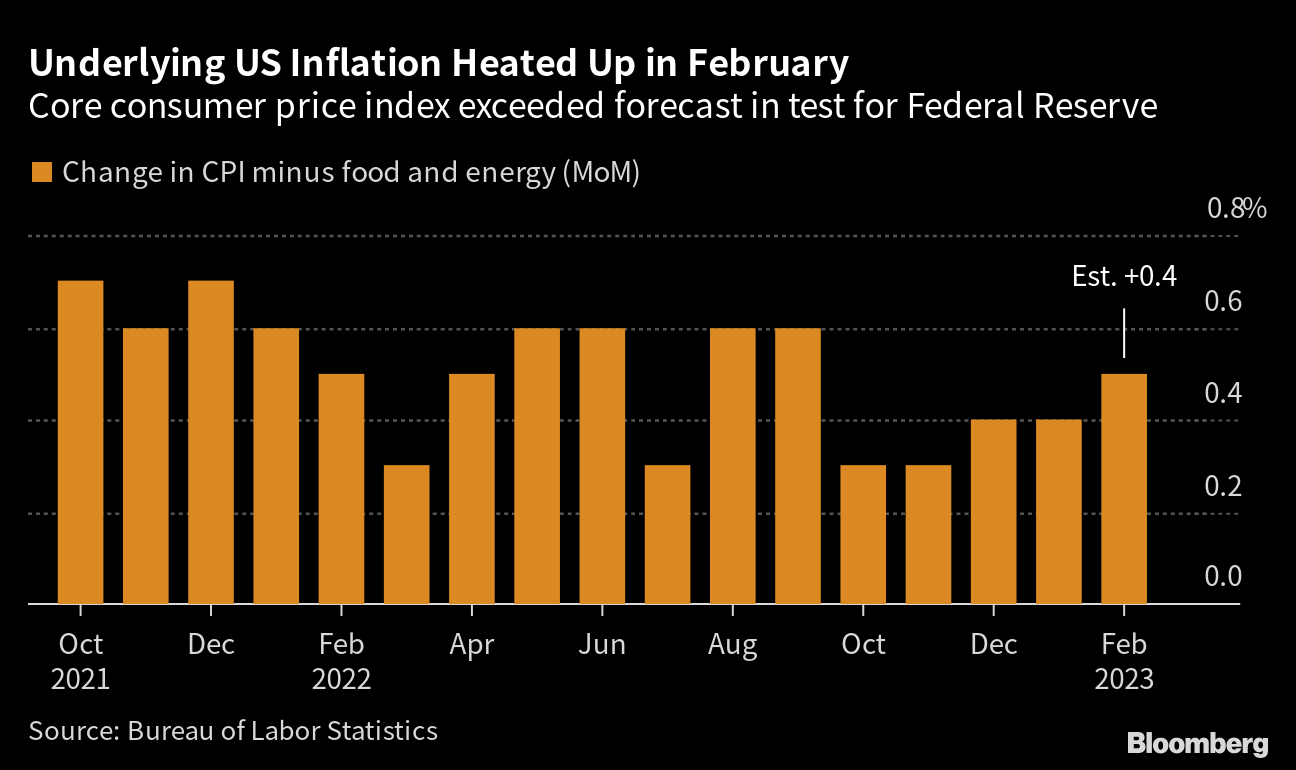
The overall CPI climbed 0.4% in February — over 70% of which was due to shelter — and 6% from a year earlier. The median estimates in a Bloomberg survey of economists called for a 0.4% monthly advance in the overall and core CPI measures.
Follow the reaction in real-time on Bloomberg's TOPLive blog
The figures reaffirm that the Fed's quest to tame inflation will be a bumpy one as the economy has largely proven resilient to a year's worth of interest-rate hikes so far. The challenge for the Fed now is how to prioritize inflation that is still far too high with growing financial stability risks in the unraveling of Silicon Valley Bank.
Just before the crisis came to fruition last week, Chair Jerome Powell had opened the door to re-accelerating the pace of rate hikes, but many economists now say the central bank will either stick with a smaller increase or pause entirely when it meets next week. One shop even says a rate cut could be in store.
“We got into this mess because a lot of central banks and a lot of economists, the Fed started to believe that inflation was largely dead,” Ethan Harris, head of global research at Bank of America Corp., said on Bloomberg Television. “Now we're seeing a massive catch-up.”
Two-year Treasury yields, which are sensitive to Fed policy, rose to session highs while the S&P 500 opened higher and the dollar fluctuated. Swaps traders maintained bets that the Fed will lift interest rates by 25 basis points at its meeting this month.
Read more: Fed Battle Plan for Inflation Shredded by Financial Turmoil
Outside of shelter, recreation, household furnishings and airfares also contributed to the monthly advance in the core measure. Grocery prices rose at the slowest monthly pace since May 2021, including the biggest decline in egg prices since the early months of the pandemic.
The goods disinflation that has driven the slide in overall inflation in recent months has lost steam. Excluding food and energy, goods prices were unchanged in February. Used-car prices — a key driver of slower price growth in recent months — dropped the most in nearly a year. Compared to last year, they declined 13.6%, the most since 1960.
Energy prices declined, due to big drops in natural gas and fuel oil prices. Meanwhile, electricity costs rose.
Shelter costs, which are the biggest services component and make up about a third of the overall CPI index, rose 0.8% last month. Hotel stays contributed to the jump, with the largest monthly advance since October.
The rent of shelter and owners' equivalent rent categories each surged by record annual amounts of at least 8%.
Because of the way this category is calculated, there's a delay between real-time measures — which currently show rents are beginning to decline — and the CPI data.
Stripping out energy and housing, services prices were up 0.5%, the most since September, according to Bloomberg calculations. Powell and his colleagues have stressed the importance of looking at such a metric when assessing the nation's inflation trajectory, though they compute it based on a separate index.
What Bloomberg Economics Says...
“February's CPI report shows that inflation is not vanishing quickly, and there remains a compelling need for the Fed to continue raising rates. A 25-bp move would be appropriate at the March FOMC meeting, followed by a couple more until the Fed reaches a terminal rate of 5.25%.”
— Anna Wong and Stuart Paul, economists
To read the full note, click here
The Fed is also keenly attune to wage growth and how it may be fanning inflation. A separate report Tuesday showed real average hourly earnings fell 0.1% in February from a month ago, and were down 1.3% from a year earlier. The annual measure has been negative every month for almost two years.
Tuesday's report is one of the last major releases the Fed will have in hand before its March 21-22 meeting. Policymakers will also scrutinize Wednesday's wholesale inflation and retail sales data, plus other figures on housing, manufacturing and consumer inflation expectations.
--With assistance from , , and .
(Updates with market open)
More stories like this are available on bloomberg.com
©2023 Bloomberg L.P.

-
One Battle After Another: India's Corporate Dynasties Battle For Control

2026 could go down as Corporate India's year of succession wars, governance battles and family fault lines.
-
Rs 50-Lakh Gold In Bank Locker, Rs 3 Lakh Of Protection: The Gap Most Families Don't Know About
The RBI ties a bank's liability to the annual locker rent and families who want to insure their jewellery face a separate question about how to prove what was inside.
-
The More Food Turns Into Fuel, The Harder It Is To Read Agricultural Markets | The Reason Why
A policy designed to reduce dependence on imported fuel can create new pressures elsewhere in the food economy.
-
Your iPhone Costs 12 Grams Of Gold, A Car About 100. What Does Your Life Weigh?
Measured in rupees, almost everything looks more expensive than it did a generation ago. Measured in grams of gold, a lot of it has become cheaper.
-
Gold Is Rs 22,000 Cheaper Than A Month Ago. Should You Buy Amid The Wedding Season?
Gold's potential slide to $3,500 could save around Rs 4,700 per 10 grams, but a soft inflation print could just as easily push prices back up. One way to split the risk is to buy in parts, some now and the rest after the Fed's Dec. 9 decision.
-
AI Agents Are Gaining Power. Who Governs Them?
Artificial intelligence agents promise to transform productivity by moving machines from assisting decisions to executing them. But as organisations delegate greater authority to these AI-agents, they must first establish who controls that authority and who remains accountable when things go wrong.
-
Why Swapping Your Old Gold Can Trigger A Rs 5 Lakh Tax Bill, And How You Can Avoid It Legally
Swapping old gold for new is taxed as a sale and a fresh purchase. Getting your own gold remade can cut most of that bill, though it has its own costs.
-
The AI Trade is Done. The Real Opportunity for Investors Starts in 2027 | Unhedged Position
As pureplay AI stocks plunge and circular, capex-led financing unwinds, 2027 is set to be a year of reckoning for AI companies. Yet the bust clears the way for a better opportunity for investors in 2027 -- shifting the spotlight from AI builders to the companies using AI.
-
Leadership As Mission: Why The Age Of AI Demands More Human Leadership
Debjani Ghosh examines how AI is changing leadership, arguing that its success must be measured by its impact on people and the accountability of those guiding its use.
-
We May Need Another Tukaram Mundhe To Fight Air Pollution | The Reason Why
Developers may install basic measures such as sprinklers and green nets, resume work, and continue violating rules when this equipment stops working.









