US Core CPI Remains Firm For Third Straight Month With 0.3% Gain

A measure of underlying US inflation remained firm in October, underscoring the ongoing risks Federal Reserve officials face in trying to achieve their target.
The so-called core consumer price index — which excludes food and energy costs — increased 0.3% for a third month and 3.3% from a year ago, Bureau of Labor Statistics figures showed Wednesday.
Economists see the core gauge as a better indicator of the inflation trend than the overall CPI. That measure, which includes food and energy, rose 0.2% for a fourth month and 2.6% from a year before, marking the first acceleration on an annual basis since March.
The BLS said shelter accounted for over half of the overall monthly advance.
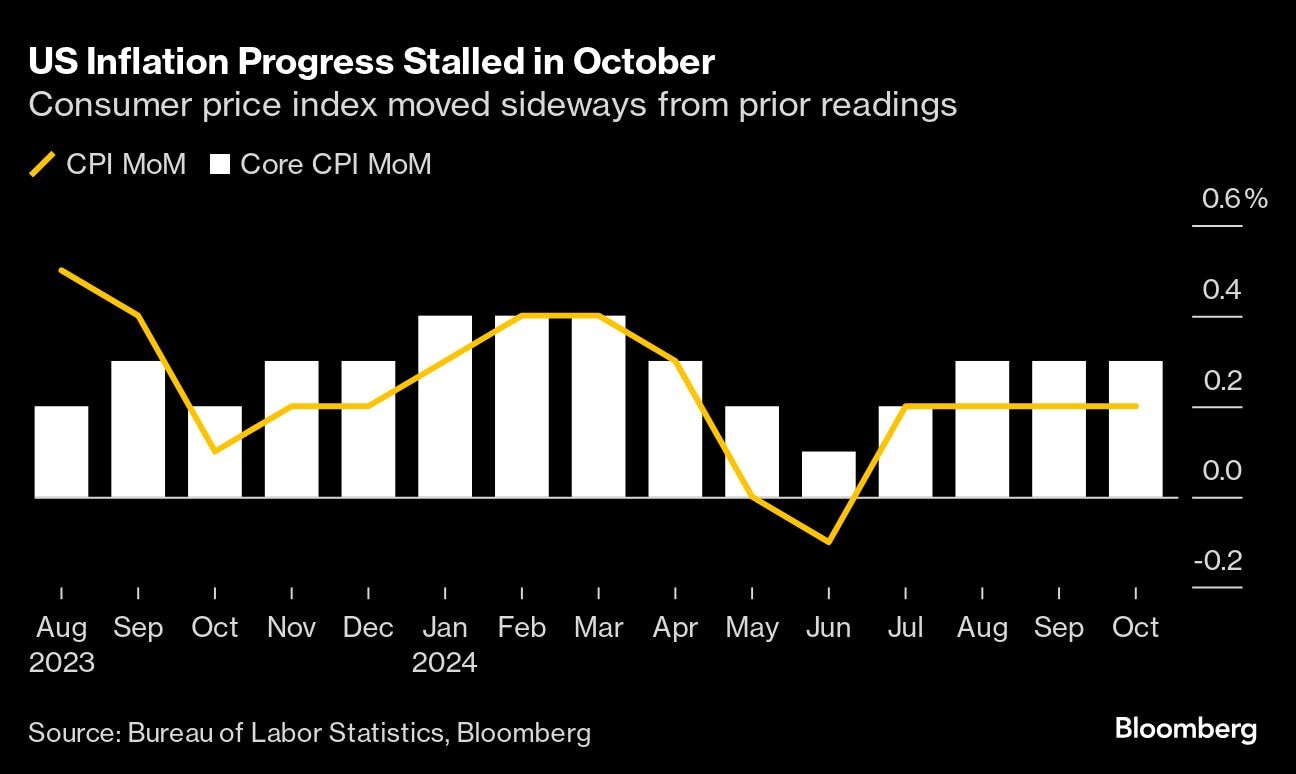
The figures underscore the slow and frustrating nature of the battle against inflation, which has often moved sideways — sometimes for months at a time — on its broader path down. The latest numbers, along with strong consumer spending and economic growth, will keep Fed officials cautious as they debate how quickly to reduce borrowing costs in the months to come.
The US central bank will also have to contend with a new set of policies under President-elect Donald Trump, with companies already considering raising prices in anticipation of the higher tariffs he's promised on imported goods. After the Fed cut interest rates by a quarter point last week, Chair Jerome Powell said the election will have “no effects” on its decisions in the near term because it's too early to know the timing or substance of any potential fiscal policy changes.
US stock futures rose while Treasury yields and the dollar fell. Traders marked up the odds of a December rate cut to around 70%, from about 60% prior to the release.
Some measures of inflation expectations also remain somewhat elevated among consumers and businesses, a potentially worrisome sign after years of robust price pressures.
Prices of used cars rose 2.7%, the most in over a year, and hotel rates climbed 0.4%, possibly reflecting damage and evacuation orders from Hurricanes Helene and Milton. Airfares continued to rise, and health insurance rose 0.5% as the BLS updated source data on premiums. Motor vehicle insurance fell slightly.
Shelter prices, the largest category within services, rose 0.4%, marking an acceleration from the prior month. Owners' equivalent rent — a subset of shelter and the biggest individual component of the CPI — rose by the same amount.
Excluding housing and energy, service prices rose 0.3%, less than in September, according to Bloomberg calculations. While central bankers have stressed the importance of looking at such a metric when assessing the overall inflation trajectory, they compute it based on a separate index.
That measure — known as the personal consumption expenditures price index — doesn't put as much weight on shelter as the CPI does, which is one reason why it's trending closer to the Fed's 2% target.
Goods prices excluding food and energy, meanwhile, rose for a second month. They had consistently fallen over much of the past year. However, excluding used cars, core goods prices fell 0.2%, marking the largest drop in 2024.
The PCE measure draws from the CPI as well as certain categories within the producer price index, which is due Thursday. Several of the CPI items that registered robust gains, like health insurance and airfares, won't feed through to the PCE, which should help keep that gauge relatively muted when the data are released later this month.
Policymakers also pay close attention to wage growth, as it can help inform expectations for consumer spending — the main engine of the economy. A separate report Wednesday that combines the inflation figures with recent wage data showed real earnings grew 1.4% from a year ago, the same as in September.
For many Americans, wage growth hasn't kept pace with inflation in recent years, and frustration about the economy was a major factor in Trump's decisive election victory. In an ABC News exit poll, 45% of people said they've become worse off under the current administration — a record high surpassing even the levels of the 2008 financial crisis.

-
Extracting Value From Battery Scrap Could Be Challenging For India | The Reason Why

A discarded lithium-ion battery still contains valuable materials such as lithium, nickel and cobalt. These can be recovered and reused. When such batteries are crushed and shredded, they produce a dark powder called black mass.
-
One El Nino, India Can Handle. Two Could Break The Granary
India's grain stocks can absorb one bad year, but a second El Nino could drain the buffer in two to three years, economists say.
-
India's Troika Of Good Luck | Joining The Dots
As Jensen Huang's exit drags Nvidia down, a cooling AI trade and resilient earnings have revived investor interest in India. A likely RBI rate hike looms.
-
Talking Points This Week: Leadership Shock At Nvidia, Earnings Strength, And The Fog Over Hormuz
The Anthropic IPO pricing and first trading day, Nvidia's upcoming earnings, and any fresh signals from Iran will set the tone for the following week.
-
Signature Play: The Classic Cocktail Is Dead. Or Is It?
Classic cocktails are disappearing from India's cocktail menus. But they're still being ordered, taught to bartenders and borrowed from. So, who's really having the last drink?
-
A New Samvat Wishlist: Inclusive Prosperity And Human Development
India has strengthened its economic foundations through infrastructure, digital access and enterprise. Its next growth chapter must deepen productivity, create better livelihoods and widen participation in prosperity.
-
Love, Sex Aur Dhokha: The Audacious Plot To Spy On Jensen Huang
A Taipei dinner, a Singapore chip buyer and a suspected Chinese asset: inside the alleged spy operation that got close to NVIDIA's Jensen Huang.
-
Ten Things I Learnt This Samvat
Patience can be a trap. Cheap stocks can stay cheap. Leverage can wipe you out. What did Samvat 2082 teach us? Niraj Shah writes on 10 lessons from the year gone by.
-
Talking Points This Week: Tech Nerves, FII Buying, And A Faraway Banking Shock
The global markets are not shining this Diwali. The exception in the large markets is, India.
-
Midterm Rally Lasted A Day. The Hard Reality Of A Divided US May Last Two Years | Opinion
Between a contested AI boom, a debt ceiling that arrives in 2027 and a president with every incentive to act alone, the next two years may prove more volatile than the first day's rally suggests.