Surge In Coronavirus Cases Slowing US Economic Recovery: US Central Bank Chief
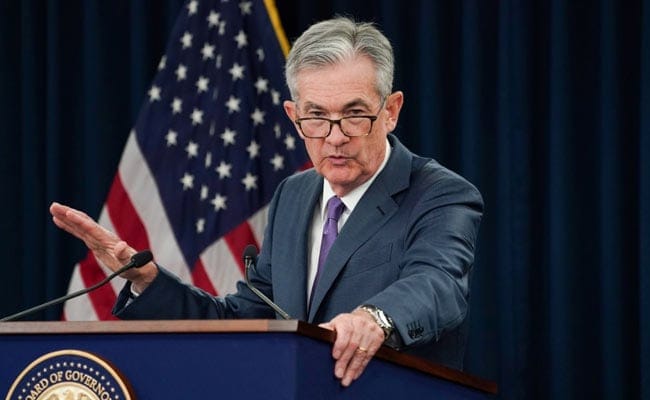
The surge in US coronavirus cases is beginning to weigh on economic activity, the head of the Federal Reserve said on Wednesday, and he promised the US central bank would "do what we can, and for as long as it takes," to limit damage and boost growth.
"It looks like the data are pointing to a slowing in the pace of the recovery," Federal Reserve Chair Jerome Powell said at a news conference, pointing to an apparent pullback by consumers and a slowdown in the rehiring of furloughed workers, particularly by small businesses.
The US, he said, "has entered a new phase in containing the virus, which is essential to protect both our health and our economy."
Mr Powell's comments, made via videoconference after the Fed announced its policy decision to leave interest rates near zero, suggest dimming hopes for a quick economic rebound. Coronavirus infections have exploded in a number of Southern and Southwestern states in recent weeks, and some states have paused or rolled back reopening measures.
The Fed's policy statement, released at the close of its two-day meeting, directly tied the economic recovery to resolution of a health crisis whose direction remains much in doubt. More than 150,000 Americans have died from COVID-19, the respiratory illness caused by the novel coronavirus.
"The path of the economy will depend significantly on the course of the virus," the central bank's policy-setting Federal Open Market Committee (FOMC) said.
In his news conference, Powell elaborated on just how much remained unclear about the direction of the world's largest economy. Fiscal programs that he credits with sustaining consumer spending in recent weeks are about to expire, with debate still under way in Congress over what, if anything, will take their place.
The virus is moving so fast that policymakers are taking cues about the economy from real-time flows of data from firms that track people's movements through cellphones, for example, or provide signals about hiring, Powell said.
"That data show that on balance ... the pace of the recovery looks like it has slowed since cases began that spike," he said. "I want to stress," he added, "it's too early to say both how large that is and how sustained that is."
The Fed held policy largely steady, with key decisions likely to come this fall after it is clearer where the health crisis is heading and just what action Congress takes to support struggling businesses and unemployed workers.
Fed policymakers repeated a pledge to use their "full range of tools" to support the economy and keep interest rates near zero for as long as it takes to recover from the epidemic.
All FOMC members voted to leave the target range for short-term rates between 0% and 0.25%, where it has been since March 15 when the virus was beginning to hit the nation.
"We are not even thinking about thinking about thinking about raising rates," Powell said, noting the economic recovery will take a long time because millions of people working in heavily affected industries like hotels or restaurants won't have jobs to go back to any time soon. "We are in this until we are well through it." Yes thanks for asking - he said "thinking about" three times)
U.S. stocks added to gains after the Fed's statement, while longer-term U.S. Treasury yields moved slightly higher. The dollar fell to a two-year low against a basket of currencies.
"The most notable thing is the statement that the path of the economy will depend on COVID-19. The Fed is putting health again front and center in its statement, which is impactful and meaningful," said Nela Richardson, investment strategist at Edward Jones in St. Louis.
"It's a bit ominous, to be frank. ... That sentence shows the primacy of COVID-19 in their outlook and the uncertainty of their outlook because of it," Richardson said.
NO CHANGE FOR NOW
If official economic data backs up early indications of a decline in growth, the Fed could ease policy further, Powell signaled, including by potentially promising no changes to interest rates until unemployment and inflation rates meet explicit benchmarks.
A government report due out Thursday is expected to show a record 34% drop in annualized economic output last quarter.
Since the Fed's last policy meeting in June, the epidemic has intensified, with an average of around 65,000 new cases detected each day, about three times the pace of mid-June.
Job growth, which had been unexpectedly strong in May and June, now appears to be slowing and consumer confidence has taken a hit.
Government aid that kept millions of unemployed Americans spending will drop sharply at the end of this week unless Congress agrees on a new relief package, with Republicans and Democrats so far not able to bridge their differences.
Small businesses, a mainstay of the U.S. economy, are increasingly facing a breaking point as government grants run dry and payments come due.

-
We May Need Another Tukaram Mundhe To Fight Air Pollution | The Reason Why

Developers may install basic measures such as sprinklers and green nets, resume work, and continue violating rules when this equipment stops working.
-
Extracting Value From Battery Scrap Could Be Challenging For India | The Reason Why
A discarded lithium-ion battery still contains valuable materials such as lithium, nickel and cobalt. These can be recovered and reused. When such batteries are crushed and shredded, they produce a dark powder called black mass.
-
One El Nino, India Can Handle. Two Could Break The Granary
India's grain stocks can absorb one bad year, but a second El Nino could drain the buffer in two to three years, economists say.
-
India's Troika Of Good Luck | Joining The Dots
As Jensen Huang's exit drags Nvidia down, a cooling AI trade and resilient earnings have revived investor interest in India. A likely RBI rate hike looms.
-
Talking Points This Week: Leadership Shock At Nvidia, Earnings Strength, And The Fog Over Hormuz
The Anthropic IPO pricing and first trading day, Nvidia's upcoming earnings, and any fresh signals from Iran will set the tone for the following week.
-
Signature Play: The Classic Cocktail Is Dead. Or Is It?
Classic cocktails are disappearing from India's cocktail menus. But they're still being ordered, taught to bartenders and borrowed from. So, who's really having the last drink?
-
A New Samvat Wishlist: Inclusive Prosperity And Human Development
India has strengthened its economic foundations through infrastructure, digital access and enterprise. Its next growth chapter must deepen productivity, create better livelihoods and widen participation in prosperity.
-
Love, Sex Aur Dhokha: The Audacious Plot To Spy On Jensen Huang
A Taipei dinner, a Singapore chip buyer and a suspected Chinese asset: inside the alleged spy operation that got close to NVIDIA's Jensen Huang.
-
Ten Things I Learnt This Samvat
Patience can be a trap. Cheap stocks can stay cheap. Leverage can wipe you out. What did Samvat 2082 teach us? Niraj Shah writes on 10 lessons from the year gone by.
-
Talking Points This Week: Tech Nerves, FII Buying, And A Faraway Banking Shock
The global markets are not shining this Diwali. The exception in the large markets is, India.









