Universal Basic Income: Government Report Lists Pros And Cons
New Delhi: Providing a cash allowance rather than cheap food or guaranteed jobs would nearly eradicate poverty, but at a cost of 4 to 5 per cent of gross domestic product, a government report said on Tuesday.
Universal basic income (UBI), a radical idea that is gaining attention in countries such as Finland and France, proposes giving every citizen an income to cover their basic needs.
Several economists advocate cash transfers in India, Asia's third-largest economy, where despite rapid economic growth, one in three of the world's extreme poor reside. An emergency medical payment or bad harvest risks a return to poverty for millions more.
The annual Economic Survey, which forms the basis of the annual budget that Finance Minister Arun Jaitley will present tomorrow, said UBI is a persuasive alternative for replacing existing welfare programmes. Yet it warned about implementation risks and the potential cost to government.
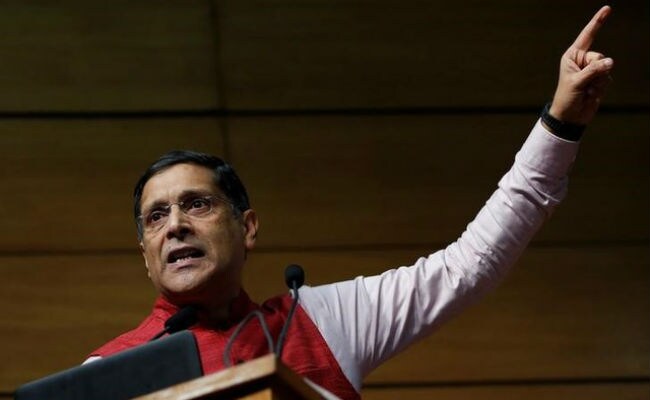
"The key merit of it is that it has the potential to improve the weak targeting of current schemes," Arvind Subramanian, the ministry's Chief Economic Adviser, told a news briefing.
Under the survey's calculation, a UBI that cuts the poverty rate to 0.5 per cent of the population would cost 4 to 5 per cent of GDP. The calculation presumes that the richest quarter of Indians do not get the income, because it says any programme cannot in practice strive for strict universality.
Also Read: Notes Ban May Drag Down This Year's GDP Growth To 4-Year Low, Says Economic Survey
At 2011/12 prices, the basic income would amount to Rs 5,400 per person per year. Some economists have questioned whether payments of that size could eliminate poverty.
India currently spends 3 per cent of GDP on subsidies, much of them for the middle class. It pays billions of dollars for some of the world's largest welfare schemes, including cheap food for more than 800 million people and jobs for 50 million households.
"Our main fear is that Universal Basic Income is just being used to replace existing social schemes," said Reetika Khera, an economist at the Indian Institute of Technology in Delhi. "This is a system that is tried and tested and showing signs of improvement."
The Economic Survey cautioned that it was not yet advocating introduction of UBI. A basic income risked becoming too costly, and India would need to improve identification schemes to ensure transfers reached beneficiaries, it said. India's existing programmes contend with corruption and leakages.
Mr Subramanian cited research showing schemes reached more people in the areas where they were least needed, because of the weak capacity of the state in less developed ones. "The advantage of UBI is that we can get around this," he said.

-
AI Bias In Investing Cannot Be Eliminated, But It Can Be Governed

Framing is a particularly important example as identical financial information presented in terms of gains rather than losses can lead an LLM to reach a different assessment.
-
Joining The Dots | Dark Skies, Steady Diya: Why Hope Holds This Diwali
With war, a weak rupee and foreign outflows weighing on sentiment, policymakers at the NDTV World Summit and market veterans at NDTV Profit Ignite: Diwali Edition offered the same advice: stay invested and filter out the noise.
-
The Curious Case of Equitas Small Finance Bank And A CEO Who Quit For Stock
PN Vasudevan believes persistent investor concerns over a perceived conflict of interest had become a governance overhang on Equitas Small Finance Bank's stock, even as the lender improved profitability and asset quality.
-
Talking Points This Week: AI Cash Burn, A Tiger Comeback And An India That Still Finds Its Own Path
India is not immune to higher oil or tighter global liquidity, yet its earnings base is broader, its domestic policy levers are still available.
-
Foreign Investors Own Half Of HDFC Bank and ICICI Bank. An LTCG Cut Could Matter Most Here
Foreign portfolio investors have US$115 billion parked in HDFC Bank, ICICI Bank. If the government cuts long-term capital gains tax, Jefferies says returning foreign money could land here first.
-
'Never Seen This Level Of Negativity': Sandeep Tandon Says The Next Rally May Be Closer Than You Think
Veteran investor Sandeep Tandon says foreign selling is easing, large-caps are due a comeback and mid-caps are crowded, while he turns positive on gold, power and pharma this Diwali.
-
Indians Stay With Family, Not In Hotels | The Reason Why
India still lacks enough clean, reliable and affordable hotels for budget-conscious travellers.
-
The Economic Imperative: Analysing The Material Driving Force Behind India-Canada Strategic Reset
This economic complementarity is further reinforced by deep institutional investment ties and talent mobility, which form the bedrock of the bilateral framework.
-
Medicine Pricing: Where Must Profit Stop?
India must confront excessive margins, hidden incentives and regulatory gaps that threaten the integrity of medicine.
-
Why Amazon And Flipkart Are Struggling To Beat Meesho In India's Smaller Cities
With 274 million users and lowest-cost logistics, Meesho is defending its value commerce crown against giants like Amazon and Flipkart.










