Union Budget 2023: Centre Likely To Focus On Deficit Reduction
The Indian government will present a budget on Feb. 1 that will likely put deficit reduction ahead of vote-winning spending, even as Prime Minister Narendra Modi looks towards seeking a rare third term of office in 2024.
Officials and economists said the large size of recent deficits and a need to gain investor confidence was forcing fiscal caution on the government, overriding the contrary priority of spending to support a weakening economy.
In pulling back the deficit, Finance Minister Nirmala Sitharaman's budget for the financial year beginning April 1 will also help hold inflation below the top of the central bank's target range, 6%.
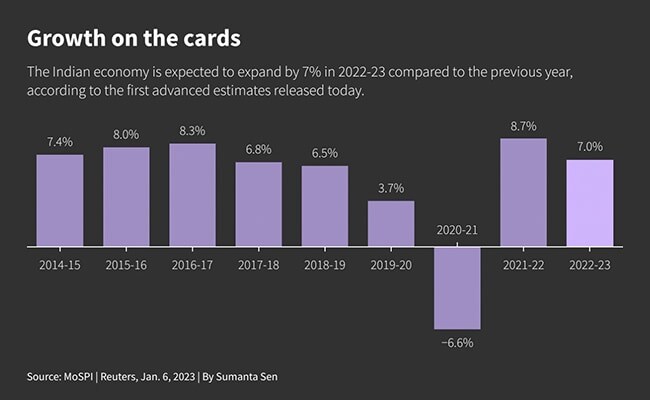
As India faces weakening demand for its exports from the slowing economies of trading partners, its own growth is still recovering from the damage of pandemic controls.
During the pandemic, India had to spend billions of dollars to provide food to the poor, cheap loans for small businesses and free vaccines, pushing the fiscal deficit to a record 9.3% of gross domestic product (GDP) in 2020/21.
Debt issuance soared, and some of those bonds are maturing and must be refinanced, further limiting the government's room for manoeuvre.
"The upcoming budget faces acute policy trade-offs between nurturing a nascent growth recovery and diminishing fiscal space with challenging debt dynamics," Madhavi Arora, economist at Emkay Global Financial Services, said.
The government is likely to cut its fiscal deficit to between 5.8% and 5.9% of GDP in 2023/24 from the 6.4% of 2022/23, other officials have said. The deficit will remain much larger than the 4% to 4.5% of GDP that was usual for decades.
The government now hoped to return to those historical levels by 2025/26, said two officials who were familiar with budget planning but asked not to be named.
The international slowdown will hold down growth in nominal GDP - real growth plus inflation - to about 11% for 2023/24 from an estimated 15.4% for 2022/23. That will lead to lower growth in tax collection.
Just a year away from elections, the government may be unable to raise more funds by stepping up the pace of selling state-run companies, a generally unpopular measure.
Sitharaman will therefore have little room to provide significant tax breaks for the salaried class and will have to substantially lower subsidies that help the poor.
"The government's promised fiscal consolidation path will require a Herculean effort over the next few year," HSBC economist Pranjul Bhandari said, adding that cutting budget deficits would be necessary for controlling inflation.
The government has already stopped the pandemic-era free food programme and is expected to cut subsidies for food and fertiliser by nearly $17 billion.
As current expenditure falls, capital expenditure will probably grow but at the slowest rate seen in three years, the two officials said.
NUMBERS VS SPEECH
Modi's government in the past has used the budget document to lay out a broad economic vision and social agenda. One, in 2014, was called "Sabka Saath Sabka Vikas", loosely translated as "inclusive growth"; another in 2020, "Aatmanirbhar", meaning "self-reliance", aimed to cut dependence on imports.
India has not met many of those objectives and is struggling to create enough jobs. Economic growth is no longer as fast as it was before 2014.
Yet Sitharaman is expected to again express a long-term vision, this time for spending tens of billions of dollars on infrastructure, green projects, health care and education.
Funds towards health, education and defence are likely to grow at not more than 10% to 12% for the current year, the two officials said.
The government is expected to borrow a record 16 trillion rupees in 2023/24, according to a Reuters poll.

-
AI Bias In Investing Cannot Be Eliminated, But It Can Be Governed

Framing is a particularly important example as identical financial information presented in terms of gains rather than losses can lead an LLM to reach a different assessment.
-
Joining The Dots | Dark Skies, Steady Diya: Why Hope Holds This Diwali
With war, a weak rupee and foreign outflows weighing on sentiment, policymakers at the NDTV World Summit and market veterans at NDTV Profit Ignite: Diwali Edition offered the same advice: stay invested and filter out the noise.
-
The Curious Case of Equitas Small Finance Bank And A CEO Who Quit For Stock
PN Vasudevan believes persistent investor concerns over a perceived conflict of interest had become a governance overhang on Equitas Small Finance Bank's stock, even as the lender improved profitability and asset quality.
-
Talking Points This Week: AI Cash Burn, A Tiger Comeback And An India That Still Finds Its Own Path
India is not immune to higher oil or tighter global liquidity, yet its earnings base is broader, its domestic policy levers are still available.
-
Foreign Investors Own Half Of HDFC Bank and ICICI Bank. An LTCG Cut Could Matter Most Here
Foreign portfolio investors have US$115 billion parked in HDFC Bank, ICICI Bank. If the government cuts long-term capital gains tax, Jefferies says returning foreign money could land here first.
-
'Never Seen This Level Of Negativity': Sandeep Tandon Says The Next Rally May Be Closer Than You Think
Veteran investor Sandeep Tandon says foreign selling is easing, large-caps are due a comeback and mid-caps are crowded, while he turns positive on gold, power and pharma this Diwali.
-
Indians Stay With Family, Not In Hotels | The Reason Why
India still lacks enough clean, reliable and affordable hotels for budget-conscious travellers.
-
The Economic Imperative: Analysing The Material Driving Force Behind India-Canada Strategic Reset
This economic complementarity is further reinforced by deep institutional investment ties and talent mobility, which form the bedrock of the bilateral framework.
-
Medicine Pricing: Where Must Profit Stop?
India must confront excessive margins, hidden incentives and regulatory gaps that threaten the integrity of medicine.
-
Why Amazon And Flipkart Are Struggling To Beat Meesho In India's Smaller Cities
With 274 million users and lowest-cost logistics, Meesho is defending its value commerce crown against giants like Amazon and Flipkart.










