UBS Deal for Credit Suisse Unseats JPMorgan as Latin America’s Top Wealth Manager
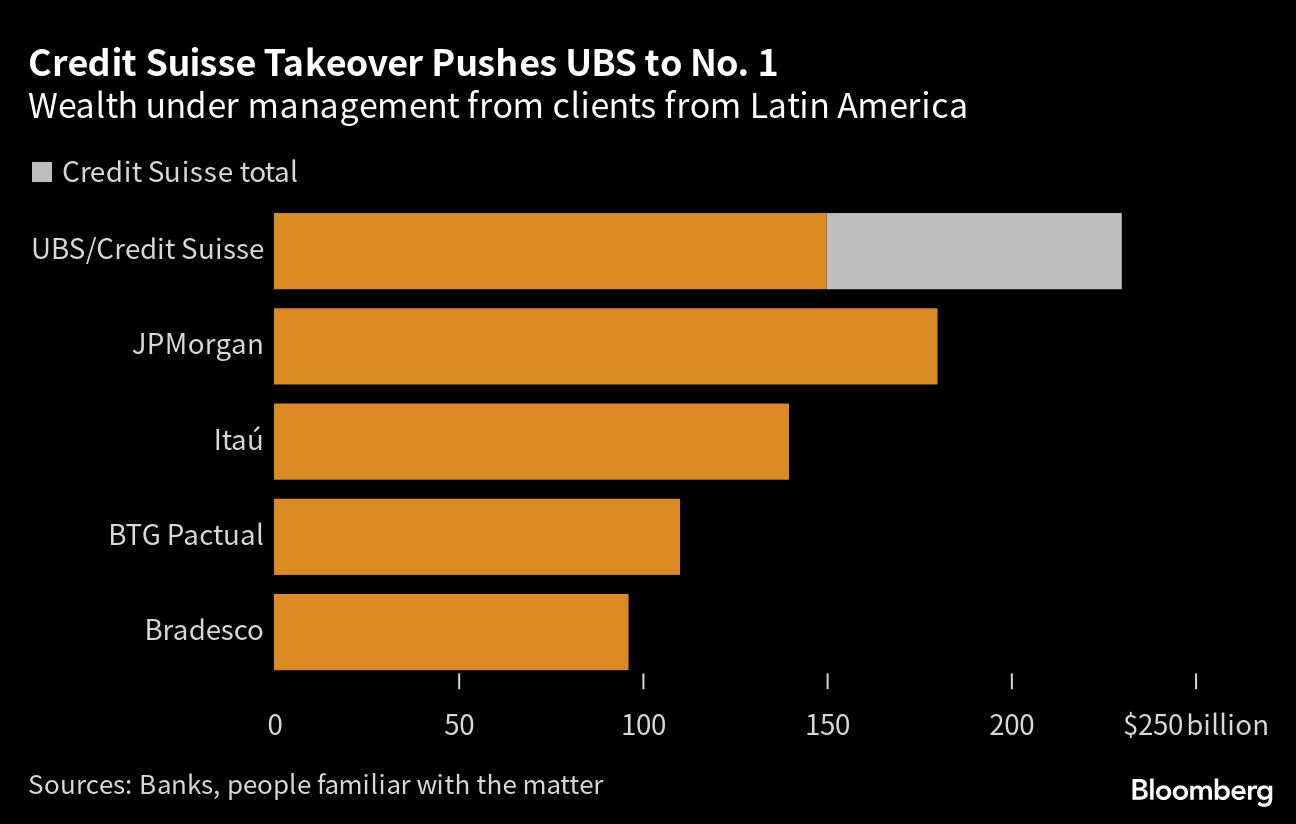
(Bloomberg) -- UBS Group AG will leapfrog JPMorgan Chase & Co. to become Latin America's biggest wealth manager through its acquisition of Credit Suisse Group AG.
With about $150 billion in wealth under management from clients from the region, UBS will take the top spot after adding Credit Suisse's $80 billion total, according to people familiar with the matter, who asked not to be identified discussing non-public data. JPMorgan manages about $180 billion. Itau Unibanco Holding SA will keep its No. 3 position, with $140 billion in assets.
Credit Suisse has a larger presence than UBS in Brazil's local private-banking market, including loans to wealthy Brazilians, while UBS has a multifamily-office model. UBS has booking centers in the US, including in cities preferred by Latin American clients, including Miami, New York and Houston — a presence Credit Suisse lacks.

UBS agreed to the acquisition last month in a deal brokered by the Swiss government, which was picking up the pieces when Credit Suisse collapsed after years of management missteps and scandals. Unlike what happened in other regions, Credit Suisse didn't suffer much in the way of outflows from Latin America during the turmoil, according to competitors who asked not to be named talking about others companies' business.
The acquisition will speed up growth of UBS's global wealth-management platform in some “white spots” where the bank wants to expand further, such as Southeast Asia, the Middle East and Latin America, Sergio Ermotti, who will take over as UBS's chief executive officer on April 5, said on call with the media last week. “We're actually filling these white spots in, and with that we can accelerate our organic growth by five to seven years,” he said.
The merged entity will also have a dominant presence in Brazil equity trading, where UBS's brokerage is already the biggest so far this year by gross volume, according to data compiled by Bloomberg. Credit Suisse will bolster that leadership, as its brokerage is seventh in equity trading in Latin America's biggest economy.
Joint Venture
Since September 2020, when it started a partnership with government-owned Banco do Brasil SA, UBS has been growing in investment banking in the region. And the association is expected to continue after the Credit Suisse acquisition, people familiar with the matter said, asking not to be identified discussing private matters.
The joint venture includes investment banking in South America and brokerage business in Brazil, as well as a commercial agreement between UBS BB Investment Bank and Banco Patagonia SA in Argentina, which is controlled by BB.
UBS BB Investment Bank is No. 3 in Brazil mergers and acquisitions advising so far this year, and is first in local bond underwriting, according to data compiled by Bloomberg.
Credit Suisse's investment-banking rank has been slipping in Latin America after many of its top bankers quit or moved to competitors. The bank's former chief executive officer in Brazil, Jose Olympio Pereira, left the bank in 2021 after 17 years, and this year joined J. Safra, the corporate and investment-banking operation of Grupo Safra. Pereira already hired Mauro Oliveira, a managing director and former head of Latin American equities at Credit Suisse.
UBS has also been adding executives from Credit Suisse. Daniel Bassan, CEO of UBS BB Investment Bank, is a former managing director at Credit Suisse. Fabio Mourão, head of M&A at UBS BB, had a 14-year stint at Credit Suisse, including as head of Brazil M&A and investment banking.
Representatives for Credit Suisse, UBS, JPMorgan and Banco do Brasil declined to comment.
More stories like this are available on bloomberg.com
©2023 Bloomberg L.P.

-
The Economic Imperative: Analysing The Material Driving Force Behind India-Canada Strategic Reset

This economic complementarity is further reinforced by deep institutional investment ties and talent mobility, which form the bedrock of the bilateral framework.
-
Medicine Pricing: Where Must Profit Stop?
India must confront excessive margins, hidden incentives and regulatory gaps that threaten the integrity of medicine.
-
Why Amazon And Flipkart Are Struggling To Beat Meesho In India's Smaller Cities
With 274 million users and lowest-cost logistics, Meesho is defending its value commerce crown against giants like Amazon and Flipkart.
-
High US Salaries, No Green Card Certainty: The Financial Calculation Facing Indian H-1B Families
The suspension of PERM processing at eight technology employers does not cancel existing H-1B visas. What it does is force a question many Indian families have been avoiding: is the US salary worth tying your career and family plans to one employer?
-
Swiggy vs Eternal: Food Delivery's Two Rivals Are No Longer In The Same Race
Eternal is building a private AI assistant, dark.ai. Swiggy is still working out how to make Instamart pay, with an operating loss of Rs 895 crore in the July-September quarter while Blinkit stayed profitable.
-
Where You Live Shapes How You Get To Work | The Reason Why
Two-wheelers are the most popular way to get to work in India, accounting for nearly 43% of workplace commutes.
-
Unhedged Position: Can India See An Indonesia-Style Time Correction?
The Nifty is trading below levels it first clocked in 2024. Is there, then, as I have suggested in the headline, potential that the current time correction drags on painfully for the next three-five, even ten years?
-
Navigating Friction And Energy Realities: An Analysis Of Marco Rubio's October Visit To India
Occurring at a critical juncture marked by stalled trade negotiations and escalating geopolitical pressures over global energy supplies, the visit offers a profound window into modern US-India relations.
-
India Exports Capital. Why Not Export Trusteeship?
The big question, then, is whether India can build an institution that global borrowers, investors, banks, and lawyers can trust, even without an Indian connection.
-
France's Economy & Politics Are In Crisis | The Reason Why
Let's look at how the French economy and politics evolved under Nicolas Sarkozy, Franois Hollande and Emmanuel Macron.










