Uber Reports First-Ever Profit But Growth Slows
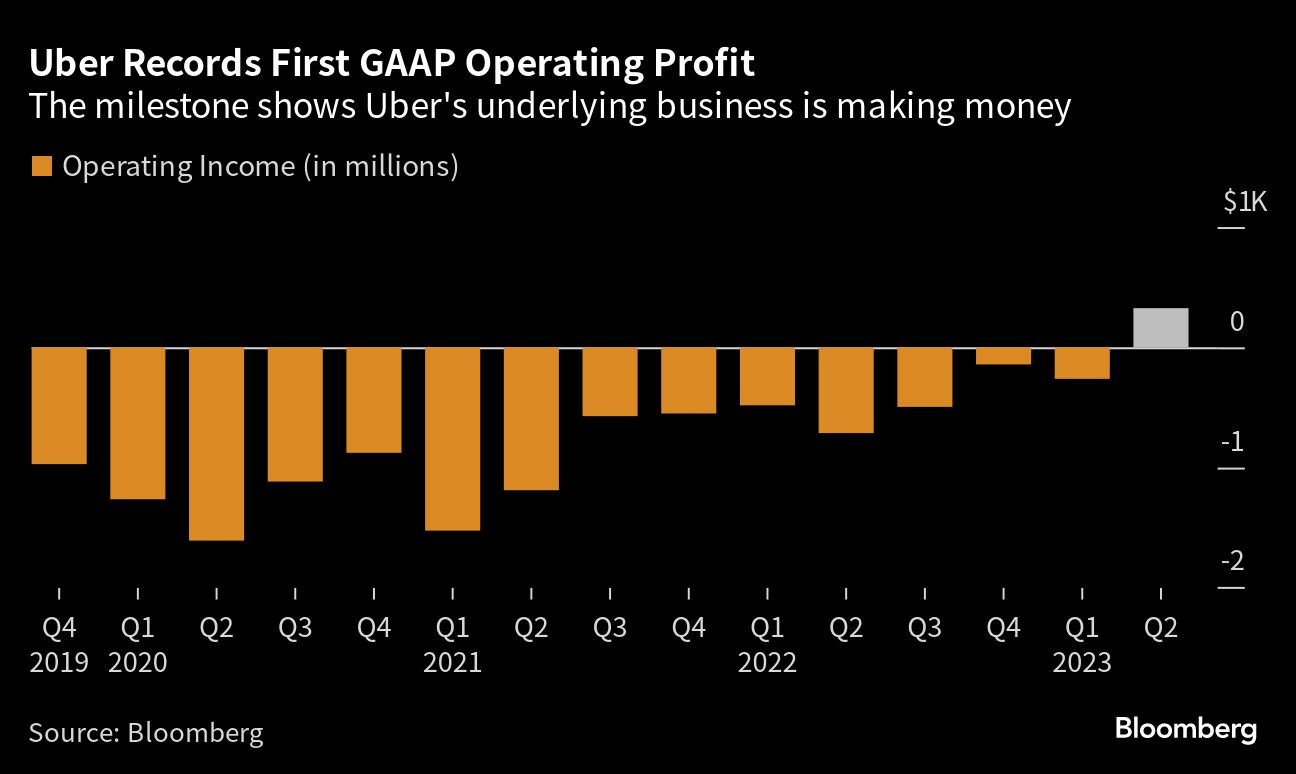
(Bloomberg) -- Uber Technologies Inc. reported its first-ever operating profit, but the shares slid as Wall Street questioned whether the company can maintain the pace of growth in its ride-hailing and delivery business.
Uber posted a second-quarter operating profit according to generally accepted accounting principles of $326 million and free-cash-flow of $1.14 billion. Total revenue jumped 14% to $9.2 billion during the period, narrowly missing the $9.3 billion analysts were expecting. It was the slowest rate of growth since the first quarter of 2021.
The shares, which had doubled this year, dropped 5.1% to $46.97 in New York Tuesday morning.
“The market doesn't believe Uber can keep top-line growth at these levels,” said Bloomberg Intelligence analyst Mandeep Singh.
The results have raised the bar for Uber going forward. Uber's business has remained largely unscathed from elevated inflation rates as customers are still willing to pay a premium for the convenience of hailing a ride and getting food delivered to their door. Trips in the US and Canada have recovered to pre-pandemic levels, while delivery demand hit an all-time high, despite increased costs for food.
After struggling with a driver shortage that caused fares and wait times to increase, Uber said the number of active drivers were up 33% in the second quarter compared with last year. The number of trips taken increased 26% from a year earlier to a record high.

Uber has focused on adding new features and products to the app, including a teen rides program, the ability to book group and guest rides, video gift messaging and a boat service. The company has also expanded advertising on the app and said it has been disciplined in cost management “across the board.” The company has avoided the widespread layoffs that have afflicted many other tech companies in recent months, though it has made limited cuts in its freight unit and in human resources. Uber was forced to undertake a major downsizing in 2020, when it dismissed about a quarter of its workforce at the height of the pandemic.
The operating profit, the company's first since its founding in 2009, helped push Uber to a surprising gain in net income in the quarter. Uber has previously reported a quarterly net profit on occasion but it has always been fueled largely from investment gains, as it was again in the second quarter. In the three months ended June 30, Uber generated net income of $394 million, far surpassing the loss of $49.2 million analysts were expecting.
Uber projected gross bookings of $34 billion to $35 billion in the current quarter and adjusted earnings before interest, tax, depreciation and amortization of $975 million to $1 billion, both beating analysts' forecasts.
“These milestones were achieved through a combination of disciplined execution, record audience, and strong engagement,” Chief Executive Officer Dara Khosrowshahi said in prepared remarks. He added that the company was “well-positioned to sustain strong, incremental profit generation.”

The company also announced that Chief Financial Officer Nelson Chai is stepping down effective Jan. 5, marking one of the most high-profile departures since the company went public in 2019. A search for his replacement is underway.
“When I joined the company in 2018, Dara asked me to lead the financial transformation of the company,” Chai said in a statement. “As you can see from our Q2 results, that transformation has occurred. I am very proud of the great work we have all accomplished and thank Dara for his partnership.”
San Francisco-based Uber shares have diverged sharply from Lyft Inc., which has struggled to fully recover from the effects of Covid-19. Unlike Uber, Lyft only operates in North America and doesn't have a food-delivery unit. Earlier this year, Uber's crosstown rival installed a new chief executive officer and lowered prices to stem market share losses to Uber. Uber accounted for 74% of the US consumer ride-share sales at the end of June, while Lyft had 26%, according to Bloomberg Second Measure. Lyft shares slid less than 1% in premarket trading. The company is scheduled to report results next week.
In a conference call with analysts, Khosrowshahi said that Ubers fares during the quarter were “comparable” to Lyft's. The two are in a “constructive” marketplace, Khosrowshahi said, adding that Lyft is “a tough competitor who now is competing effectively. We think the US is going to be a two-player market for some periods to come.”

When the pandemic crushed demand for rides, Uber's decision to focus on Uber Eats helped it gain a foothold in the meal delivery sector which has continued to grow, even as indoor dining has resumed. Uber Eats generated $3.06 billion in revenue, slightly below Wall Street's estimates, but better-than-expected adjusted Ebitda of $329 million as the unit benefitted from advertising. Customers seem to have been undeterred by higher prices for food, with delivery frequency of four monthly orders per eater, up 8% from a year earlier.

Uber generated $33.6 billion in gross bookings, which include ride hailing, food delivery and freight. That was up 16% from a year earlier and beat the $33.5 billion Wall Street had forecast.
Uber's freight unit dragged on the company's overall results. The division, which accounts for less than a quarter of total revenue, saw bookings and sales tumble 30% in the quarter. Uber said the unit is pressured by “category-wide headwinds,” with spot rates seasonally weak, a trend it expects to continue in the near term.
(Updates shares in third paragraph. A previous version of this story corrected a typo on Uber name in first paragraph.)
More stories like this are available on bloomberg.com
©2023 Bloomberg L.P.

-
Signature Play: The Classic Cocktail Is Dead. Or Is It?

Classic cocktails are disappearing from India's cocktail menus. But they're still being ordered, taught to bartenders and borrowed from. So, who's really having the last drink?
-
A New Samvat Wishlist: Inclusive Prosperity And Human Development
India has strengthened its economic foundations through infrastructure, digital access and enterprise. Its next growth chapter must deepen productivity, create better livelihoods and widen participation in prosperity.
-
Love, Sex Aur Dhokha: The Audacious Plot To Spy On Jensen Huang
A Taipei dinner, a Singapore chip buyer and a suspected Chinese asset: inside the alleged spy operation that got close to NVIDIA's Jensen Huang.
-
Ten Things I Learnt This Samvat
Patience can be a trap. Cheap stocks can stay cheap. Leverage can wipe you out. What did Samvat 2082 teach us? Niraj Shah writes on 10 lessons from the year gone by.
-
Talking Points This Week: Tech Nerves, FII Buying, And A Faraway Banking Shock
The global markets are not shining this Diwali. The exception in the large markets is, India.
-
Midterm Rally Lasted A Day. The Hard Reality Of A Divided US May Last Two Years | Opinion
Between a contested AI boom, a debt ceiling that arrives in 2027 and a president with every incentive to act alone, the next two years may prove more volatile than the first day's rally suggests.
-
Blue Wave Will Derail the AI Trade but Won't Dismantle the AI Era | Unhedged Position
The Democrats' sweep of the US Congress will see politics collide with economic forces both over the long and short term.
-
It's Time To Take The GST Council's Bet On Trust Global
Payment records can prove India's services exports, and clear, proportionate rules can bring foreign digital sellers into the tax net.
-
Opinion | India at 38: From Innovation Overperformer to Innovation Powerhouse
India now has 453 VC-backed deep science startups, 18 of them late-stage, after 117 percent growth since 2020. Laurus Labs, at USD 9.3 billion, is the most valuable deep science company in any middle-income economy outside China.









