Turkish Inflation Quickens To Highest Level In 2023

(Bloomberg) -- Turkey's consumer inflation accelerated to its highest level this year as household energy use exceeded state support for natural gas consumption.
Prices rose an annual 62% through November, less than the median estimate of 62.6% in a Bloomberg survey of economists. Monthly inflation was 3.28%, Turkey's state statistics bureau said, with housing including gas bills the leading contributor.
Colder weather has pushed household gas use beyond the volume promised by President Recep Tayyip Erdogan before May elections. The gas giveaway covers up to 25 cubic meters per month – about half of average household consumption at this time of year.
What Bloomberg Economics Says..
Turkey's slow inflation gain for November is a temporary respite, with the battle against high prices still far from over. We maintain our view that price gains will peak at 73% in the second quarter of next year. Risks to this view are tilted to the upside, based on strong underlying trends and a likely stimulus boom ahead of local elections in March.
— Selva Bahar Baziki, economist. Click here to read more.
The monetary authority has raised interest rates sharply since President Recep Tayyip Erdogan's reelection in May, rolling back some of its earlier, unconventional measures that were blamed for driving away foreign investors and causing a series of currency crises.
But even as monthly hikes since June have nearly quintupled the key rate to 40%, it remains deeply negative when adjusted for current prices. Real rates are now above zero relative to projected inflation at the end of 2024, a gauge that's preferred by policymakers when talking about monetary tightening.
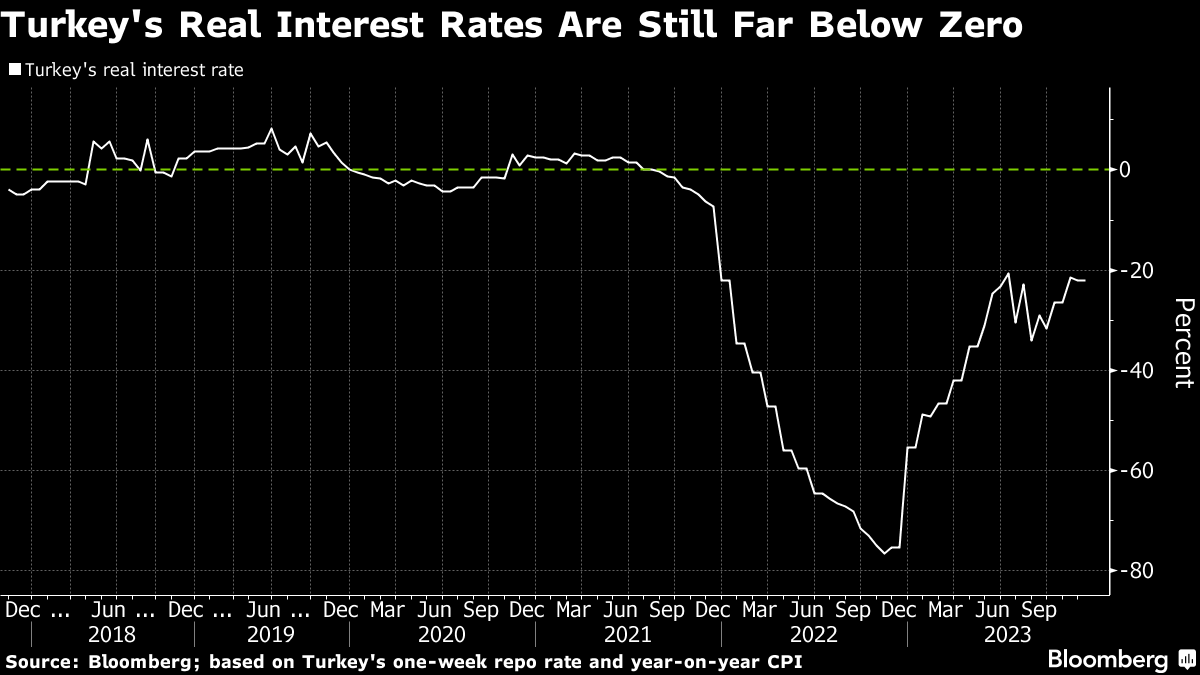
Municipal elections in March are raising the possibility that the focus will shift back to supporting the economy. Other risks abound for inflation, including an expected increase in the minimum wage next month.
“Inflation will remain a challenge,” Deutsche Bank AG analysts including Yigit Onay said in a report before the data release. “The upcoming minimum wage decision, expected to be sizable given the approaching local elections, adds an additional layer of uncertainty for next year.”
Central bank Governor Hafize Gaye Erkan, who was appointed in June, has acknowledged that temporary factors outside the reach of monetary policy — including gas consumption in November — may push up price gains. Still, she said in a speech last week that “a decline in the underlying trend of inflation has started.”
The central bank anticipates price growth will peak next May at as high as 75% then fall to 36% by the end of 2024.
(Updates with highlights, chart, more context.)
More stories like this are available on bloomberg.com
©2023 Bloomberg L.P.

-
'Never Seen This Level Of Negativity': Sandeep Tandon Says The Next Rally May Be Closer Than You Think

Veteran investor Sandeep Tandon says foreign selling is easing, large-caps are due a comeback and mid-caps are crowded, while he turns positive on gold, power and pharma this Diwali.
-
Indians Stay With Family, Not In Hotels | The Reason Why
India still lacks enough clean, reliable and affordable hotels for budget-conscious travellers.
-
The Economic Imperative: Analysing The Material Driving Force Behind India-Canada Strategic Reset
This economic complementarity is further reinforced by deep institutional investment ties and talent mobility, which form the bedrock of the bilateral framework.
-
Medicine Pricing: Where Must Profit Stop?
India must confront excessive margins, hidden incentives and regulatory gaps that threaten the integrity of medicine.
-
Why Amazon And Flipkart Are Struggling To Beat Meesho In India's Smaller Cities
With 274 million users and lowest-cost logistics, Meesho is defending its value commerce crown against giants like Amazon and Flipkart.
-
High US Salaries, No Green Card Certainty: The Financial Calculation Facing Indian H-1B Families
The suspension of PERM processing at eight technology employers does not cancel existing H-1B visas. What it does is force a question many Indian families have been avoiding: is the US salary worth tying your career and family plans to one employer?
-
Swiggy vs Eternal: Food Delivery's Two Rivals Are No Longer In The Same Race
Eternal is building a private AI assistant, dark.ai. Swiggy is still working out how to make Instamart pay, with an operating loss of Rs 895 crore in the July-September quarter while Blinkit stayed profitable.
-
Where You Live Shapes How You Get To Work | The Reason Why
Two-wheelers are the most popular way to get to work in India, accounting for nearly 43% of workplace commutes.
-
Unhedged Position: Can India See An Indonesia-Style Time Correction?
The Nifty is trading below levels it first clocked in 2024. Is there, then, as I have suggested in the headline, potential that the current time correction drags on painfully for the next three-five, even ten years?
-
Navigating Friction And Energy Realities: An Analysis Of Marco Rubio's October Visit To India
Occurring at a critical juncture marked by stalled trade negotiations and escalating geopolitical pressures over global energy supplies, the visit offers a profound window into modern US-India relations.










