Treasury Losses To Put A Dent On Indian Banks’ Recapitalisation
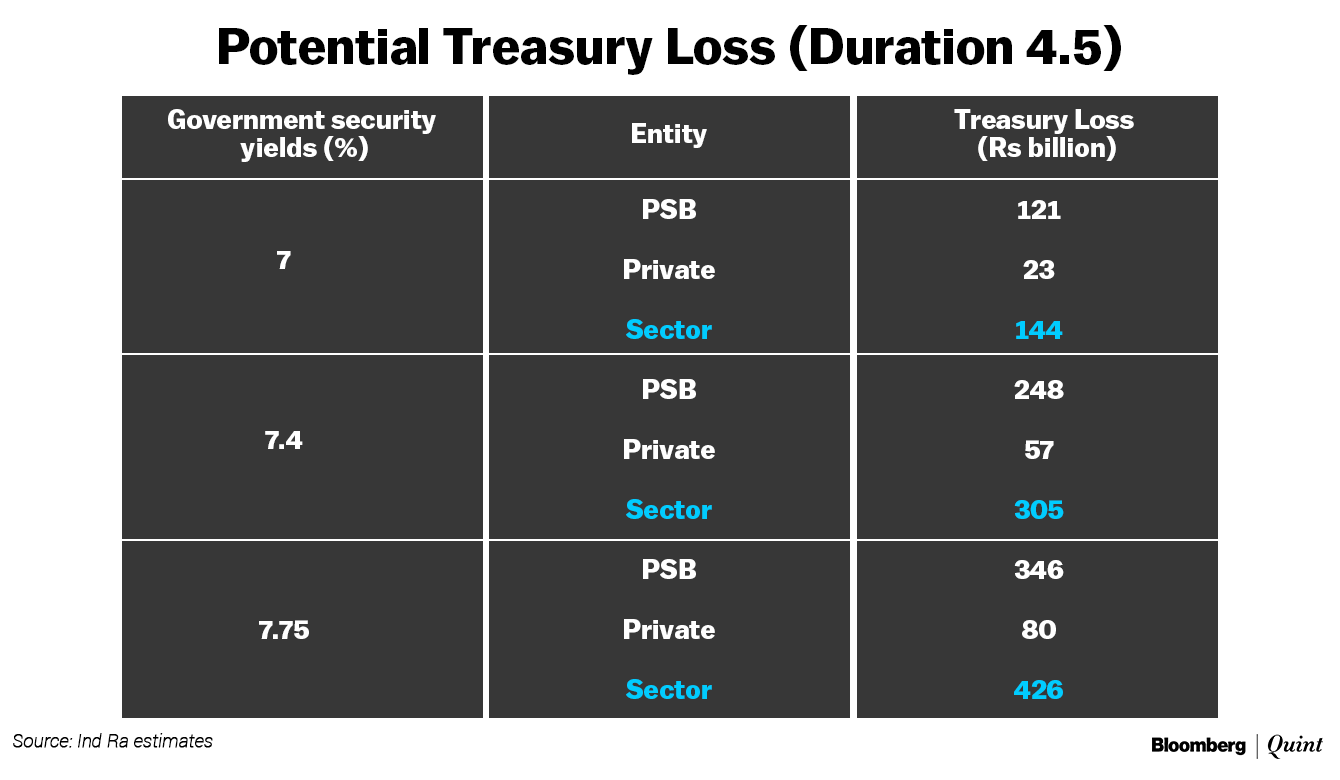
India Ratings and Research (Ind-Ra) estimates the banking industry's profitability would be affected to the tune of Rs 30,500 crore in financial year 2018 with a return on assets of around 30 basis points. Also, public sector banks would continue to report losses in FY18.
The large losses emanating out of the quick rise in bond yields, especially in the last six weeks, will result in large mark-to-market losses on lenders' non held-to-maturity investment holdings. This will lead to a considerable fall in the banking industry's treasury income in Q4FY18 with a spillover effect in FY19. In FY17, banks reported a gain on treasury of Rs 59,800 crore.
The agency believes mid-sized banks would be the worst hit, considering their proportionally swollen treasury books, after a period of muted credit and large deposit growth, and steeper treasury profit booking in FY17.
Out of the total potential loss, the share of PSBs will be Rs 24,800 crore in FY18 (FY17: profit of Rs 42,700 crore) and that of private sector banks will be Rs 5,700 crore (profit of Rs 20,100 crore).
Ind-Ra believes the resulting treasury loss will impact the renewed vigour post announcement of bank recapitalisation.
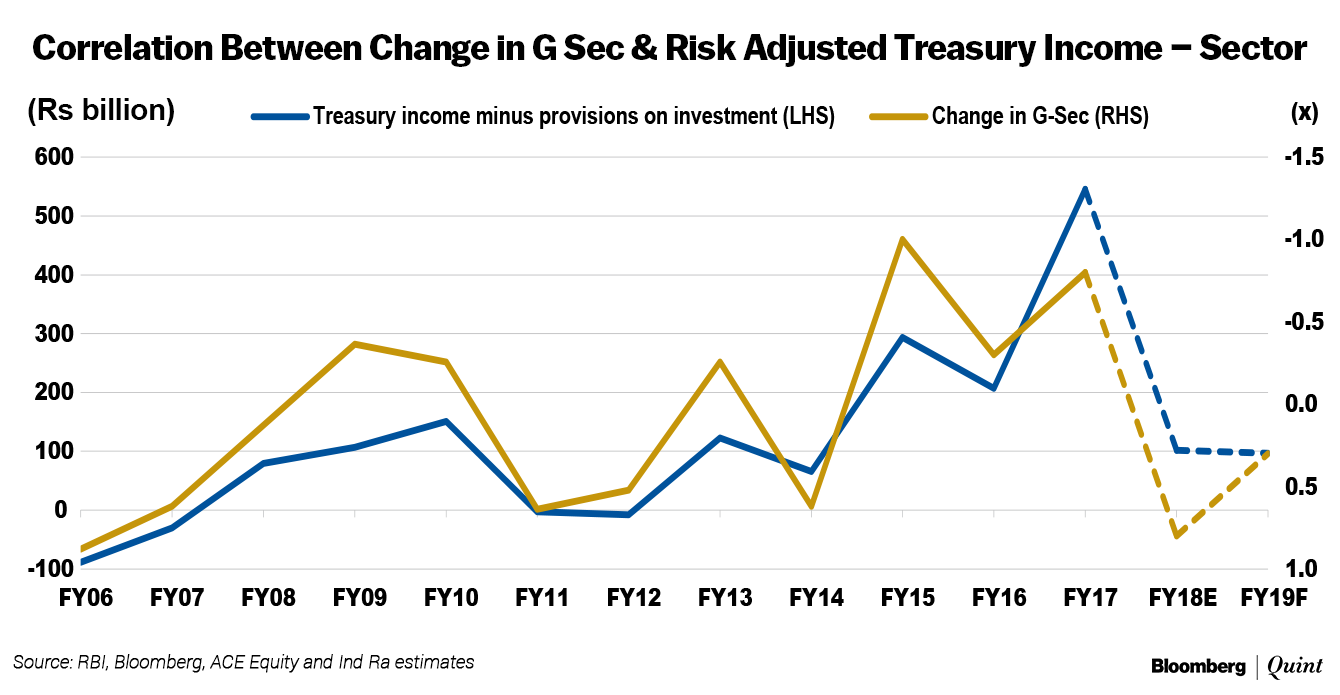
After a successive fall in bond yields starting January 2015, rates have hardened since July 2017. The 10-year benchmark yield has moved up to 7.6 percent in January 2018 from 6.5 percent as on July 2017, a 110 basis point gain in six months.
Excess Statutory Liquidity Ratio Investments
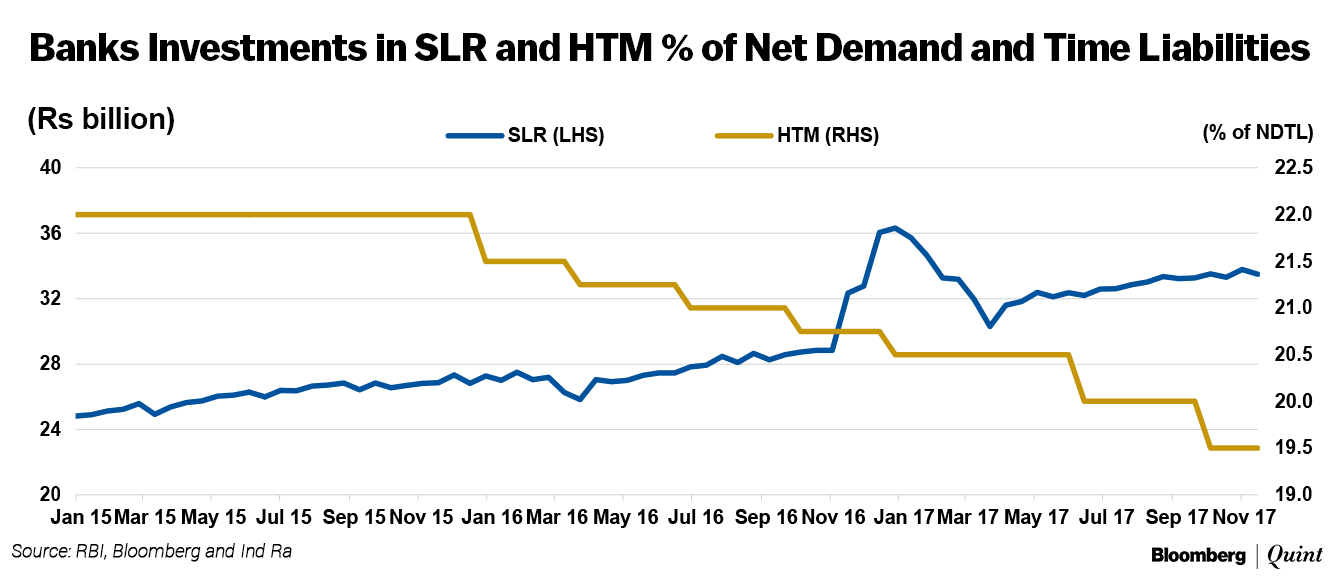
The banking systems' investments increased significantly in FY17 and FY18 as banks constrained by capitalisation and low credit offtake parked their deposit accretion in low risk weight government securities. As the yields were falling, some of the banks used realised gains to offset the profitability pressure on the core business. As the interest rate curve shifts, many banks, especially mid-sized banks could face large provisioning requirements.
Further, the proportion of investment book that is exposed to mark to market losses has increased significantly over the years as the cap on held-to-maturity bonds reduced to 19.5 percent in FY17 from 22 percent in 2015. With rising bond yields, banks will have to provide MTM losses on these.
Mounting Treasury Losses And Other Provisioning
The agency also expects additional burden emanating from migrations to Ind-AS and step-up in provisioning due to faster resolution of stressed assets would further dent banks' profitability. The agency believes scheduled commercial banks may need up to Rs 89,000 crore towards incremental provisioning for advances while transiting to the Ind-AS 109 regime.
Banks To Revive Core Earnings
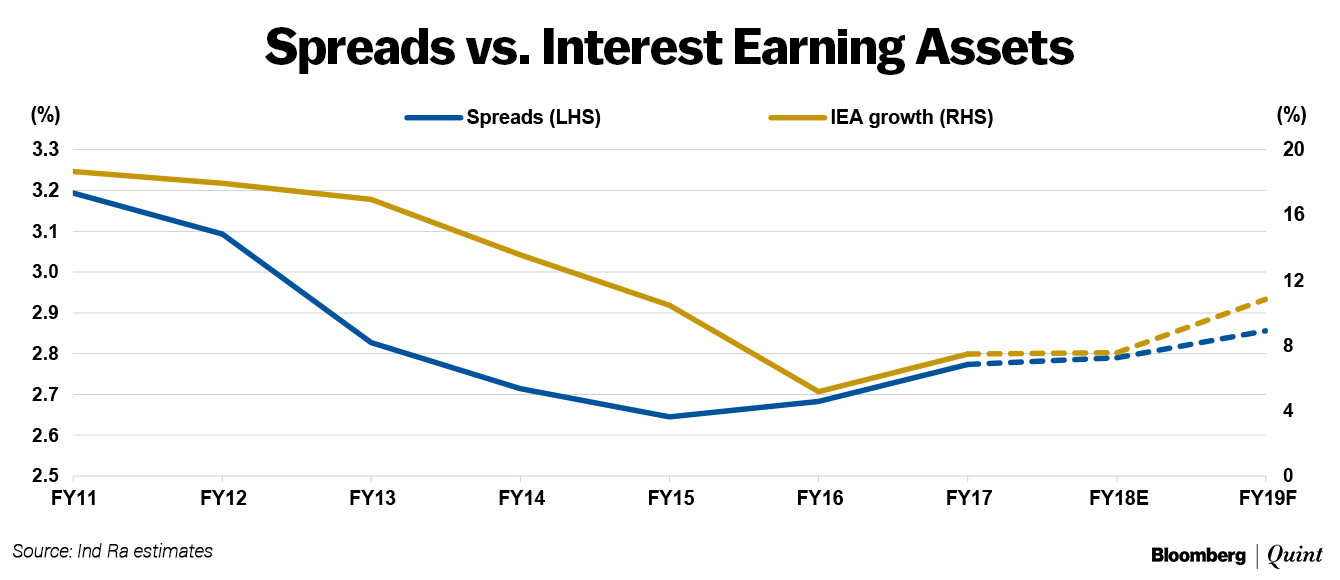
The agency believes with a recovery in demand for bank credit, banks with better capitalisation may raise lending rates to improve net interest margins. Moreover, the growing consensus towards a rise in rates by the Reserve Bank of India would entice banks to pre-empt asset repricing decisions. Hence, growth in advances and a likely improvement in spreads will aid banks' pre-provisioning operating profitability.
India Ratings and Research, a wholly owned subsidiary of Fitch Group, is a SEBI and RBI accredited credit rating agency operating in the Indian credit market.

-
Signature Play: The Classic Cocktail Is Dead. Or Is It?

Classic cocktails are disappearing from India's cocktail menus. But they're still being ordered, taught to bartenders and borrowed from. So, who's really having the last drink?
-
A New Samvat Wishlist: Inclusive Prosperity And Human Development
India has strengthened its economic foundations through infrastructure, digital access and enterprise. Its next growth chapter must deepen productivity, create better livelihoods and widen participation in prosperity.
-
Love, Sex Aur Dhokha: The Audacious Plot To Spy On Jensen Huang
A Taipei dinner, a Singapore chip buyer and a suspected Chinese asset: inside the alleged spy operation that got close to NVIDIA's Jensen Huang.
-
Ten Things I Learnt This Samvat
Patience can be a trap. Cheap stocks can stay cheap. Leverage can wipe you out. What did Samvat 2082 teach us? Niraj Shah writes on 10 lessons from the year gone by.
-
Talking Points This Week: Tech Nerves, FII Buying, And A Faraway Banking Shock
The global markets are not shining this Diwali. The exception in the large markets is, India.
-
Midterm Rally Lasted A Day. The Hard Reality Of A Divided US May Last Two Years | Opinion
Between a contested AI boom, a debt ceiling that arrives in 2027 and a president with every incentive to act alone, the next two years may prove more volatile than the first day's rally suggests.
-
Blue Wave Will Derail the AI Trade but Won't Dismantle the AI Era | Unhedged Position
The Democrats' sweep of the US Congress will see politics collide with economic forces both over the long and short term.
-
It's Time To Take The GST Council's Bet On Trust Global
Payment records can prove India's services exports, and clear, proportionate rules can bring foreign digital sellers into the tax net.
-
Opinion | India at 38: From Innovation Overperformer to Innovation Powerhouse
India now has 453 VC-backed deep science startups, 18 of them late-stage, after 117 percent growth since 2020. Laurus Labs, at USD 9.3 billion, is the most valuable deep science company in any middle-income economy outside China.









