Treasuries Are Still In a Class of Their Own Despite Fitch Cut

(Bloomberg) -- The US sovereign rating may have slipped but Treasuries remain a buy.
That's the prognosis of strategists, who say US government bonds will still be the cornerstone of portfolios even after Fitch Ratings cut the nation's AAA credit grade. The reason? There are few assets that can rival Treasuries' status as the haven of choice.
“Because Treasury securities are such an important asset class, most investment mandates and regulatory regimes refer to them specifically, rather than AAA-rated government debt,” Goldman Sachs Group Inc. economists including Alec Phillips wrote in a note. “We do not believe there are any meaningful holders of Treasury securities who will be forced to sell due to a downgrade.”
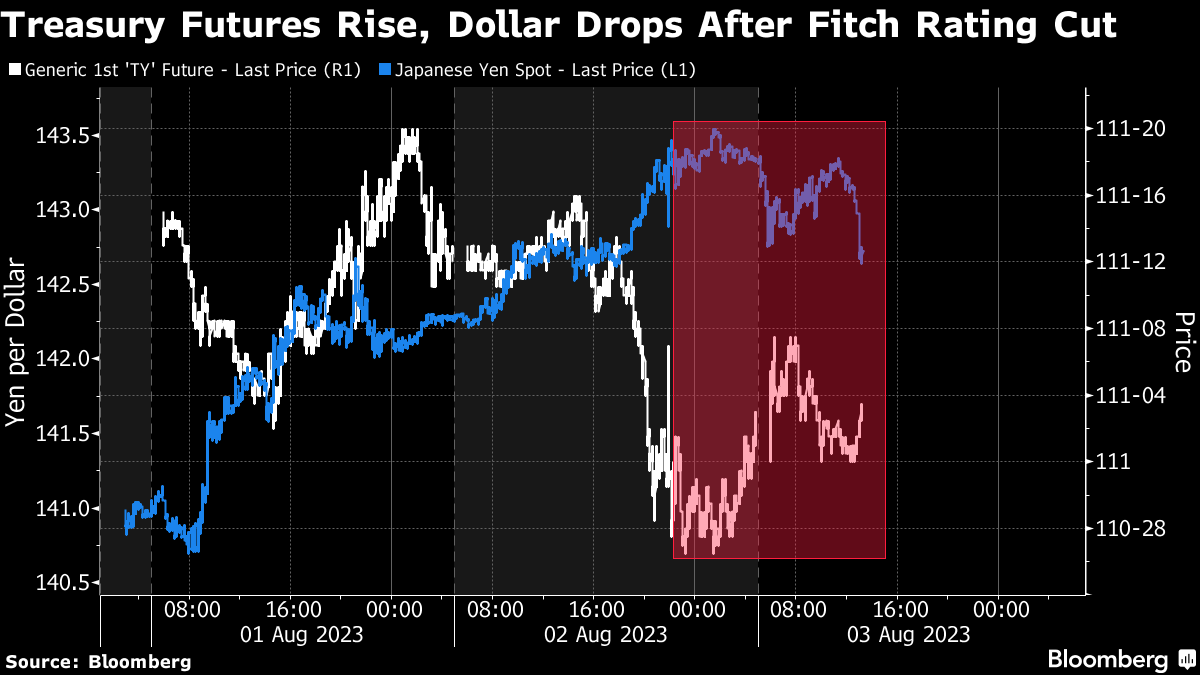
The view was reflected in market moves on Wednesday as short-end Treasuries rose and a gauge of the dollar reversed a drop to edge higher. Taking the US out of the equation, investors have a limited pool of AAA-rated sovereign debt to choose from. Economies with the highest credit rating at S&P Global Ratings, Fitch and Moody's Investors Service include Germany, Denmark, Netherlands, Sweden and Norway.
Such rating cuts “are a bit like these debt ceiling debacles — they can cause a bit of short term angst, but never amounts to anything much,” said Amy Xie Patrick, money manager in at Pendal Group. There needs to be a “credible alternative in terms of both being safe enough and large enough” to displace Treasuries, and there are no clear options now, she added.
Fitch cited the US' ballooning fiscal deficits among the reasons for its decision, which echoes a a move made more than a decade ago by S&P Global Ratings.
2011 Downgrade
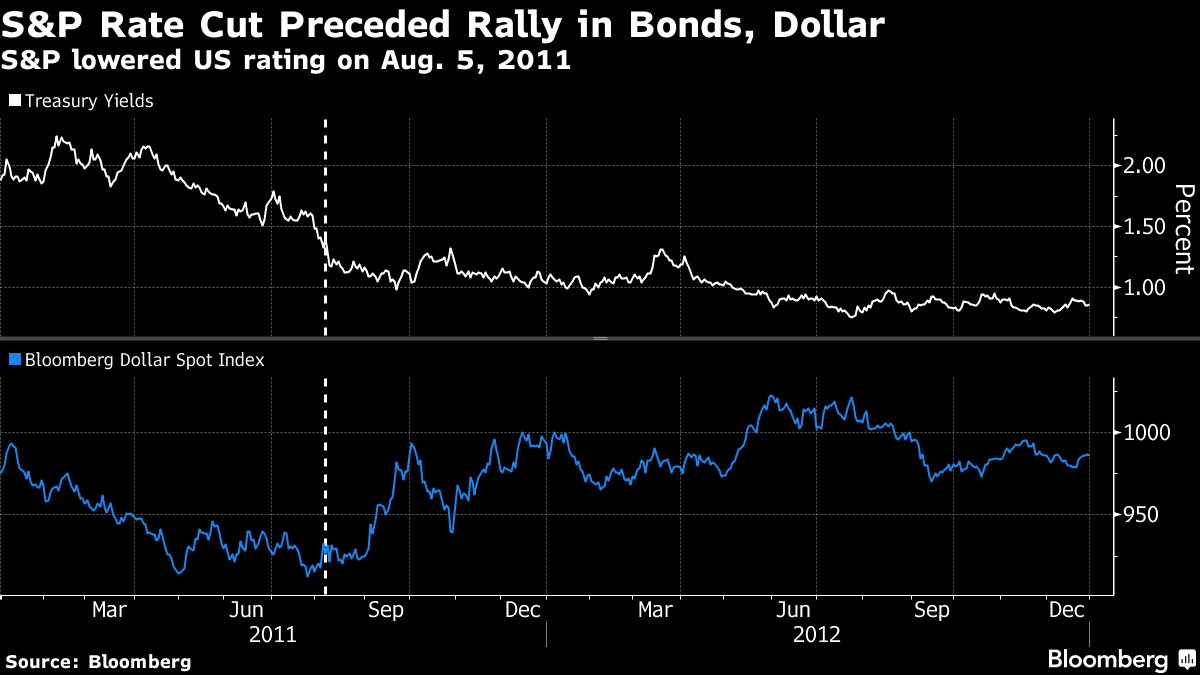
S&P's rating cut in 2011 triggered a selloff in risk assets such as global equities, but boosted Treasuries as investors sought out havens. Yields on 10-year Treasuries slid 24 basis points on Aug. 8 that year, the first trading day after the S&P downgrade.
Fitch's decision fueled a similar reaction on Wednesday, with Asian stocks declining and the two-year Treasury yield falling as much as three basis points. Benchmark 10-year US yields edged up one basis point to 4.03% after declining two basis points.
“Treasuries still provide the broad risk off hedge during periods of stress, which ironically, the downgrade may morph into,” said Marvin Loh, global macro strategist at State Street Corp. “When we look at 2011, credit and stocks initially were the most volatile following the S&P downgrade.”
“We do not believe the Fitch downgrade will have a huge market impact, as this brings the US into line with S&P ratings,” said James Wilson, senior portfolio manager at Jamieson Coote Bonds in Melbourne. “The financial system has weathered much bigger storms since then, and the bigger factor toward higher yields is the glut of Treasury supply that is set to come through the market with the larger coupon announcement.”
On Monday, the Treasury raised its net borrowing estimate for the July-through-September quarter to $1 trillion, more than some analysts expected and well above the $733 billion it had predicted in early May. The Treasury will preview its quarterly financing plans on Wednesday at 8:30 a.m. in Washington.
Borrowing Risk
Some commentators including Larry Summers and Mohamed El-Erian have criticized Fitch's decision given US economic resilience. Summers, a former Treasury Secretary, said while there were reasons for concern about the long-run US deficit trajectory, the nation's ability to service its debts isn't in doubt.
Yields on 30-year US debt climbed eight basis on Tuesday and held at 4.10% in Asia Wednesday, around the highest level since November.
What Bloomberg Strategists Say...
“There shouldn't be much lasting impact on Treasuries as Fitch put the US onto a stable outlook from negative. That means another move is very unlikely — its a one-and-done operation and marking to market with S&P's AA+ rating.”
Mark Cranfield, Markets Live strategist
While some parts of the US curve face selling pressure, the consensus is that demand for Treasuries will persist as investors struggle to find other safe and liquid options to park their cash in.
“The Fitch downgrade will have minimal negative impact on the allure of US Treasuries,” said Chang Wei Liang, strategist at DBS Bank Ltd. in Singapore. In fact, it “may ironically support Treasuries buying on concerns of follow-on downgrades to US corporate credit.”
--With assistance from Michael G. Wilson.
More stories like this are available on bloomberg.com
©2023 Bloomberg L.P.

-
Signature Play: The Classic Cocktail Is Dead. Or Is It?

Classic cocktails are disappearing from India's cocktail menus. But they're still being ordered, taught to bartenders and borrowed from. So, who's really having the last drink?
-
A New Samvat Wishlist: Inclusive Prosperity And Human Development
India has strengthened its economic foundations through infrastructure, digital access and enterprise. Its next growth chapter must deepen productivity, create better livelihoods and widen participation in prosperity.
-
Love, Sex Aur Dhokha: The Audacious Plot To Spy On Jensen Huang
A Taipei dinner, a Singapore chip buyer and a suspected Chinese asset: inside the alleged spy operation that got close to NVIDIA's Jensen Huang.
-
Ten Things I Learnt This Samvat
Patience can be a trap. Cheap stocks can stay cheap. Leverage can wipe you out. What did Samvat 2082 teach us? Niraj Shah writes on 10 lessons from the year gone by.
-
Talking Points This Week: Tech Nerves, FII Buying, And A Faraway Banking Shock
The global markets are not shining this Diwali. The exception in the large markets is, India.
-
Midterm Rally Lasted A Day. The Hard Reality Of A Divided US May Last Two Years | Opinion
Between a contested AI boom, a debt ceiling that arrives in 2027 and a president with every incentive to act alone, the next two years may prove more volatile than the first day's rally suggests.
-
Blue Wave Will Derail the AI Trade but Won't Dismantle the AI Era | Unhedged Position
The Democrats' sweep of the US Congress will see politics collide with economic forces both over the long and short term.
-
It's Time To Take The GST Council's Bet On Trust Global
Payment records can prove India's services exports, and clear, proportionate rules can bring foreign digital sellers into the tax net.
-
Opinion | India at 38: From Innovation Overperformer to Innovation Powerhouse
India now has 453 VC-backed deep science startups, 18 of them late-stage, after 117 percent growth since 2020. Laurus Labs, at USD 9.3 billion, is the most valuable deep science company in any middle-income economy outside China.









