US Treasury Yields Hit 2023 Highs After Fitch Downgrade
(Bloomberg) -- Bond investors are pushing US Treasury yields to fresh 2023 highs, spooked by plans for a flood of government-debt issuance and signs of the labor market's enduring strength.
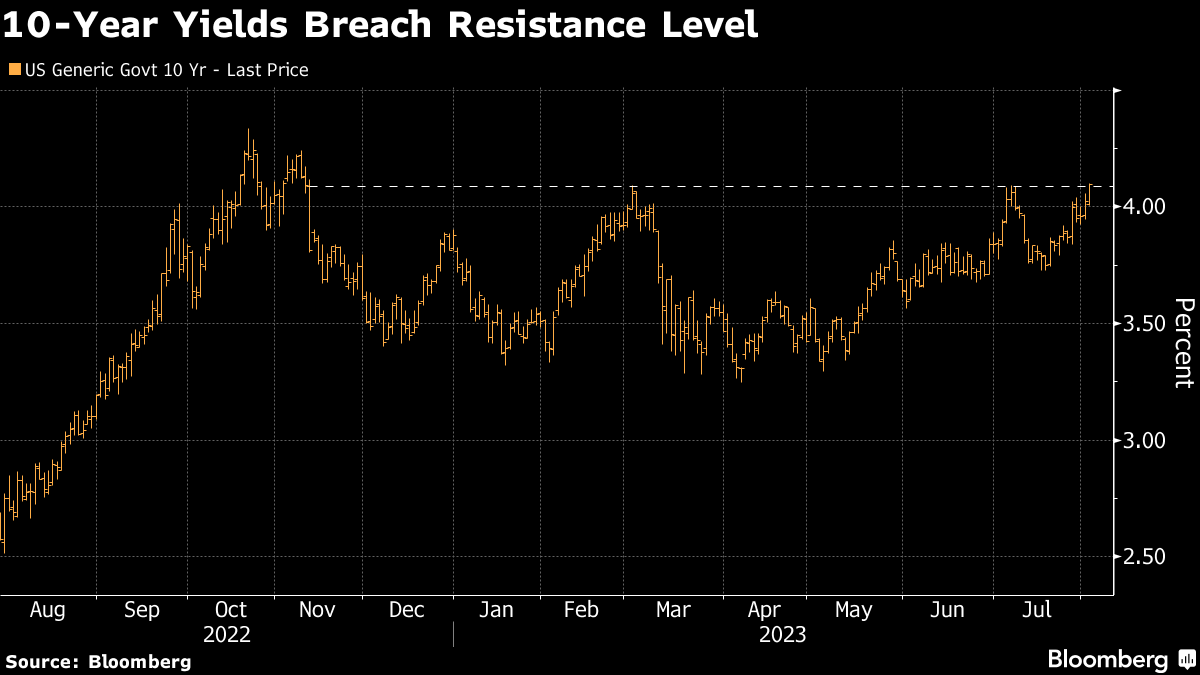
Treasuries fell across maturities on Wednesday, lifting the 10-year yield as much as 10 basis points to 4.12%, the highest since November 2022. The yield on 30-year bonds reached 4.2%, the highest in nearly nine months.
The Treasury Department on Wednesday said it plans to boost sales of longer-term debt to $103 billion next week, from $96 billion previously. The total was slightly more than most dealers expected, testing demand amid a surge in budget deficits so pronounced it helped spur Fitch Ratings to strip the US of its AAA credit rating.
“The timing of the downgrade is a bit weird, but the fiscal situation in the US is concerning,” said Tracy Chen, a portfolio manager at Brandywine Global Investment Management. “And this downgrade happens amid the Treasury refunding, so we might see term premium rising and curve steepening.”
The surge in yields also picked up momentum after data showed US companies added more jobs in July than expected, highlighting the persistent strength of the labor market. Private payrolls increased by 324,000 last month, according to figures published Wednesday by the ADP Research Institute in collaboration with Stanford Digital Economy Lab. That exceeded all estimates in a Bloomberg survey of economists.
The yield curve steepened, extending a trend since the Bank of Japan last week surprised markets by widening the allowable trading band in the 10-year yield to 1%. At 4.92%, two-year yields are 82 basis points higher than those of the 10-year note. That's compared to a gap of 102 basis points two weeks ago.
Treasuries are also getting closer to wiping out their year-to-date gain, with the Bloomberg US Treasury Total Return Index up just 0.7% in 2023. The gauge lost a record 12% in 2022.
Risk Aversion
Wednesday's moves come in the wake of a US sovereign credit downgrade by Fitch, which cut the debt to AA+. The credit assessor said the country's finances will likely deteriorate over the next three years given tax cuts, new spending initiatives, economic shocks and repeated political gridlock.
While Fitch's action echoed one made in 2011 by S&P Global Ratings, the latest change comes in a starkly different economic environment, said Ed Al-Hussainy, a global rates strategist at Columbia Threadneedle.
This time, the Treasury market is under pressure from the government's plan to ramp up bond supply, as well as the fallout of Bank of Japan's tweaked yield-control policy, he said.
Resilience in the labor market also stands in contrast to the 9% unemployment rate that plagued the US back in 2011, according to Al-Hussainy.
Even so, he said, a worsening selloff in the stock market would likely lure bond buyers back to Treasuries. The S&P 500 Index fell as much as 1.4% on Wednesday, the most since May.
“US Treasuries remain the preeminent safe haven asset with no practical substitute,” Al-Hussainy said.
(Updates market prices throughout; Adds detail, comment on rating change starting in eighth paragraph.)
More stories like this are available on bloomberg.com
©2023 Bloomberg L.P.

-
Signature Play: The Classic Cocktail Is Dead. Or Is It?

Classic cocktails are disappearing from India's cocktail menus. But they're still being ordered, taught to bartenders and borrowed from. So, who's really having the last drink?
-
A New Samvat Wishlist: Inclusive Prosperity And Human Development
India has strengthened its economic foundations through infrastructure, digital access and enterprise. Its next growth chapter must deepen productivity, create better livelihoods and widen participation in prosperity.
-
Love, Sex Aur Dhokha: The Audacious Plot To Spy On Jensen Huang
A Taipei dinner, a Singapore chip buyer and a suspected Chinese asset: inside the alleged spy operation that got close to NVIDIA's Jensen Huang.
-
Ten Things I Learnt This Samvat
Patience can be a trap. Cheap stocks can stay cheap. Leverage can wipe you out. What did Samvat 2082 teach us? Niraj Shah writes on 10 lessons from the year gone by.
-
Talking Points This Week: Tech Nerves, FII Buying, And A Faraway Banking Shock
The global markets are not shining this Diwali. The exception in the large markets is, India.
-
Midterm Rally Lasted A Day. The Hard Reality Of A Divided US May Last Two Years | Opinion
Between a contested AI boom, a debt ceiling that arrives in 2027 and a president with every incentive to act alone, the next two years may prove more volatile than the first day's rally suggests.
-
Blue Wave Will Derail the AI Trade but Won't Dismantle the AI Era | Unhedged Position
The Democrats' sweep of the US Congress will see politics collide with economic forces both over the long and short term.
-
It's Time To Take The GST Council's Bet On Trust Global
Payment records can prove India's services exports, and clear, proportionate rules can bring foreign digital sellers into the tax net.
-
Opinion | India at 38: From Innovation Overperformer to Innovation Powerhouse
India now has 453 VC-backed deep science startups, 18 of them late-stage, after 117 percent growth since 2020. Laurus Labs, at USD 9.3 billion, is the most valuable deep science company in any middle-income economy outside China.









