Need A Refund Against Train Ticket Cancellation? Here Are The Latest Rules

IRCTC, the ticketing arm of Indian Railways, allows refund on a booked train ticket under certain conditions. While IRCTC allows refund through online and offline modes in case of cancellation of a regular train ticket, no refund - or money back - is permitted in case of a confirmed Tatkal ticket. Tatkal tickets, introduced by the Railways in 1997, are meant for passengers who want to travel at a short notice. In the online mode, through its portal irctc.co.in, IRCTC enables train ticket holders - or passengers holding a regular train ticket, not Tatkal - to apply for refund of money on ticket cancellations.
In online cancellation of tickets, the money is returned to the passenger through the same channel used for booking the railway ticket, according to IRCTC. In offline mode, the train ticket holder is required to visit a reservation counter. IRCTC only allows money back in case of Tatkal ticket in select conditions. IRCTC charges certain cancellation charges towards refund in case of cancellation of a train ticket (regular or Tatkal ticket) and refunds the remaining amount.
Indian Railways' rules on refund and cancellation of regular train ticket
1. The Railways levies a clerkage fee of Rs 30 per passenger for cancellation of unreserved, RAC (reservation against cancellation) and waitlisted train tickets under the unreserved (second class) category. For the tickets of second class (reserved) and other classes, a fee of Rs 60 per passenger is charged, according to Indian Railways' website - indianrail.gov.in.
2. Cancellation charge per passenger on confirmed (reserved) tickets when done 48 hours before the scheduled departure of the train costs to Rs 240 for 1st AC/executive class. For 2 AC/1st class, it costs to Rs 200. The charges for 3AC/3A economy is Rs 180 while for sleeper class, the charges are priced at Rs 120. The cancellation charges for second class are Rs 60.
3. Cancellation charge per passenger on confirmed (reserved) tickets when done in between 48 hours and 12 hours before the scheduled departure of the train costs 25 per cent subject to minimum charge mentioned above. Cancellation charge per passenger on confirmed (reserved) tickets when done in between 12 hours and 4 hours before the scheduled departure of the train costs 50 per cent, subject to minimum charge as mentioned above. No refund is given by Indian Railways after the above prescribed time limit.
4. Partially confirmed tickets can be cancelled up to half an hour before the scheduled departure of the train from the ticket counter, said Indian Railways.
5. Refund on unused RAC/WL (Waitlisted) tickets is given up to half an hour before the scheduled departure of the train subject to deduction of clerkage charge.
6. In case of cancellation of trains for online tickets, automatic refund is granted. Filing of TDR (Ticket Deposit Receipt) is not required.
The Railways provides an online facility to enable users to find the refund status of their cancelled tickets in real time. This facility can be accessed through the Indianrail website, refunds.indianrail.gov.in. If passengers have cancelled their tickets, they can key in the Passenger Name Record (PNR) numbers of the tickets to know the refund status.
(Also read: How to file a TDR to seek refund)
Refund in case of cancellation of Tatkal ticket
The Railways does not permit a refund in case of cancellation of a confirmed Tatkal ticket. However, in case of "contingent cancellation and waitlisted Tatkal ticket cancellations", refunds are allowed after deduction of charges as per the rules. "Partial cancellation of Tatkal e-tickets is allowed... If the train is marked as 'CANCELLED' due to breaches, floods, accidents etc. full refund is permissible in case the ticket is cancelled within three days of the scheduled departure of the train. In case of e-tickets, such cancellations can be done by the customer through Internet," according to the IRCTC website.
The Railways allows a full refund of fare and Tatkal charges on tickets booked under Tatkal scheme under the following conditions, according to the carrier's website:
1. If the train is delayed by more than three hours at the journey originating point of the passenger and not the boarding point if the passenger's journey originating point and boarding point are different.
2. If the train is to run on a diverted route and passenger is not willing to travel.
3. If the train is to run on diverted route and boarding station or the destination or both the stations are not on the diverted route.
4. In case of non attachment of coach in which Tatkal accommodation has been earmarked and the passenger has not been provided accommodation in the same class.
5. If the party has been accommodated in lower class and does not want to travel. In case the party travels in lower class, the passenger will be given refund of difference of fare and also the difference of Tatkal charges, if any.
How to know the status of refund against cancelled train tickets
1. The user is required to log in to the website Indianrail Refunds website - refunds.indianrail.gov.in.
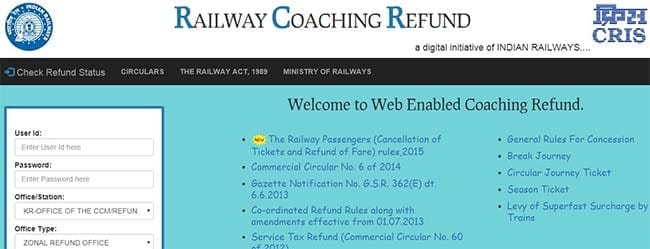
(The Railway Coaching Refund website also contains information on cancellation and refund rules)
2. The user is then required to select the 'Check Refund Status' option and enter his or her PNR details.
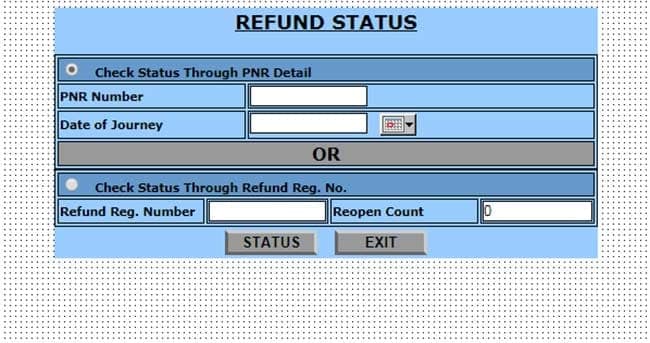
(The user is required to provide the PNR number as well as the date of train journey as given on the train ticket)
3. The website then displays the status of refund against cancellation of train tickets booked through either online or offline modes.

-
Indians Stay With Family, Not In Hotels | The Reason Why

India still lacks enough clean, reliable and affordable hotels for budget-conscious travellers.
-
The Economic Imperative: Analysing The Material Driving Force Behind India-Canada Strategic Reset
This economic complementarity is further reinforced by deep institutional investment ties and talent mobility, which form the bedrock of the bilateral framework.
-
Medicine Pricing: Where Must Profit Stop?
India must confront excessive margins, hidden incentives and regulatory gaps that threaten the integrity of medicine.
-
Why Amazon And Flipkart Are Struggling To Beat Meesho In India's Smaller Cities
With 274 million users and lowest-cost logistics, Meesho is defending its value commerce crown against giants like Amazon and Flipkart.
-
High US Salaries, No Green Card Certainty: The Financial Calculation Facing Indian H-1B Families
The suspension of PERM processing at eight technology employers does not cancel existing H-1B visas. What it does is force a question many Indian families have been avoiding: is the US salary worth tying your career and family plans to one employer?
-
Swiggy vs Eternal: Food Delivery's Two Rivals Are No Longer In The Same Race
Eternal is building a private AI assistant, dark.ai. Swiggy is still working out how to make Instamart pay, with an operating loss of Rs 895 crore in the July-September quarter while Blinkit stayed profitable.
-
Where You Live Shapes How You Get To Work | The Reason Why
Two-wheelers are the most popular way to get to work in India, accounting for nearly 43% of workplace commutes.
-
Unhedged Position: Can India See An Indonesia-Style Time Correction?
The Nifty is trading below levels it first clocked in 2024. Is there, then, as I have suggested in the headline, potential that the current time correction drags on painfully for the next three-five, even ten years?
-
Navigating Friction And Energy Realities: An Analysis Of Marco Rubio's October Visit To India
Occurring at a critical juncture marked by stalled trade negotiations and escalating geopolitical pressures over global energy supplies, the visit offers a profound window into modern US-India relations.
-
India Exports Capital. Why Not Export Trusteeship?
The big question, then, is whether India can build an institution that global borrowers, investors, banks, and lawyers can trust, even without an Indian connection.










