Traders Brace for BOE to Hint at Faster Pace of Bond Sales

(Bloomberg) -- Speculation is growing the Bank of England will surprise economists by signaling an increase to the pace of bond sales as it looks to reduce its outsized footprint in the market.
Officials may say as soon as Thursday they will start shrinking their balance sheet at a faster pace, according to analysts at firms including Capital Economics and BNP Paribas. The BOE halted reinvestments of its maturing gilts and has been actively selling bonds since September, targeting a £80 billion annual portfolio reduction.
While most economists expect the overall target to be raised because there are more gilts maturing in the coming year, an increase to outright bond sales could catch the market off guard. Capital Economics says the pace could increase to £120 billion, with bond sales almost doubling to £70 billion.
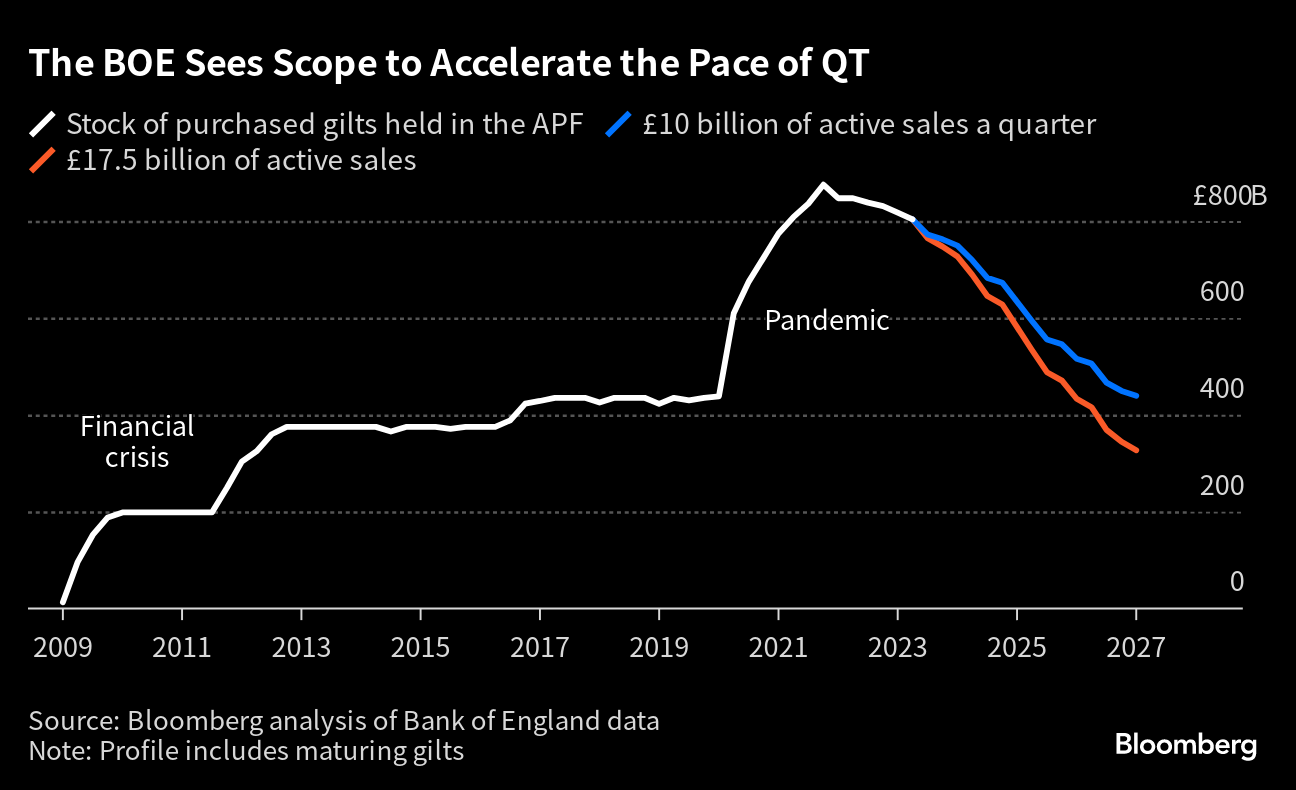
The out-of-consensus view gained traction after deputy governor Dave Ramsden said last month he sees scope to step up the pace of QT to give policymakers more “headroom” to act again in a crisis. The BOE currently holds about £800 billions of bonds accumulated over years of quantitative easing programs to support the economy.
“The Bank has learnt that well-telegraphed gilt sales don't destabilize the market,” said Paul Dales, chief UK economist at Capital Economics, encouraging the BOE to press on at a faster clip.
UBS and Nomura forecast the pace of QT will increase to £100 billion, while BNP Paribas and Goldman Sachs expect it to be raised to £95 billion and £90 billion respectively, due to higher bond redemptions. There are around £50 billion in gilts held by the BOE set to mature over the next year, versus £35 billion in the previous year.
A “carefully considered increase” to £100 billion per year would result in “steeper curves and tighter asset-swap spreads,” said UBS analysts including Anna Titareva, who expect the BOE will wait until September.
The QT program aims to reduce the BOE's bloated balance sheet, which remains well above pre-pandemic levels despite a £100 billion unwind over the past year. By removing liquidity in the market, it could also help tighten financial conditions.
Still, BOE officials have flagged the economic impact has been limited, with interest-rate hikes remaining the key tool to fight inflation that is still running above target. They are expected to raise rates by a quarter point on Thursday, with some economists forecasting a larger half-point hike.
QT also appears to have helped ease concerns about gilt scarcity in repo markets, where they are used as collateral, according to Ramsden. An increase in the pace may further free up supply.
‘Elevated Supply'
“We can expect short-term gilt repos to cheapen further given the ongoing QT which, together with the elevated supply, should alleviate short-term gilt scarcity,” Morgan Stanley strategist Fabio Bassanin wrote in a note.
The BOE said it will confirm QT details for the year ahead in September, but it could give markets a provisional plan a month ahead as it did last year. RBC Capital Markets analysts don't expect a new QT target to be announced until the September decision, while others see it coming earlier.
“We expect the BOE to follow its 2022 playbook on QT” by annoucing its QT plans in August, BNP Paribas analysts including Matthew Swannell wrote in a note. Ramsden's comments suggest that “the pace of active sales has been conservative” meaning the risks are skewed toward a larger program, they said.
--With assistance from Andrew Atkinson and Alex Mortimer.
(Adds UBS comment starting in sixth paragraph. An earlier version of this story corrected BNP Paribas' QT forecast.)
More stories like this are available on bloomberg.com
©2023 Bloomberg L.P.

-
Signature Play: The Classic Cocktail Is Dead. Or Is It?

Classic cocktails are disappearing from India's cocktail menus. But they're still being ordered, taught to bartenders and borrowed from. So, who's really having the last drink?
-
A New Samvat Wishlist: Inclusive Prosperity And Human Development
India has strengthened its economic foundations through infrastructure, digital access and enterprise. Its next growth chapter must deepen productivity, create better livelihoods and widen participation in prosperity.
-
Love, Sex Aur Dhokha: The Audacious Plot To Spy On Jensen Huang
A Taipei dinner, a Singapore chip buyer and a suspected Chinese asset: inside the alleged spy operation that got close to NVIDIA's Jensen Huang.
-
Ten Things I Learnt This Samvat
Patience can be a trap. Cheap stocks can stay cheap. Leverage can wipe you out. What did Samvat 2082 teach us? Niraj Shah writes on 10 lessons from the year gone by.
-
Talking Points This Week: Tech Nerves, FII Buying, And A Faraway Banking Shock
The global markets are not shining this Diwali. The exception in the large markets is, India.
-
Midterm Rally Lasted A Day. The Hard Reality Of A Divided US May Last Two Years | Opinion
Between a contested AI boom, a debt ceiling that arrives in 2027 and a president with every incentive to act alone, the next two years may prove more volatile than the first day's rally suggests.
-
Blue Wave Will Derail the AI Trade but Won't Dismantle the AI Era | Unhedged Position
The Democrats' sweep of the US Congress will see politics collide with economic forces both over the long and short term.
-
It's Time To Take The GST Council's Bet On Trust Global
Payment records can prove India's services exports, and clear, proportionate rules can bring foreign digital sellers into the tax net.
-
Opinion | India at 38: From Innovation Overperformer to Innovation Powerhouse
India now has 453 VC-backed deep science startups, 18 of them late-stage, after 117 percent growth since 2020. Laurus Labs, at USD 9.3 billion, is the most valuable deep science company in any middle-income economy outside China.









