Top Tech Dealmaker Warns China’s VC Winter Is Far From Over
(Bloomberg) -- Chinese startups will struggle to attract investment throughout 2022 and possibly beyond, one of the country's most successful dealmakers said, adding to a chorus of warnings about a reckoning for global tech firms after years of easy money.
Investors in private equity and venture capital funds, known as limited partners, are becoming a lot more selective before committing capital, Bao Fan, founder of China Renaissance Holdings, told Bloomberg News in Hong Kong. The industry may be witnessing the start of a longer-term shift in the geography and type of investor, as American and risk-averse backers begin to cool on China, he said in an interview.
“It's very difficult for new funds -- especially the first-timers -- to raise capital under current circumstances,” the 52-year old financier said. “No one knows when this will end.”

The former Morgan Stanley and Credit Suisse banker should know. He's had his finger on the pulse of China's tech and VC ecosystem over the past two decades, having been an early investor in big names like Didi Global Inc. and Meituan as well as a bookrunner on JD.com Inc.'s $2 billion US initial public offering in 2014. Last year, his company was a top underwriter for Kuaishou Technology's Hong Kong listing, the biggest internet IPO since Uber Technologies Inc.'s debut in 2019.
His near-term outlook adds to a frosty mood around investments into China, which was recently dubbed “uninvestable” by JPMorgan Chase & Co. analysts following a withering year of government regulations, Covid-19 disruptions and geopolitical tensions battering the country's economy. JPMorgan analysts later revised that assessment.
Is China ‘Uninvestable' and What Does That Even Mean?
“At the end of the day, investment is to make money,” Bao said. “If the market is not good, it will definitely affect everybody's enthusiasm for investment.” The Nasdaq Golden Dragon China Index -- a benchmark tracking Chinese stocks listed in the US -- slid roughly 20% this year. Meanwhile, Hong Kong's closely-watched Hang Seng Index has fallen 9%.
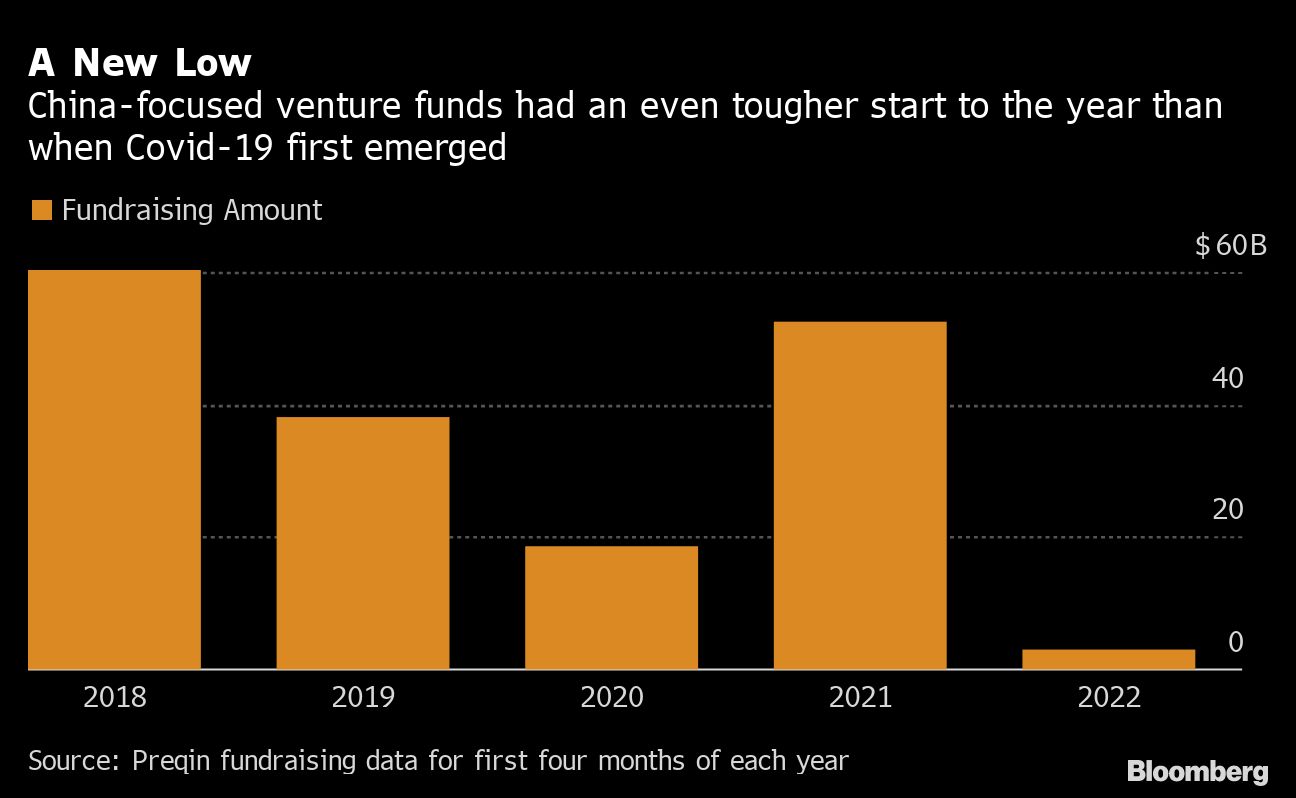
Fundraising for new ventures in the country has fallen off a cliff, mirroring the performance of its best-known tech stocks like Alibaba Group Holding Ltd. and Tencent Holdings Ltd., which have been in the crosshairs of a wide-ranging Beijing crackdown on internet firms. Venture capital and private equity funds raised $3 billion in the first four months of 2022, marking a decline of more than 90% compared to a year ago, according to estimates from industry data provider Preqin.
Markets all over the world are going through a painful rethink about the lofty valuations they've put on tech stocks, and China is leading the way with a decline in VC deals this year that's nearly four times the pace of the global slide, Preqin's figures showed.

As a frontline fundraiser, Bao has witnessed a pullback from many US and European investors. But at the same time, he sees emerging markets increasingly stepping in to fill the void for China-focused private equity investors.
“Western LPs are investing in China primarily for financial returns but LPs from emerging markets, sovereign funds in particular, have a different mandate,” Bao said, pointing to the desire to strengthen a country's domestic economy through outward investment.
“We could act as a bridge and help export China's knowhow, expertise and talents to emerging markets and help LPs there to develop their digital economy,” said Bao, who is visiting Dubai this week.
China Renaissance managed 48.9 billion yuan ($7.3 billion) across its ten private equity funds as of December 2021, according to its most recent filing. Some of his portfolio companies, such as Shenzhen-based MGI Tech, which provides advanced gene-sequencing solutions to health care companies, could use the Middle East as its launchpad for going global, Bao said.
He has also backed companies that provide smart industrial technology used in supply chains, contracts and transactions -- advanced manufacturing is another area of interest for many in Southeast Asia, for instance.
China Is Leading the Global Contraction in Venture Capital Deals
Bao's ability to connect rising Chinese companies with investors in emerging markets may hold the key for his team to fend off competition from the likes of KKR & Co. and Tiger Global Management, which in recent years are also increasingly turning to deep-pocketed Middle East investors for funding.
Bao's sales pitch appears to be resonating with regional funders. From a total of $800 million raised as of early 2022 for his Huaxing Growth Capital Fund IV, 60% of that came from Asian investors including those from the Middle East, while American investors chipped in only 2%, according to China Renaissance.
At home, Bao sees good opportunity in sectors that align with Beijing's long-term tech ambition, such as manufacturing automation and so-called deep tech, businesses that will help resolve the supply chain bottlenecks that gripped the world for much of the past two years. It's a tricky market to navigate, with Beijing reining in internet companies and Washington threatening to expel more than 200 US-listed Chinese firms.
But if you believe China's economy will eventually regain momentum and strength, now is a good time to invest in its companies, according to Bao.
“The uglier the market, the more attractive the opportunities it yields for investors, unless you truly believe China is uninvestable,” he said.
More stories like this are available on bloomberg.com
©2022 Bloomberg L.P.

-
Talking Points This Week: Leadership Shock At Nvidia, Earnings Strength, And The Fog Over Hormuz

The Anthropic IPO pricing and first trading day, Nvidia's upcoming earnings, and any fresh signals from Iran will set the tone for the following week.
-
Signature Play: The Classic Cocktail Is Dead. Or Is It?
Classic cocktails are disappearing from India's cocktail menus. But they're still being ordered, taught to bartenders and borrowed from. So, who's really having the last drink?
-
A New Samvat Wishlist: Inclusive Prosperity And Human Development
India has strengthened its economic foundations through infrastructure, digital access and enterprise. Its next growth chapter must deepen productivity, create better livelihoods and widen participation in prosperity.
-
Love, Sex Aur Dhokha: The Audacious Plot To Spy On Jensen Huang
A Taipei dinner, a Singapore chip buyer and a suspected Chinese asset: inside the alleged spy operation that got close to NVIDIA's Jensen Huang.
-
Ten Things I Learnt This Samvat
Patience can be a trap. Cheap stocks can stay cheap. Leverage can wipe you out. What did Samvat 2082 teach us? Niraj Shah writes on 10 lessons from the year gone by.
-
Talking Points This Week: Tech Nerves, FII Buying, And A Faraway Banking Shock
The global markets are not shining this Diwali. The exception in the large markets is, India.
-
Midterm Rally Lasted A Day. The Hard Reality Of A Divided US May Last Two Years | Opinion
Between a contested AI boom, a debt ceiling that arrives in 2027 and a president with every incentive to act alone, the next two years may prove more volatile than the first day's rally suggests.
-
Blue Wave Will Derail the AI Trade but Won't Dismantle the AI Era | Unhedged Position
The Democrats' sweep of the US Congress will see politics collide with economic forces both over the long and short term.
-
It's Time To Take The GST Council's Bet On Trust Global
Payment records can prove India's services exports, and clear, proportionate rules can bring foreign digital sellers into the tax net.
-
Opinion | India at 38: From Innovation Overperformer to Innovation Powerhouse
India now has 453 VC-backed deep science startups, 18 of them late-stage, after 117 percent growth since 2020. Laurus Labs, at USD 9.3 billion, is the most valuable deep science company in any middle-income economy outside China.









