Tim Cook Is Back in China. Apple Intelligence Isn’t
(Bloomberg Opinion) --If you log onto Chinese social media these days, you may encounter many young people expressing the “involution” or neijuan mentality. It's become a buzzword for a generation of college students and recent graduates beaten down by society's relentless competition, and roughly translates to rolling inwards.
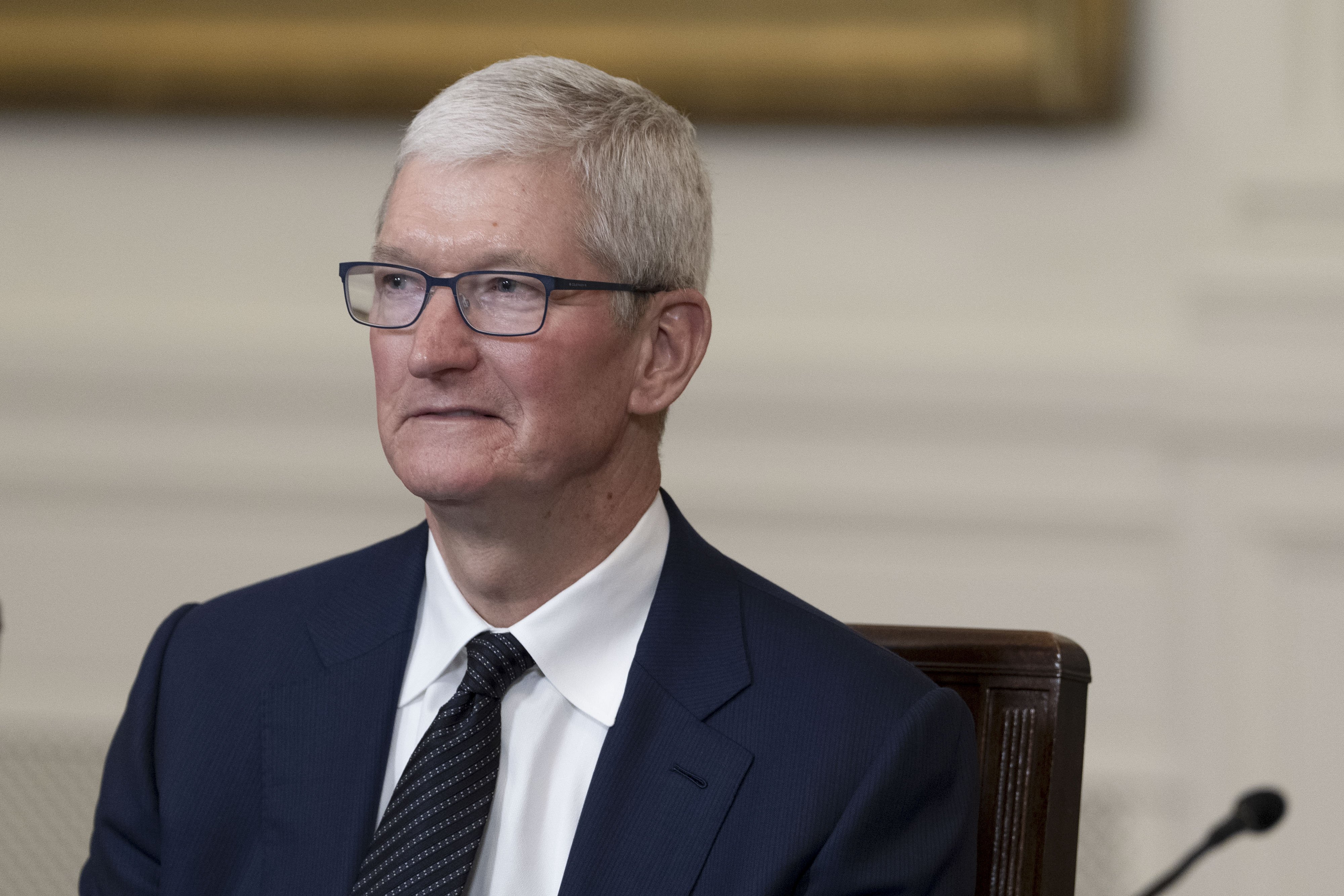
You also might stumble upon new selfies of Apple Inc. Chief Executive Officer Tim Cook, who was back in China this week for his first visit of the year. The US business leader and de-facto diplomat between the geopolitical nemeses had a packed itinerary: Meeting officials in Beijing, stopping by a local Apple store and visiting students in Hangzhou, among other events. As usual, he chronicled much of his journey via bilingual Weibo posts.
So far, there's been no official updates on the rollout of Apple Intelligence in the country. But his trip comes as competition in China's AI sector has become ferocious, revitalized by the success of DeepSeek and fresh top-down government support. Domestic smartphone rivals, meanwhile, have been much quicker to incorporate the buzzy technology into devices. iPhone sales have seen a precipitous drop, falling more than 18% in the December quarter. On a recent earnings call, Cook called China “the most competitive market in the world.”
Bringing the AI iPhone features to China at a time of hyper-competition is fraught, and it will be hard for Apple to not feel the pains of involution. But there are reasons to believe that the tech giant has a unique opportunity to get this right in a way that it has noticeably not done elsewhere.
In being forced by regulators to work with local partners — it's chosen Alibaba Group Holdings Ltd. and Baidu Inc. — the company will have to loosen the reins it famously likes to hold tight. But with its in-house AI efforts sputtering, this could end up being a blessing. For Apple to overcome involution in China, it must find a way to invigorate local tech talent — who have been flooding the market with AI products — to build these services for the iPhone.
It's been an unusually rocky few weeks for Apple outside of China, when even the most long-standing Apple supporters seemed to realize the company was much further behind on AI than initially thought. It indefinitely delayed some of its most exciting updates that were advertised to sell its iPhone 16. The AI features that have arrived have been imperfect, to put it mildly. The company is also undergoing a rare leadership shakeup to address some of these issues.
Back in China, the Apple Intelligence delay has been ominous. AI could ultimately be what makes or breaks the future of the iPhone, especially in this market, where personal demand for such services is enormous. If Apple doesn't keep pace, it could see AI-enabled rivals crush its most valuable product the same way the iPhone did to the BlackBerry soon after launch. The company is expected to finally bring Apple Intelligence to China by the middle of this year, likely May. It can't come soon enough.
The delay has also given time for China's AI sector to explode at a rapid clip. It has driven down the cost for developers building new services and products on top of existing models. The more Apple opens its iPhone to support these tools, the more it can meet the moment.
Geopolitical tensions still loom as large as ever. Cook's visit notably came ahead of “Liberation Day,” when President Donald Trump promised to unleash a fresh round of tariffs, and it's still not clear if Apple will be exempt from new levies. Critics are not wrong to question how tenable this relationship between Apple and China is, or the consequences of the company making itself beholden to Beijing by concentrating its supply chains in the country. But the reality now is that Apple's entanglement with China has only grown. And at this stage, it may not just be relying on Chinese talent for its hardware, but also to keep pace in the AI race.
Earlier this week, Cook made a pitstop at Zhejiang University to donate some $4 million to a fund for young coders at the same school that produced the founder of DeepSeek. Apple also reportedly hosted a virtual session for Chinese developers on Apple Intelligence offerings — who may be among the growing pool of engineers that end up building the products and services that the AI iPhone's future depends on.
State-backed media quoted Cook as saying he predicts “more Chinese apps will become popular overseas, because the creativeness of Chinese developers is second to none.”
Let's hope he's correct. If Apple wants to reverse the involution of the iPhone in China, it's going to need all the help it can get.

-
The Curious Case of Equitas Small Finance Bank And A CEO Who Quit For Stock

PN Vasudevan believes persistent investor concerns over a perceived conflict of interest had become a governance overhang on Equitas Small Finance Bank's stock, even as the lender improved profitability and asset quality.
-
Talking Points This Week: AI Cash Burn, A Tiger Comeback And An India That Still Finds Its Own Path
India is not immune to higher oil or tighter global liquidity, yet its earnings base is broader, its domestic policy levers are still available.
-
Foreign Investors Own Half Of HDFC Bank and ICICI Bank. An LTCG Cut Could Matter Most Here
Foreign portfolio investors have US$115 billion parked in HDFC Bank, ICICI Bank. If the government cuts long-term capital gains tax, Jefferies says returning foreign money could land here first.
-
'Never Seen This Level Of Negativity': Sandeep Tandon Says The Next Rally May Be Closer Than You Think
Veteran investor Sandeep Tandon says foreign selling is easing, large-caps are due a comeback and mid-caps are crowded, while he turns positive on gold, power and pharma this Diwali.
-
Indians Stay With Family, Not In Hotels | The Reason Why
India still lacks enough clean, reliable and affordable hotels for budget-conscious travellers.
-
The Economic Imperative: Analysing The Material Driving Force Behind India-Canada Strategic Reset
This economic complementarity is further reinforced by deep institutional investment ties and talent mobility, which form the bedrock of the bilateral framework.
-
Medicine Pricing: Where Must Profit Stop?
India must confront excessive margins, hidden incentives and regulatory gaps that threaten the integrity of medicine.
-
Why Amazon And Flipkart Are Struggling To Beat Meesho In India's Smaller Cities
With 274 million users and lowest-cost logistics, Meesho is defending its value commerce crown against giants like Amazon and Flipkart.
-
High US Salaries, No Green Card Certainty: The Financial Calculation Facing Indian H-1B Families
The suspension of PERM processing at eight technology employers does not cancel existing H-1B visas. What it does is force a question many Indian families have been avoiding: is the US salary worth tying your career and family plans to one employer?
-
Swiggy vs Eternal: Food Delivery's Two Rivals Are No Longer In The Same Race
Eternal is building a private AI assistant, dark.ai. Swiggy is still working out how to make Instamart pay, with an operating loss of Rs 895 crore in the July-September quarter while Blinkit stayed profitable.










