Thyssenkrupp To Decide When Its European Venture With Tata Steel Goes Public
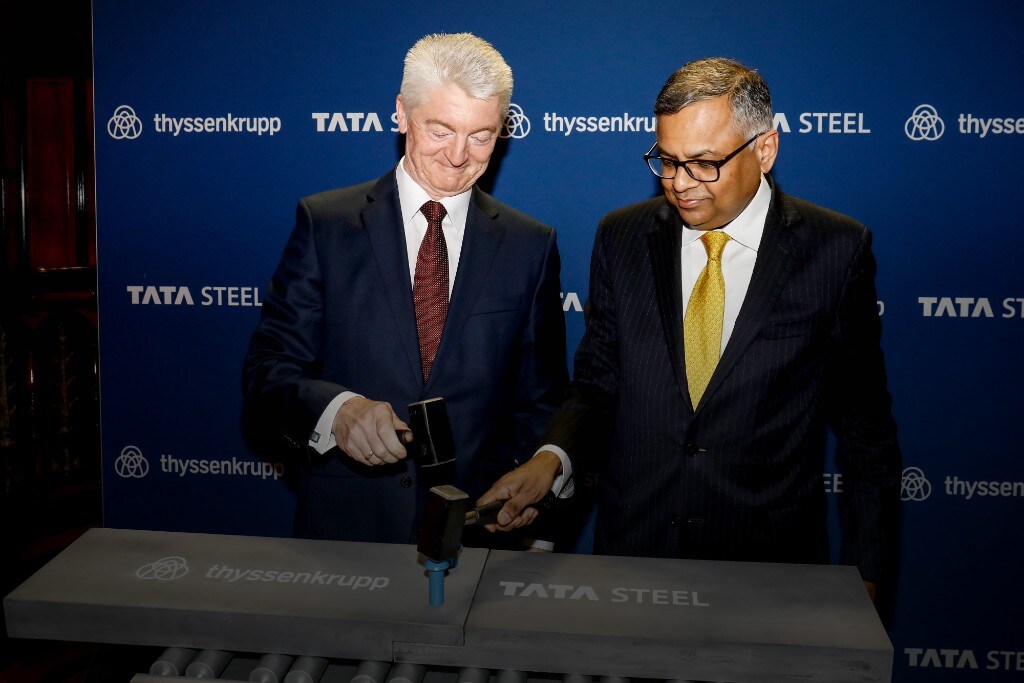
Germany's Thyssenkrupp AG will have the rights to decide when it wants to list the combined European steel operations in its joint venture with Tata Steel Ltd., according to the chairman of the Indian steelmaker N Chandrasekaran.
“Thyssenkrupp has the rights to decide the timing of the IPO so that they can capture the value at an appropriate time,” Chandrasekaran, chairman of the salt-to-software Tata Sons, parent of Tata Steel, told Bloomberg TV in an interview. “The immediate focus should be on getting [regulatory] approval so we can close the transaction. And then we've got to form the company and gain some credibility before we think about an IPO.”
The deal to create Europe's second largest steelmaker, which has been in the works since last year, received an approval from the board of Tata Steel last week. The joint venture will see both Thyssenkrupp and Tata holding 50 percent stake each. The partners will have to hold a combined stake of at least 50 percent for at least six years. At the time of an initial public offering, Thyssenkrupp will be allowed to increase its stake to 55 percent upon conversion of warrants issued by Tata Steel.
Despite a nod by Thyssenkrupp's board, the deal has faced criticism from its investors. Its largest investor Cevian Capital voted against the deal, Bloomberg reported. Activist investor Elliott Capital and Thyssenkrupp's workers union too put pressure on Chief Executive Hiesinger, arguing that a slump in profits at Tata made the deal less attractive.
Chandrasekaran remains optimistic that the deal would create significant value for the shareholders of both firms. “It will allow us to get our research and development together. There is very strong R&D spend at both companies and we'll be able to draw synergies out of that.”
We'll be able to come out with products, which are a lot more in terms for the range they can support, for our customers.N Chandrasekaran, Chairman, Tata Steel
He added that combining businesses had become crucial in a world where there is an overcapacity of steel. “Individually we won't be able to achieve the kind of competitiveness that we will do together. That's why the consolidation in this situation makes a lot more sense.”
The combined entity also does not expect any direct impact of U.S. President Donald Trump's tariffs on steel and aluminium imports, Chandrasekaran said. He explained that Europe is a big enough market for them and the two steelmakers haven't decided on how much of their total capacity will they be shipping to the U.S. “These are things that have to play out once we form the JV. So its a little early to say.”
Watch the full conversation with Chandrasekaran here:
Heisinger, the German steelmaker's chief, said that he is satisfied with the deal that brings to close two years of negotiations. “What's important is that we could address the major issues for us – structural problems for the European steel industry, creating substantial value for our shareholders with synergies of $400-500 million a year, securing a promising future for a majority of our employees,” he told Bloomberg TV. “And the fact that we remain a shareholder is a good cultural fit for our transformation.”
Here's the edited transcript of the interview with Chandrasekaran:
How does the deal benefit the shareholders?
It is good deal for both parties, shareholders and employees because it creates very strong European steel company with synergies of 500 million euros and a potential value of $5 million.
Explain to us why this combined asset is worth more than the two assets that are being put into it. Is this largely a question of more efficiencies, which is a euphemism for cost cutting?
There is definitely a very strong focus on efficiency. It will allow us to get our research and development together. There is very strong R&D spend at both companies and we'll be able to draw synergies out of that. We'll be able to come out with products which are a lot more in terms for the range it can support for our customers. So, efficiency is the key.
Can you give a sense of timing and price of the eventual IPO of the combined firm?
The first thing is the new terms -- which have 55-45 percent benefits -- and immediate focus should be on getting the approval so we can close the transaction and then we gotta form the company and gain some credibility before we think of IPO.
Thyssenkruup has the rights to decide the timing of the IPO so that they can capture the value at an appropriate time.
How does this venture fit in a world where too much steel is being produced?
I think that is why consolidation becomes very important so that we can be much more competitive. Individually we won't be able to achieve the kind of competitiveness that we will do together. That's why the consolidation in this situation makes a lot more sense.
What impact do you see from the trade tariffs imposed by the U.S.?
We will have to wait and see. So far we have not seen any direct impact. But we got to wait and see.
The Canadians are looking at further options to prevent dumping as a result of the lack of access to the U.S. for other players. What do you think on this front in particular? Are you worried about the same in Europe?
From Tata Steel's point of view, Europe is a very large market already. For the combined company we will have to see how much is the total capacity that we'll be selling in the U.S. vis-a-vis other markets. These are things that have to play out once we form the JV. So it's a little early to say.
If you take the longer view, is the Trump administration actually doing you a favour?
From Tata point of view, we have two platforms – India platform and European platform. We want to grow in the India platform on one hand because there is huge market in India and we have 13 million tonne capacity. We want to double that capacity. We are already moving in that direction with an acquisition that we announced recently. In order to do that, we also have to provide a strong platform in Europe. That would not have been possible without a combined entity with Thyssenkrupp with which we create a very strong platform. It also reduces leverage on the India company. We have two platforms which are going to be strong. The European platform will have competitiveness and efficiencies which we have already identified in terms of synergy of 500 million. The India platform would be growth opportunity. In long term, from Tata Steel point of view, we will create lot of value in steel company in both platforms.
Watch the interaction with Thyssenkrupp's CEO Heinrich Hiesinger here:

-
The Economic Imperative: Analysing The Material Driving Force Behind India-Canada Strategic Reset

This economic complementarity is further reinforced by deep institutional investment ties and talent mobility, which form the bedrock of the bilateral framework.
-
Medicine Pricing: Where Must Profit Stop?
India must confront excessive margins, hidden incentives and regulatory gaps that threaten the integrity of medicine.
-
Why Amazon And Flipkart Are Struggling To Beat Meesho In India's Smaller Cities
With 274 million users and lowest-cost logistics, Meesho is defending its value commerce crown against giants like Amazon and Flipkart.
-
High US Salaries, No Green Card Certainty: The Financial Calculation Facing Indian H-1B Families
The suspension of PERM processing at eight technology employers does not cancel existing H-1B visas. What it does is force a question many Indian families have been avoiding: is the US salary worth tying your career and family plans to one employer?
-
Swiggy vs Eternal: Food Delivery's Two Rivals Are No Longer In The Same Race
Eternal is building a private AI assistant, dark.ai. Swiggy is still working out how to make Instamart pay, with an operating loss of Rs 895 crore in the July-September quarter while Blinkit stayed profitable.
-
Where You Live Shapes How You Get To Work | The Reason Why
Two-wheelers are the most popular way to get to work in India, accounting for nearly 43% of workplace commutes.
-
Unhedged Position: Can India See An Indonesia-Style Time Correction?
The Nifty is trading below levels it first clocked in 2024. Is there, then, as I have suggested in the headline, potential that the current time correction drags on painfully for the next three-five, even ten years?
-
Navigating Friction And Energy Realities: An Analysis Of Marco Rubio's October Visit To India
Occurring at a critical juncture marked by stalled trade negotiations and escalating geopolitical pressures over global energy supplies, the visit offers a profound window into modern US-India relations.
-
India Exports Capital. Why Not Export Trusteeship?
The big question, then, is whether India can build an institution that global borrowers, investors, banks, and lawyers can trust, even without an Indian connection.
-
France's Economy & Politics Are In Crisis | The Reason Why
Let's look at how the French economy and politics evolved under Nicolas Sarkozy, Franois Hollande and Emmanuel Macron.










