This Time, the Cake Is Fully Baked
When Hyundai dipped a toe in the luxury-car waters in 2009, it followed an underdog formula set by Toyota's Lexus division two decades earlier: Mimic the established brands' design, undercut them on price and overdeliver on features.
But unlike the 1990 Lexus LS400, which kicked off an invasion of Asian luxury cars that continues today, the first Hyundai Genesis offered little to brag about beyond a discount price and some bonus features.
That Genesis was mostly a skin-deep simulation of a luxury sedan, and it looked as generic as a Korean airport taxi. The Hyundai's woozy handling and jiggly, dated chassis made it the s'mores of luxury sedans, a half-baked marshmallow smooshed into a stale graham cracker.
Now the second chapter of the Genesis has begun, and while the redesigned model is not a full-on revelation, it earned serious praise over a week of testing in the New York area.
Hyundai has learned that a luxury car is about more than a laundry list of specifications and features. When even $30,000 family sedans deliver sharp handling, leather upholstery and high-tech gadgets, you've got to bring something more to a party in the $40,000-to-$50,000 neighborhood.
That something is distinctive design. And for luxury sedans, a sense that something special is afoot in terms of a silent interior, roominess or performance.
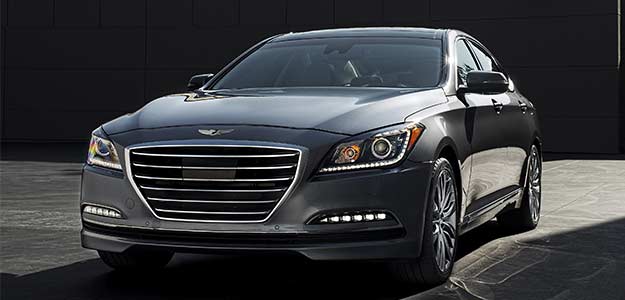
First, this redesigned Genesis looks much more distinctive, inside and out. The new Hyundai has the length and tailoring of a big European sedan, drawing inspiration from the HCD-14 Genesis concept car. It speaks the brand's evolving design language, called "Fluidic Sculpture 2.0," which makes me think of those mischievous cherubs urinating in a fountain. But you can't help but look at the handsome, flowing lines of this family sedan.
Hyundai still isn't shy about borrowing; it might as well pay royalties to Audi for the Genesis' ribbed, single-frame grille. It also nabs Land Rover-style puddle lamps that beam a visual welcome mat outside the driver and front passenger doors - in this case, an image of the winged Genesis logo (itself reminiscent of Aston Martin's).
Inside, the Genesis combines space with newfound swagger. The 1o8 cubic feet of interior volume easily outstrips all midsize competitors, including the BMW 5 Series, Cadillac CTS, Mercedes E-Class and Audi A6. The trunk is equally enormous and smartly finished, and hides a full-size spare tire. A Smart Trunk feature pops the lid when you stand behind the locked car for roughly three seconds with the keyfob in your pocket, without requiring an under-bumper foot waggle as with Fords.
The well-upholstered front leather seats feature heat, ventilation, a massage ...(Continued on next page) function and a powered thigh cushion; the steering wheel is heated. My test car featured matte-finish black timber interior trim that looks a bit like charred firewood, along with touches of real aluminum.
Hyundai claims one technology first: Because high interior carbon dioxide levels can make occupants drowsy, a CO 2 sensor pumps in fresh ambient air when carbon dioxide levels exceed 2,000 parts per million.
Automatic emergency braking can halt the Hyundai when it recognizes an impending collision or unsafe closing speed.
With the Genesis' interior luxury now fully legitimate, Hyundai was clearly determined to stop faking the driving experience. It's hard to overstate how much better this car drives than the previous version.
The thorough changes produce a far quieter, better-riding and sharper-handling sedan. The suspension doesn't have to mask the chassis' weakness with supersoft tuning that oozes over every ripple and bump. Instead, the car feels professional and confident. Even with standard 18-inch wheels - 19-inchers are available - the Genesis clung to curves at speeds few owners will attempt.
The advantages of a rear-drive car include superior weight balance, and the Genesis delivers with 52 percent of its mass up front, 48 percent in the rear.
Rear-drive luxury sedans tend to scare off Northerners, even though modern rear-drive cars, if properly equipped with winter tires, handle surprisingly well in the snow. Bowing to demand, the 2015 Genesis offers all-wheel drive for the first time.
I tested that winter-friendly 3.8L AWD version, which starts at $41,450. That's $2,500 more than the standard rear-drive Genesis; the upgrade includes a heated steering wheel, rear seat warmers and headlamp washers.
Both versions come with a 3.8-liter V6, now with direct injection. With 311 horsepower, this reworked engine offers more standard power than any competitor except the Infiniti M35. Spurred by either a foot to the floor or the paddle shifters, the eight-speed transmission lets the V6 charge to its redline of 6,500 rpm before it upshifts, maximizing power. There's less reason now to spring for the optional V8.
If you do, the 5-liter Tau V8 delivers powerfully, with 420 horses and 383 pound-feet of torque. Offered only with rear drive, the 5.0L model starts at $52,450; it is $55,700 with the Ultimate Package, which adds an active suspension, Lexicon audio and every available option.
My six-cylinder test car reached $52,450 after being crammed with $11,000 worth of option packages (Signature, Tech and Ultimate). Some image-conscious buyers will surely still flinch at a $50,000 Hyundai, no matter how well it is executed.
Other people will see a nearly full-size sedan - roughly three inches shorter than a BMW 750i - that's priced closer to loaded compact cars from BMW, Mercedes or Audi.
Over the last decade, Hyundai has learned from the masters, beginning with the mainstream and now applying lessons gleaned from the Germans. Judging from the results, brands like Acura, Buick and Lincoln might set their pride aside and start taking lessons from Hyundai.
© 2014, The New York Times News Service

-
The Curious Case of Equitas Small Finance Bank And A CEO Who Quit For Stock

PN Vasudevan believes persistent investor concerns over a perceived conflict of interest had become a governance overhang on Equitas Small Finance Bank's stock, even as the lender improved profitability and asset quality.
-
Talking Points This Week: AI Cash Burn, A Tiger Comeback And An India That Still Finds Its Own Path
India is not immune to higher oil or tighter global liquidity, yet its earnings base is broader, its domestic policy levers are still available.
-
Foreign Investors Own Half Of HDFC Bank and ICICI Bank. An LTCG Cut Could Matter Most Here
Foreign portfolio investors have US$115 billion parked in HDFC Bank, ICICI Bank. If the government cuts long-term capital gains tax, Jefferies says returning foreign money could land here first.
-
'Never Seen This Level Of Negativity': Sandeep Tandon Says The Next Rally May Be Closer Than You Think
Veteran investor Sandeep Tandon says foreign selling is easing, large-caps are due a comeback and mid-caps are crowded, while he turns positive on gold, power and pharma this Diwali.
-
Indians Stay With Family, Not In Hotels | The Reason Why
India still lacks enough clean, reliable and affordable hotels for budget-conscious travellers.
-
The Economic Imperative: Analysing The Material Driving Force Behind India-Canada Strategic Reset
This economic complementarity is further reinforced by deep institutional investment ties and talent mobility, which form the bedrock of the bilateral framework.
-
Medicine Pricing: Where Must Profit Stop?
India must confront excessive margins, hidden incentives and regulatory gaps that threaten the integrity of medicine.
-
Why Amazon And Flipkart Are Struggling To Beat Meesho In India's Smaller Cities
With 274 million users and lowest-cost logistics, Meesho is defending its value commerce crown against giants like Amazon and Flipkart.
-
High US Salaries, No Green Card Certainty: The Financial Calculation Facing Indian H-1B Families
The suspension of PERM processing at eight technology employers does not cancel existing H-1B visas. What it does is force a question many Indian families have been avoiding: is the US salary worth tying your career and family plans to one employer?
-
Swiggy vs Eternal: Food Delivery's Two Rivals Are No Longer In The Same Race
Eternal is building a private AI assistant, dark.ai. Swiggy is still working out how to make Instamart pay, with an operating loss of Rs 895 crore in the July-September quarter while Blinkit stayed profitable.










