Curbs On Panel Imports Will Hurt Solar Power Demand, Hero Future Energies Says
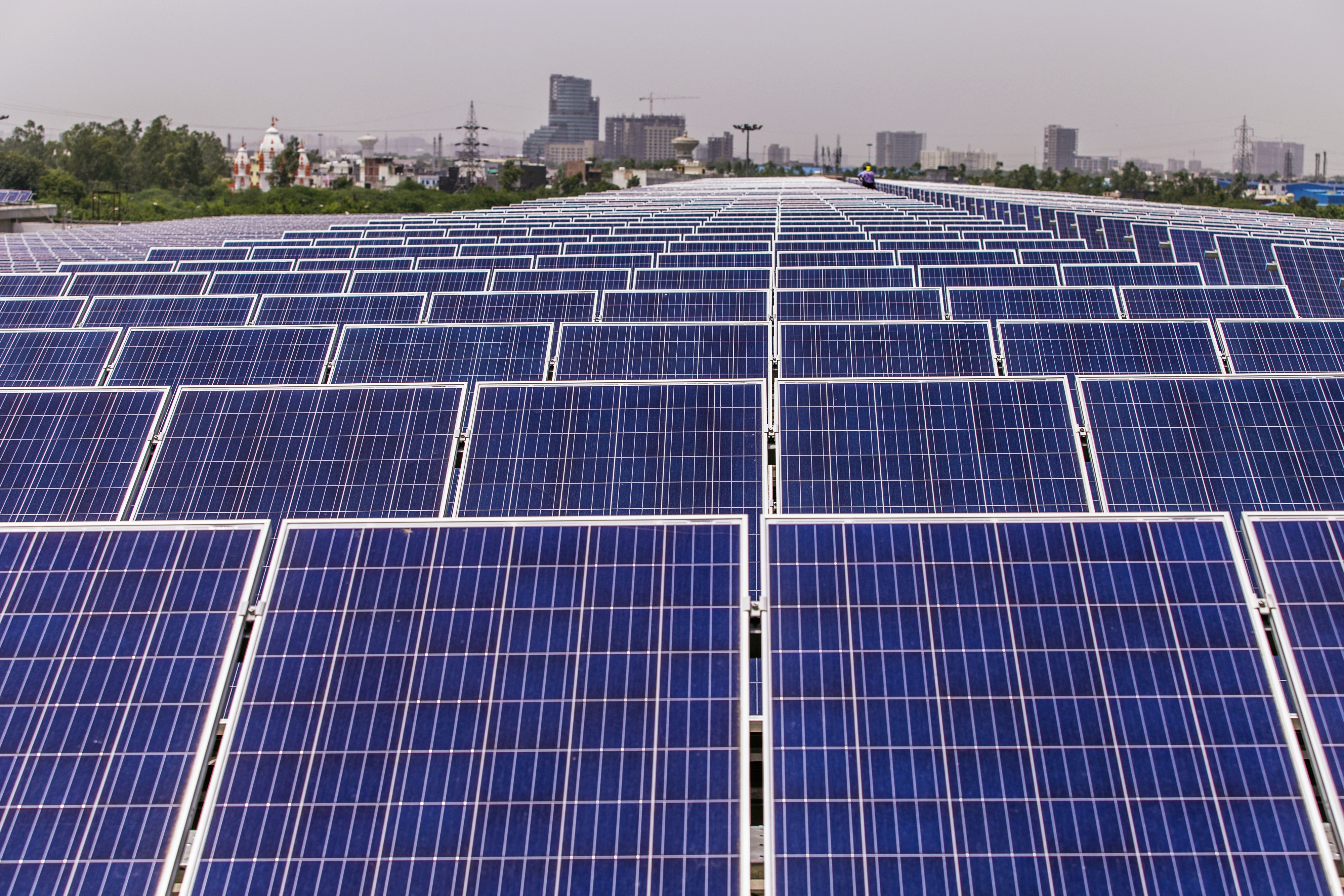
The renewable energy producer that quoted one of India's lowest solar tariffs is worried that a 70 percent safeguard duty suggested on Chinese solar panel imports will increase prices to a level where states may not want to buy in a surplus market.
“Today, states are used to buying affordable power at Rs 2.5 per unit and suddenly with a 70 percent safeguard duty on panels, it will go up to Rs 3.7-3.9 per unit,” Sunil Jain, chief executive officer at Hero Future Energies, told BloombergQuint in an interview. “It is a huge jump. I don't know why states would buy because today we have surplus energy.”
The Directorate General of Safeguards Duty suggested a 70 percent safeguards duty on solar panel imports from China and Malaysia to protect the domestic industry. CRISIL estimated that a duty at that rate will increase project costs by about 25 percent. That's because solar modules contribute about half the costs and developers meet 84 percent of the demand through imports.
Also Read: India Is Said to Consider 7.5% Tariff on Imported Solar Panels
Lower panel costs allowed power producers to quote cheaper tariffs to win bids as India targets to increase renewable energy capacity threefold to 175 gigawatts by 2022. In December, Hero Future Energies, part of the Hero Group, won Solar Energy Corporation of India's tender for 300 megawatts of the 500-MW Bhadla Solar Park Phase III-Rajasthan, quoting Rs 2.47 a unit—just above the lowest tariff of Rs 2.44 a unit quoted in May.
The company has 436 MW of commissioned wind projects with an additional pipeline of 500 MW, and 203 MW of commissioned solar farm with an additional 500 MW under construction. It plans to reach 1,250 MW in renewable energy capacity by March-end.
“Project costs will go up and so will the tariffs after the safeguard duty. How will they sell power?” Jain said. “Will states be convinced by the government to buy power? I don't think that the Ministry (of New and Renewable Energy) will jeopardise the Prime Minister's vision of 175 GW of renewable by 2022.”
A “fine balancing act” is needed, Jain said. “A 10 percent safeguard duty is better as it will increase the tariff by 10-15 paise which is affordable.” Solar power developers met Power Minister RK Singh, who assured that the projects awarded before the proposed safeguard duty will be exempted.
Pitches For Sops In Budget
Jain pitched for more incentives for solar power developers in the budget. The government should allocate more capital for solar parks. It also needs to give incentives to distribution companies to buy more renewable power, including wind energy.
“It is going to be one of the worst years for the wind sector. I don't think we will cross 1,000 MW (in new capacity) and that is also a spillover of some previous projects,” he said. “Otherwise, it will be a washout, compared to 5,000 MW previous year. I am not seeing a great future in the coming year as well.”
Also Read: Economic Survey: Renegotiating Power Pacts Will Disrupt Renewable Energy Sector
Total auctions by state and central governments have hardly touched 2,500 MW this year. “Only 1000 MW will come up from those (central) projects, and you may get another 500 MW from states.” For the industry to sustain, they need a consistent pipeline of 6,000-8,000 MW a year. “That is why we need to incentivise state discoms to encourage them to come out with tenders.”
(Corrects an earlier version that misstated that Hero Future Energies quoted the lowest solar tariff)

-
Gold Is Rs 22,000 Cheaper Than A Month Ago. Should You Buy Amid The Wedding Season?

Gold's potential slide to $3,500 could save around Rs 4,700 per 10 grams, but a soft inflation print could just as easily push prices back up. One way to split the risk is to buy in parts, some now and the rest after the Fed's Dec. 9 decision.
-
AI Agents Are Gaining Power. Who Governs Them?
Artificial intelligence agents promise to transform productivity by moving machines from assisting decisions to executing them. But as organisations delegate greater authority to these AI-agents, they must first establish who controls that authority and who remains accountable when things go wrong.
-
Why Swapping Your Old Gold Can Trigger A Rs 5 Lakh Tax Bill, And How You Can Avoid It Legally
Swapping old gold for new is taxed as a sale and a fresh purchase. Getting your own gold remade can cut most of that bill, though it has its own costs.
-
The AI Trade is Done. The Real Opportunity for Investors Starts in 2027 | Unhedged Position
As pureplay AI stocks plunge and circular, capex-led financing unwinds, 2027 is set to be a year of reckoning for AI companies. Yet the bust clears the way for a better opportunity for investors in 2027 -- shifting the spotlight from AI builders to the companies using AI.
-
Leadership As Mission: Why The Age Of AI Demands More Human Leadership
Debjani Ghosh examines how AI is changing leadership, arguing that its success must be measured by its impact on people and the accountability of those guiding its use.
-
We May Need Another Tukaram Mundhe To Fight Air Pollution | The Reason Why
Developers may install basic measures such as sprinklers and green nets, resume work, and continue violating rules when this equipment stops working.
-
Extracting Value From Battery Scrap Could Be Challenging For India | The Reason Why
A discarded lithium-ion battery still contains valuable materials such as lithium, nickel and cobalt. These can be recovered and reused. When such batteries are crushed and shredded, they produce a dark powder called black mass.
-
One El Nino, India Can Handle. Two Could Break The Granary
India's grain stocks can absorb one bad year, but a second El Nino could drain the buffer in two to three years, economists say.
-
India's Troika Of Good Luck | Joining The Dots
As Jensen Huang's exit drags Nvidia down, a cooling AI trade and resilient earnings have revived investor interest in India. A likely RBI rate hike looms.
-
Talking Points This Week: Leadership Shock At Nvidia, Earnings Strength, And The Fog Over Hormuz
The Anthropic IPO pricing and first trading day, Nvidia's upcoming earnings, and any fresh signals from Iran will set the tone for the following week.









