The World’s Appetite For Solar Panels Is Squeezing Silver Supply
(Bloomberg) -- Changes to solar panel technology are accelerating demand for silver, a phenomenon that's widening a supply deficit for the metal with little additional mine production on the horizon.
Silver, in paste form, provides a conductive layer on the front and the back of silicon solar cells. But the industry is now beginning to make more efficient versions of cells that use a lot more of the metal, which is set to boost already-increasing consumption.
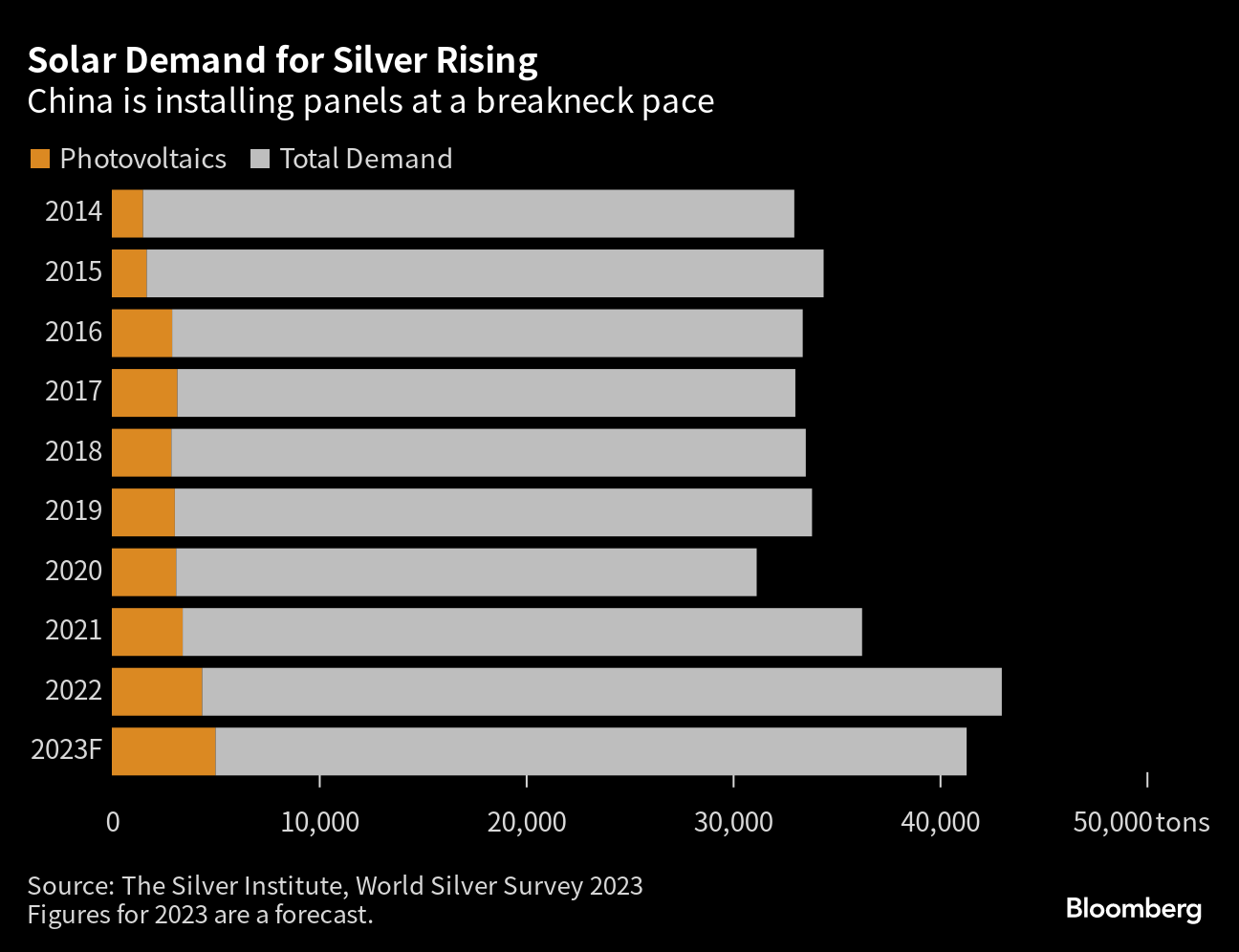
Solar is still a fairly small part of overall silver demand, but it's growing. It's forecast to make up 14% of consumption this year, up from around 5% in 2014, according to a report from The Silver Institute, an industry association. Much of the growth is coming from China, which is on track to install more panels this year than the entire total in the US.
Solar is a “great example of how inelastic demand for silver is,” said Gregor Gregersen, founder of Singapore-based dealer Silver Bullion. The solar industry has evolved to become much more efficient with using smaller amounts of silver, but that's now changing, he said.
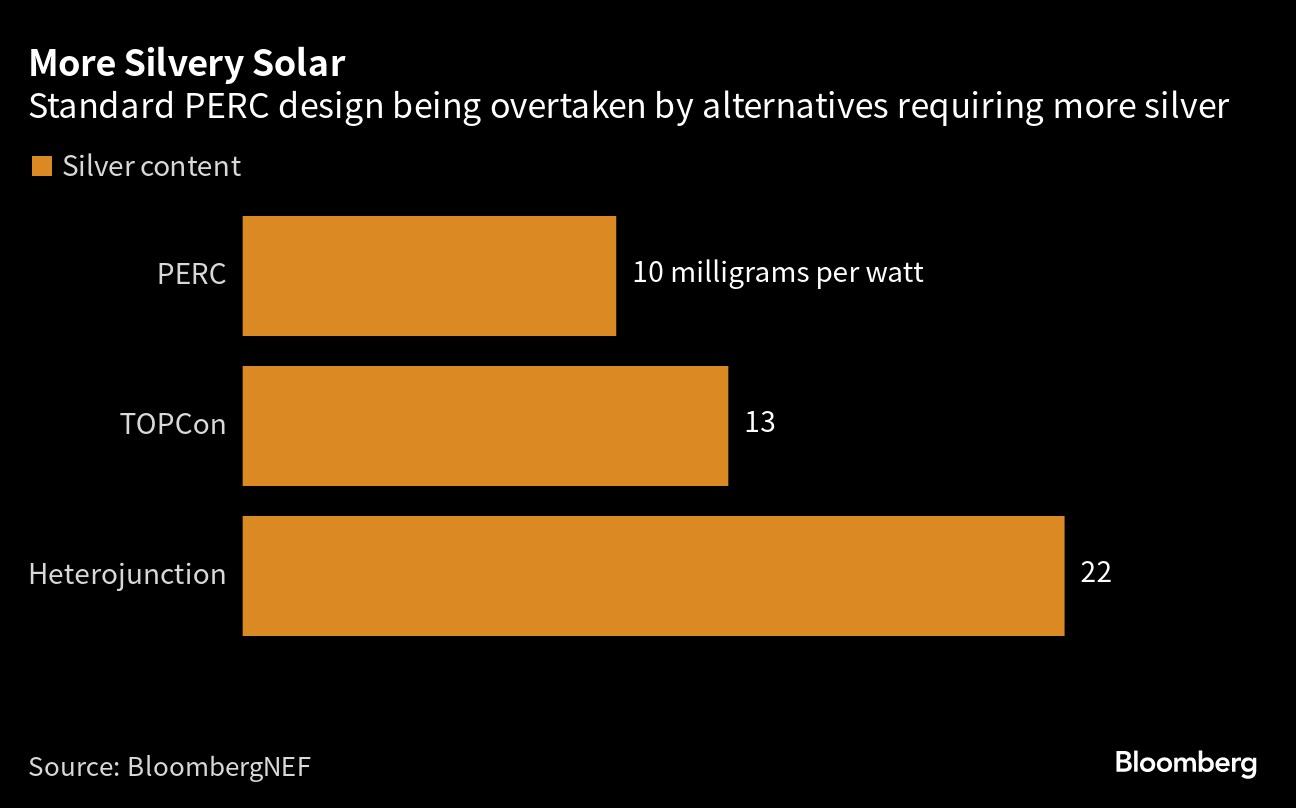
The standard passivated emitter and rear contact cell will likely be overtaken in the next two to three years by tunnel oxide passivated contact and heterojunction structures, according to BloombergNEF. While PERC cells need about 10 milligrams of silver per watt, TOPCon cells require 13 milligrams and heterojunction 22 milligrams.
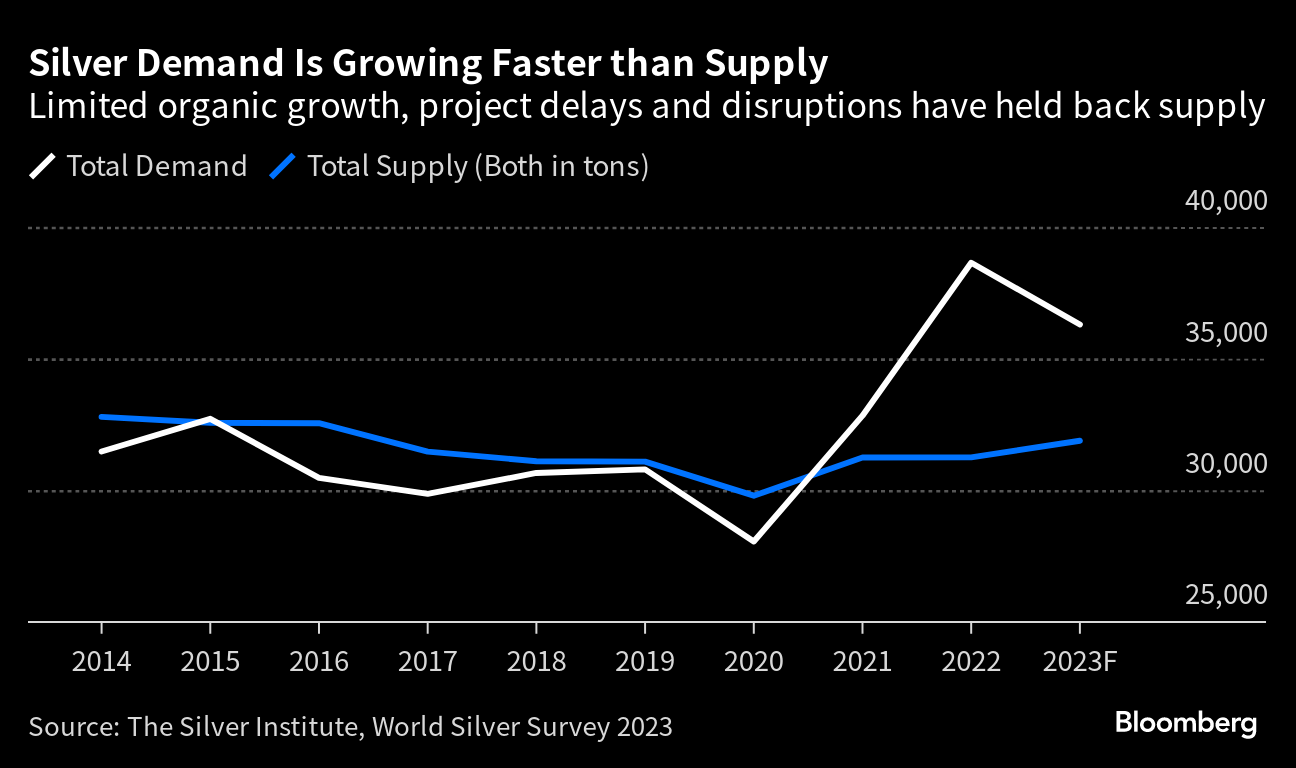
At the same time, supply is starting to look tight. It was flat last year, even as demand rose by nearly a fifth, figures from The Silver Institute show. This year, production is forecast to increase by 2% while industrial consumption climbs 4%.
The trouble for silver buyers is that cranking up supply is far from easy, given the rarity of primary mines. About 80% of supply of the metal comes from lead, zinc, copper and gold projects, with silver a by-product.
And in an environment where miners are already reluctant to commit to large new projects, lower margins in silver compared with other precious and industrial metals mean positive price signals aren't enough to crank up output. Even newly approved projects could be a decade away from production.
The result is a strain on supply so significant that a study from the University of New South Wales forecasts the solar sector could exhaust between 85–98% of global silver reserves by 2050. The volumes of silver used per cell will increase and it could take about five to 10 years to bring them back to current levels, according to Brett Hallam, one of the authors of the paper.
Chinese solar companies, however, are actively exploring using cheaper alternatives like electroplated copper, though so far results have been mixed. Technologies that use cheaper metals are now sufficiently advanced, and will soon be put into mass production once silver prices surge, according to Zhong Baoshen, chairman of Longi Green Energy Technology Co., the world's biggest panel manufacturer.
Silver is currently trading at about $22.70 an ounce. It's dropped around 5% this year, but is well above where it was before surging in 2020 as the pandemic buoyed demand.
“Substitution will look more interesting when silver's at say $30 an ounce as opposed to $22 to $23,” said Philip Klapwijk, managing director of Hong Kong-based consultant Precious Metals Insights Ltd. and one of the authors of the silver institute report. There won't be a “doomsday scenario” where we run out of silver, but “the market will restore an equilibrium at a higher price,” he said.
--With assistance from Dan Murtaugh.
More stories like this are available on bloomberg.com
©2023 Bloomberg L.P.

-
The Economic Imperative: Analysing The Material Driving Force Behind India-Canada Strategic Reset

This economic complementarity is further reinforced by deep institutional investment ties and talent mobility, which form the bedrock of the bilateral framework.
-
Medicine Pricing: Where Must Profit Stop?
India must confront excessive margins, hidden incentives and regulatory gaps that threaten the integrity of medicine.
-
Why Amazon And Flipkart Are Struggling To Beat Meesho In India's Smaller Cities
With 274 million users and lowest-cost logistics, Meesho is defending its value commerce crown against giants like Amazon and Flipkart.
-
High US Salaries, No Green Card Certainty: The Financial Calculation Facing Indian H-1B Families
The suspension of PERM processing at eight technology employers does not cancel existing H-1B visas. What it does is force a question many Indian families have been avoiding: is the US salary worth tying your career and family plans to one employer?
-
Swiggy vs Eternal: Food Delivery's Two Rivals Are No Longer In The Same Race
Eternal is building a private AI assistant, dark.ai. Swiggy is still working out how to make Instamart pay, with an operating loss of Rs 895 crore in the July-September quarter while Blinkit stayed profitable.
-
Where You Live Shapes How You Get To Work | The Reason Why
Two-wheelers are the most popular way to get to work in India, accounting for nearly 43% of workplace commutes.
-
Unhedged Position: Can India See An Indonesia-Style Time Correction?
The Nifty is trading below levels it first clocked in 2024. Is there, then, as I have suggested in the headline, potential that the current time correction drags on painfully for the next three-five, even ten years?
-
Navigating Friction And Energy Realities: An Analysis Of Marco Rubio's October Visit To India
Occurring at a critical juncture marked by stalled trade negotiations and escalating geopolitical pressures over global energy supplies, the visit offers a profound window into modern US-India relations.
-
India Exports Capital. Why Not Export Trusteeship?
The big question, then, is whether India can build an institution that global borrowers, investors, banks, and lawyers can trust, even without an Indian connection.
-
France's Economy & Politics Are In Crisis | The Reason Why
Let's look at how the French economy and politics evolved under Nicolas Sarkozy, Franois Hollande and Emmanuel Macron.










