The Value Of A Petal
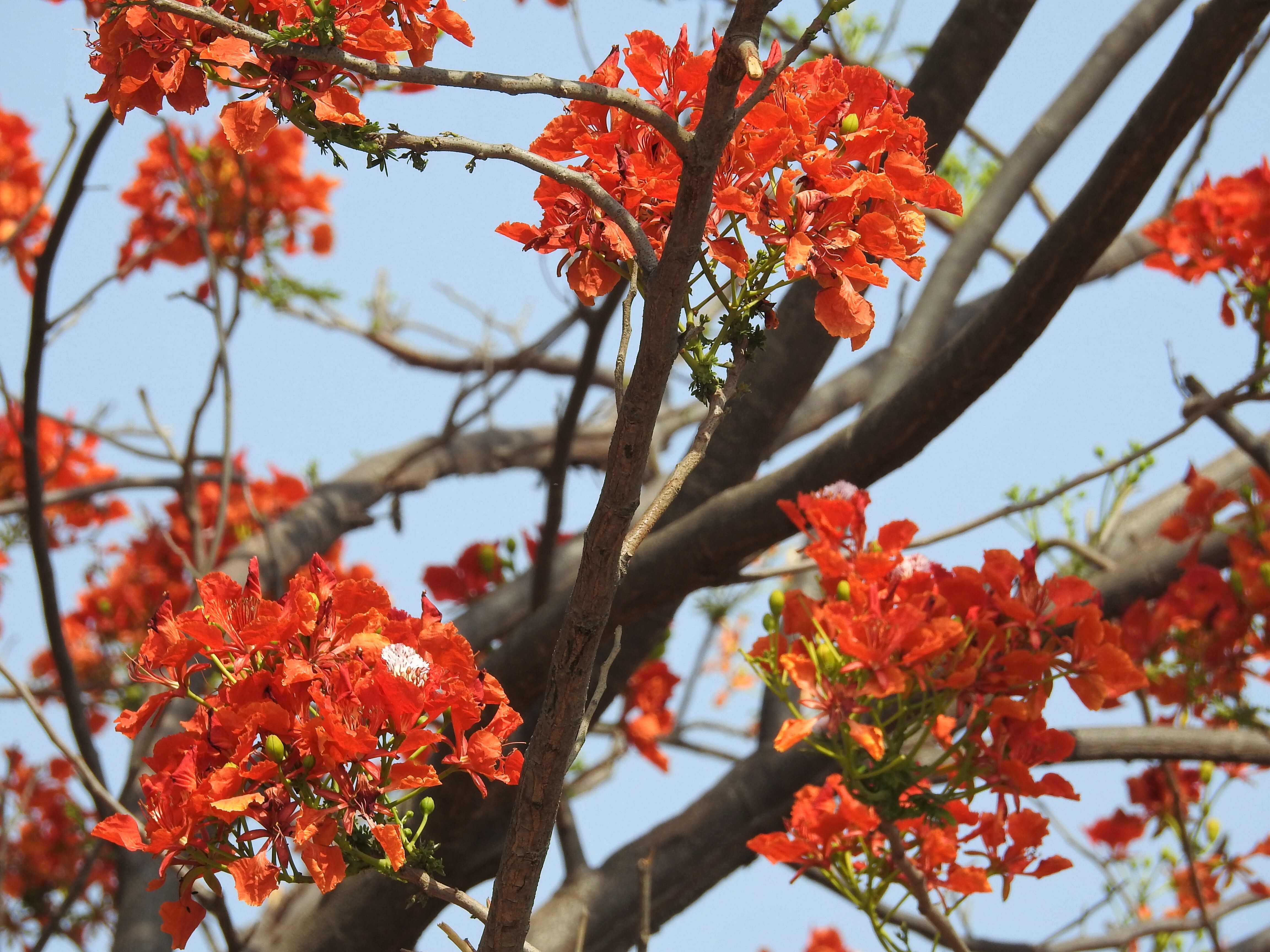
Four clean, fiery-orange petals. And one petal in neat rebellion – not a solid orange, but yellow streaked with red morse-code-like rows of dots and dashes. This is the Gulmohar flower, Delonix regia, a tree from Madagascar that is now naturalised in India. The dotted and dashed petal is the Rani (queen) petal. That's the one we would pop into our mouths as kids when the tree blossomed in May. Children instinctively seemed to know that the tangy flower is edible – and standing below the Gulmohar was enough to get the snack, which felt better than it tasted. Fallen flowers decorated the ground like crayon shavings, they were beautiful and slightly forbidden, outside one's daily diet. Groups of children out to play also knew that if you gently press the buds of a crepe myrtle flower (Lagerstroemia indica, an Indian native tree which is also flowering now), the bloom would emerge like a time-lapse video of a flower opening, something one may not have seen in real life.

Ecological Grief
Childhoods touched by nature assume great importance today, because worldwide, adults find that ecological landscapes they know have disappeared. This is true for disparate groups of people. Aboriginal people in Australia are depressed, faced by climate change and separation from their traditional lands.
So are the people in Indian cities who no longer see House Sparrows in their windows nor earthworms in their soil.

Some scholars have called this phenomenon ‘ecological grief'. This is not just the sense of having lost a way of life, but also a feeling that way will not return. A recent United Nations backed report, compiled by the Intergovernmental Science-Policy Platform on Biodiversity and Ecosystem Services, has put a number to the loss – 75 percent of land area is altered, 66 percent of the vast ocean is facing human-led impacts, and 85 percent of wetland areas are gone.
The report, which studied more than 15,000 sources worldwide, clarifies two things immediately. First, it is not just forests and wetlands far from me and you that are changing. These are places we know; places over which cities have been built on; places like Mumbai's mangroves which the city (or bullet trains) intend to build over. Official parley doesn't call it cutting of trees: instead, more procedural, impersonal terms such as ‘forest diversion' or ‘tree removal' are used.

However, environmental grief mingles beautifully with nostalgia. All too often we romanticise losses. Colony trees twisting near our gates are gone because the old-fashioned house had to come down, parks became parking lots, local wetland was built over because concretisation seemed more efficient. Thus, the loss becomes justifiable, another hard fact of hard lives. But this leads to the second point the IPBES report stresses on. The loss of nature is a direct loss to our habitation and lives. Services such as soil quality, crop pollination, buffers against natural hazard (trees that hold soil in the onslaught of storms, for instance) and filtration of water and air are being lost. The problem is that these knowledge-systems lose perspective when faced by the idea of progress.

Natural Shields To Heat
The nation needs to progress, and so we need roads, cities and bullet trains. Or so we are told by officials not capable of thinking beyond boxes of construction. Our international commitments state we will achieve sustainable development. Clearly, we will be regressing, not progressing, if we don't safeguard the environment. Yet, any form of intersectionality in our planning is sorely missing, as most answers to problems are seen as falling in the realm of technology. A recent example is the government's new National Cooling Plan. The plan acknowledges that cooling is a developmental need. This is a welcome step. In this hot country, finding ways (and means) to be cool often depicts how well you are doing; inversely it can show how much you may suffer in a lifetime. Yet the plan restricts itself to the ambit of technological solutions like retrofitting buildings or making better air conditioners. While this is important, it also misses a larger point.
We are in the middle of an environmental emergency, and the infrastructure of nature should be built into all our planning.
Community cooling facilities should have rings of trees. Trees lower tarmac temperature by five to 10 degrees. Trees are indispensable in town and highway planning and in building heat action or cooling plans. Cities need to be planned with feasibility studies that analyse the cost of losing trees and open spaces.

Also Read: Rebuild Nature's Cathedral
Despite everything, from our wild spaces, good news continues to trickle in. Three new snake species have been found in India. One is a venomous viper, Trimeresurus arunachalensis, that looks just like fallen leaves from Arunachal Pradesh. The other is an impossibly slender snake with a head like a leaf—the Ahaetulla laudankia, a vine snake from Odisha. And yet another snake, Smithophis atemporalis, a striped serpent that likes water, has been found in Mizoram.
Back To The Gulmohar

Blossoming once a year in summer, the Gulmohar is currently all over social media, adding excitement to the searing air, and creating paintings out of cityscapes. There may be some who may never know the Gulmohar's Rani petal, because there is always a tree-cutting plan afoot near us, justified in the choicest words. Perhaps some may be better off without knowing the value of this petal, its sour taste, the long wait for it, its neat buds. After all, who wants more grief in their lives? But not looking at Nature—or more accurately, being denied the chance to look at it—means she will never care for a vine snake, nor mourn its loss.
And while nature undeniably looks good on postcards or in obituaries, the real thing—like actually living life instead of escaping into virtual reality—is always better.
Neha Sinha is with the Bombay Natural History Society. Views expressed are personal.
The views expressed here are those of the author and do not necessarily represent the views of BloombergQuint or its editorial team.

-
AI Bias In Investing Cannot Be Eliminated, But It Can Be Governed

Framing is a particularly important example as identical financial information presented in terms of gains rather than losses can lead an LLM to reach a different assessment.
-
Joining The Dots | Dark Skies, Steady Diya: Why Hope Holds This Diwali
With war, a weak rupee and foreign outflows weighing on sentiment, policymakers at the NDTV World Summit and market veterans at NDTV Profit Ignite: Diwali Edition offered the same advice: stay invested and filter out the noise.
-
The Curious Case of Equitas Small Finance Bank And A CEO Who Quit For Stock
PN Vasudevan believes persistent investor concerns over a perceived conflict of interest had become a governance overhang on Equitas Small Finance Bank's stock, even as the lender improved profitability and asset quality.
-
Talking Points This Week: AI Cash Burn, A Tiger Comeback And An India That Still Finds Its Own Path
India is not immune to higher oil or tighter global liquidity, yet its earnings base is broader, its domestic policy levers are still available.
-
Foreign Investors Own Half Of HDFC Bank and ICICI Bank. An LTCG Cut Could Matter Most Here
Foreign portfolio investors have US$115 billion parked in HDFC Bank, ICICI Bank. If the government cuts long-term capital gains tax, Jefferies says returning foreign money could land here first.
-
'Never Seen This Level Of Negativity': Sandeep Tandon Says The Next Rally May Be Closer Than You Think
Veteran investor Sandeep Tandon says foreign selling is easing, large-caps are due a comeback and mid-caps are crowded, while he turns positive on gold, power and pharma this Diwali.
-
Indians Stay With Family, Not In Hotels | The Reason Why
India still lacks enough clean, reliable and affordable hotels for budget-conscious travellers.
-
The Economic Imperative: Analysing The Material Driving Force Behind India-Canada Strategic Reset
This economic complementarity is further reinforced by deep institutional investment ties and talent mobility, which form the bedrock of the bilateral framework.
-
Medicine Pricing: Where Must Profit Stop?
India must confront excessive margins, hidden incentives and regulatory gaps that threaten the integrity of medicine.
-
Why Amazon And Flipkart Are Struggling To Beat Meesho In India's Smaller Cities
With 274 million users and lowest-cost logistics, Meesho is defending its value commerce crown against giants like Amazon and Flipkart.










