The ‘Mathematics’ Behind Early Elections
A recent article (12 Reasons Why Lok Sabha Elections Could Happen In Next 100 Days) by Rajesh Jain, the architect of BJP's Mission 272 electoral campaign in 2014, has captured the imagination of political pundits, analysts, and leaders. The article lists out six reasons for the 2019 Lok Sabha elections to be advanced and held as early as in May 2018. The article goes on to draw six inferences from recent events to substantiate this claim. The first and foremost reason the article cites as a rationale for early elections is a declining trend in the Bharatiya Janata Party's electoral performance since 2014 and hence an early election is the BJP's best bet to arrest its loss. While Rajesh Jain's arguments are intuitive and observational, what does data tell us about a seemingly declining trend for the BJP?
There have been 15 state elections held in the four years since the 2014 general election. One can impute BJP's potential performance based on what economists call ‘revealed preferences' of voters in these state elections. This is very different from electoral surveys where voters are expected to answer questions to a pollster, which is fraught with various flaws, intentional or otherwise. While the usual caveats of how state elections differ from parliament elections etc. apply, a revealed preference analysis of voter choices in state elections is a reasonable method to gauge the trend of BJP's popularity with voters, after its 2014 victory.
In the 2014 general elections, the BJP won 282 of the total of 543 seats in the Lok Sabha, a clear majority. Subsequent to the 2014 general elections, there have been state elections held in 15 of India's 29 states. Each Lok Sabha seat corresponds to a fixed set of assembly constituencies in each state. So, one can aggregate assembly constituencies to impute potential Lok Sabha seats.
The BJP won 191 Lok Sabha seats in these 15 states in the 2014 elections but its performance in the subsequent state elections corresponds to a tally of 146 seats, a loss of 45 Lok Sabha seats.
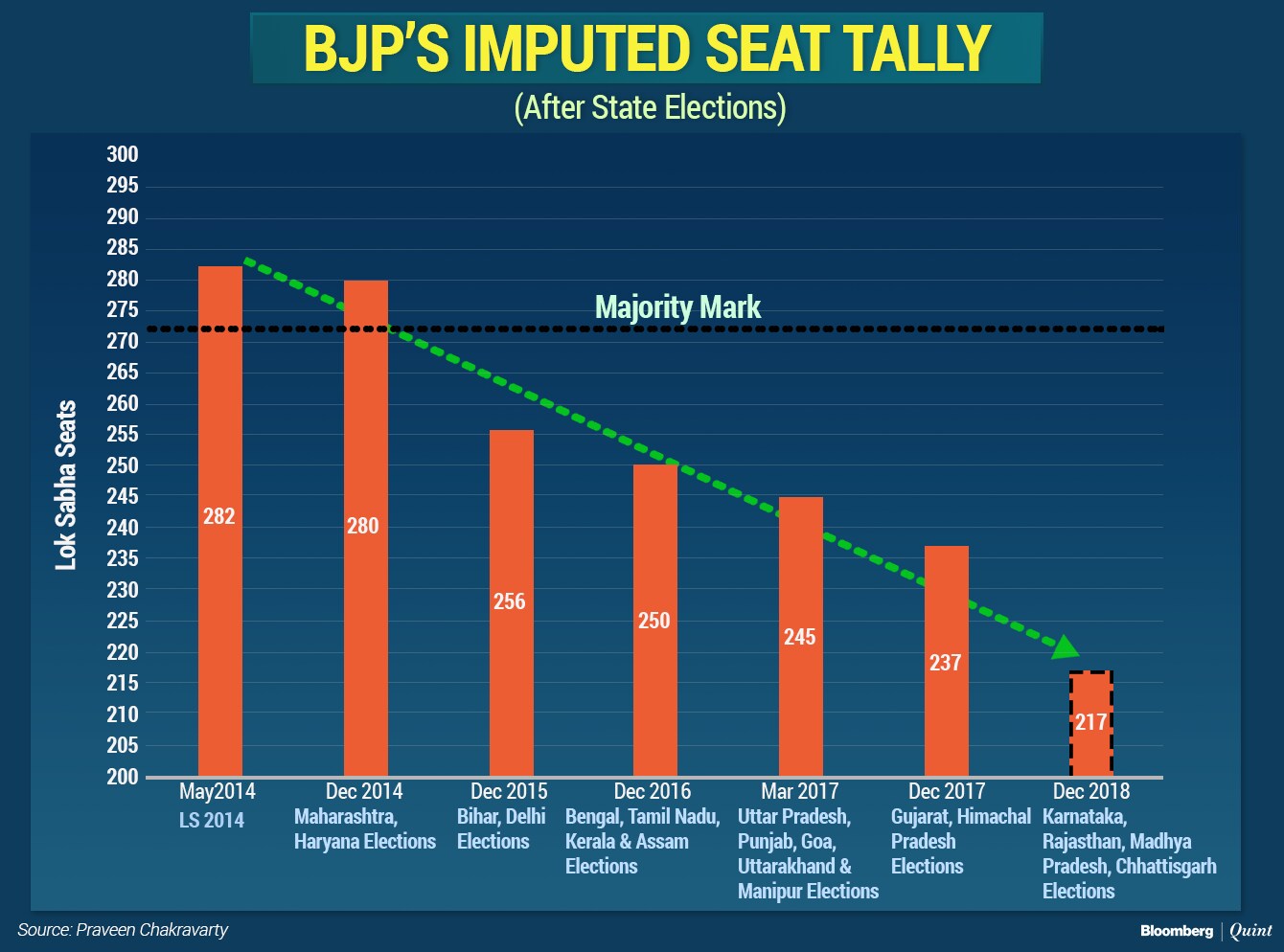
In other words, after the 15 state elections, the BJP's imputed Lok Sabha seat tally is 237, 45 less than its 2014 tally of 282 seats. Thus, if the state elections are any harbinger for the next general elections, then the BJP is certainly on a declining trend.
This declining trend is further confirmed by the BJP's vote share and seat share performance in these state elections.
Even in terms of vote share, the BJP secured a 39 percent vote share in these 15 states in the 2014 elections which has now fallen to 29 percent. That is, in exactly the same constituencies, 39 out of 100 voters chose the BJP in 2014 while only 29 out of 100 did, in the subsequent elections. Thus, data supports the claim made in the article about BJP's declining support from its 2014 high.
Further, four large states are scheduled to go to polls later this year. These four states (Karnataka, Rajasthan, Madhya Pradesh and Chhattisgarh) accounted for a big 79 seats for the BJP in the 2014 elections. If the current declining trend of the BJP continues and is extrapolated to these four states, then the BJP can lose 20 more Lok Sabha seats in these four states which will bring its total imputed Lok Sabha tally down to 217 seats by the end of this state election cycle. The chart below shows how this declining trend for the BJP with time.
Also Read: Gujarat, Style, Substance And BJP Leadership
The obvious counter to this analysis will be the argument that voters vote differently for state elections and national elections. There is actually no empirical evidence to support this assertion. To the contrary, my research shows that when state and national elections are held simultaneously, 77 percent of voters choose the same party for both. If, as the data shows, the BJP is on a steady declining trend to lose its 2014 majority and as research shows, simultaneous elections can induce voters to vote for the same party, then the rationale for advancing national elections to be held along with other major state elections sounds entirely logical. There is strong electoral math support for the BJP to hold early and simultaneous elections to arrest its decline.
Praveen Chakravarty is Contributing Editor at BloombergQuint. He is an economist, Senior Fellow at IDFC Institute and Founding Trustee, IndiaSpend.
The views expressed here are those of the author's and do not necessarily represent the views of BloombergQuint or its editorial team.

-
One El Nino, India Can Handle. Two Could Break The Granary

India's grain stocks can absorb one bad year, but a second El Nino could drain the buffer in two to three years, economists say.
-
India's Troika Of Good Luck | Joining The Dots
As Jensen Huang's exit drags Nvidia down, a cooling AI trade and resilient earnings have revived investor interest in India. A likely RBI rate hike looms.
-
Talking Points This Week: Leadership Shock At Nvidia, Earnings Strength, And The Fog Over Hormuz
The Anthropic IPO pricing and first trading day, Nvidia's upcoming earnings, and any fresh signals from Iran will set the tone for the following week.
-
Signature Play: The Classic Cocktail Is Dead. Or Is It?
Classic cocktails are disappearing from India's cocktail menus. But they're still being ordered, taught to bartenders and borrowed from. So, who's really having the last drink?
-
A New Samvat Wishlist: Inclusive Prosperity And Human Development
India has strengthened its economic foundations through infrastructure, digital access and enterprise. Its next growth chapter must deepen productivity, create better livelihoods and widen participation in prosperity.
-
Love, Sex Aur Dhokha: The Audacious Plot To Spy On Jensen Huang
A Taipei dinner, a Singapore chip buyer and a suspected Chinese asset: inside the alleged spy operation that got close to NVIDIA's Jensen Huang.
-
Ten Things I Learnt This Samvat
Patience can be a trap. Cheap stocks can stay cheap. Leverage can wipe you out. What did Samvat 2082 teach us? Niraj Shah writes on 10 lessons from the year gone by.
-
Talking Points This Week: Tech Nerves, FII Buying, And A Faraway Banking Shock
The global markets are not shining this Diwali. The exception in the large markets is, India.
-
Midterm Rally Lasted A Day. The Hard Reality Of A Divided US May Last Two Years | Opinion
Between a contested AI boom, a debt ceiling that arrives in 2027 and a president with every incentive to act alone, the next two years may prove more volatile than the first day's rally suggests.
-
Blue Wave Will Derail the AI Trade but Won't Dismantle the AI Era | Unhedged Position
The Democrats' sweep of the US Congress will see politics collide with economic forces both over the long and short term.