Tesla’s Annual EV Sales Drop For First Time In Over A Decade

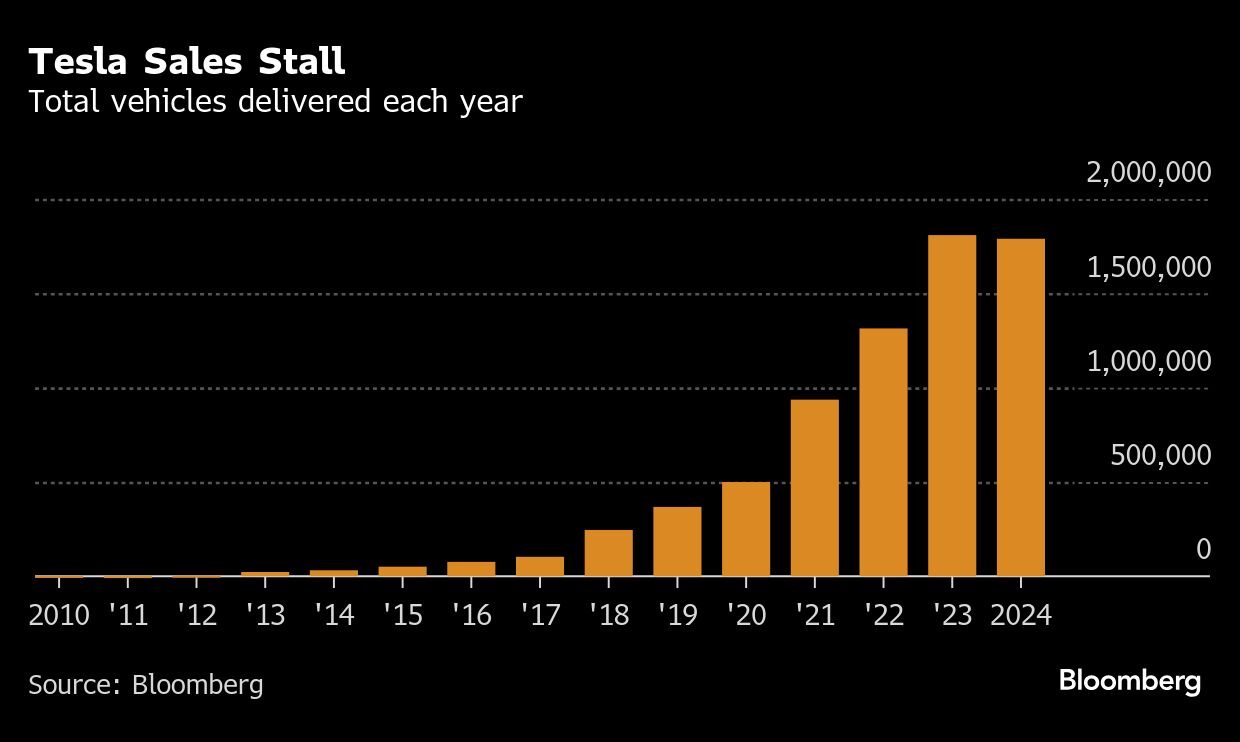
Tesla Inc.'s annual vehicle sales dropped for the first time in more than a decade despite a year-end push that sent deliveries to a record in the fourth quarter.
The Elon Musk-led company sold 1.79 million vehicles last year, it said Thursday, which was slightly less than what it delivered in 2023 and also below analysts' consensus estimate.
The results offer a sobering reminder of the real-world challenges for EV makers, even as hype around driverless cars and Musk's closeness with President-elect Donald Trump have sent Tesla's stock soaring in recent months. Lukewarm consumer demand is weighing on sales of electric cars, an issue that could be exacerbated by Trump's push to rein in EV incentives.
Tesla's shares tumbled after the results, falling 4.5% to $385.72 as of 9:32 a.m. in New York. The stock rose 63% in 2024.
For the quarter ended Dec. 31, it delivered 495,570 vehicles, missing the 512,277 analysts had projected. It needed to sell nearly 515,000 vehicles in the quarter to meet its goal for “slight” growth in the full year.
Tesla faced a series of setbacks earlier in the year, including an arson attack at its Berlin factory, shipping diversions and an industry-wide slowdown in EV sales. And it has told investors that demand for its all-electrics is between two major growth waves. In April, the Austin-based automaker cut more than 10% of its workforce, including sales staff.
Even so, Tesla said as recently as October that it expected to achieve modest growth in its deliveries for all of 2024.
2025 Growth Projection
Musk told investors on Tesla's latest earnings call that he sees 20% to 30% growth this year, fueled in part by a more affordable vehicle expected to be unveiled in the first half and on the company's autonomous technology. The company has said little about what that new vehicle will look like or what its price will be.
There is already some doubt over the company's ability to achieve Musk's 2025 growth objective, particularly if EV tax credits are rolled back under Trump. The president-elect has been critical of Joe Biden-era EV policies and the EV tax credit, which Musk claimed in July would hurt Tesla in the near term — but hurt Tesla's competitors more.
At the same time, Trump also is expected to loosen federal rules on self-driving vehicles, which could benefit Tesla and its robotaxi ambitions. Musk was a top Republican donor in 2024 and has become part of Trump's inner circle of advisers.
Tesla's Cybertruck drew headlines this week after one of the vehicles exploded outside a Trump hotel in Las Vegas, killing the driver and injuring several others. The Federal Bureau of Investigation is probing the incident and exploring whether there are links with an attack in New Orleans several hours earlier that killed at least 15 people.
Musk said on social media that Tesla determined the Las Vegas blast was caused by something in the bed of the truck and was “unrelated to the vehicle itself.”
The carmaker's combined Model 3 and Model Y vehicle sales category accounted for 471,930 deliveries in the fourth quarter. It also reported that its “other models” category, which includes vehicles such as the Model X, S and Cybertruck saw 23,640 deliveries. It has said that the US and China are its top two markets globally.

-
Indians Stay With Family, Not In Hotels | The Reason Why

India still lacks enough clean, reliable and affordable hotels for budget-conscious travellers.
-
The Economic Imperative: Analysing The Material Driving Force Behind India-Canada Strategic Reset
This economic complementarity is further reinforced by deep institutional investment ties and talent mobility, which form the bedrock of the bilateral framework.
-
Medicine Pricing: Where Must Profit Stop?
India must confront excessive margins, hidden incentives and regulatory gaps that threaten the integrity of medicine.
-
Why Amazon And Flipkart Are Struggling To Beat Meesho In India's Smaller Cities
With 274 million users and lowest-cost logistics, Meesho is defending its value commerce crown against giants like Amazon and Flipkart.
-
High US Salaries, No Green Card Certainty: The Financial Calculation Facing Indian H-1B Families
The suspension of PERM processing at eight technology employers does not cancel existing H-1B visas. What it does is force a question many Indian families have been avoiding: is the US salary worth tying your career and family plans to one employer?
-
Swiggy vs Eternal: Food Delivery's Two Rivals Are No Longer In The Same Race
Eternal is building a private AI assistant, dark.ai. Swiggy is still working out how to make Instamart pay, with an operating loss of Rs 895 crore in the July-September quarter while Blinkit stayed profitable.
-
Where You Live Shapes How You Get To Work | The Reason Why
Two-wheelers are the most popular way to get to work in India, accounting for nearly 43% of workplace commutes.
-
Unhedged Position: Can India See An Indonesia-Style Time Correction?
The Nifty is trading below levels it first clocked in 2024. Is there, then, as I have suggested in the headline, potential that the current time correction drags on painfully for the next three-five, even ten years?
-
Navigating Friction And Energy Realities: An Analysis Of Marco Rubio's October Visit To India
Occurring at a critical juncture marked by stalled trade negotiations and escalating geopolitical pressures over global energy supplies, the visit offers a profound window into modern US-India relations.
-
India Exports Capital. Why Not Export Trusteeship?
The big question, then, is whether India can build an institution that global borrowers, investors, banks, and lawyers can trust, even without an Indian connection.










