Tesla And Detroit’s Automakers Price In A Trump Joyride. Good Luck.
Detroit voted overwhelmingly for Vice President Kamala Harris, but investors in “Detroit” backed President-elect Donald Trump. Shares in General Motors Co. and Ford Motor Co. jumped on news of Trump's election win, with GM reaching a new high for the year and Ford up by almost 6% on Wednesday, more than double the S&P 500 Index's gain. Meanwhile, in that other motor city, Austin, Tesla Inc. has added more than $100 billion to its already enormous market value.
The gains all look questionable, albeit for very different reasons when it comes to Elon Musk's electric vehicle maker.
The positive take on a Trump presidency for Detroit's incumbents revolves mostly around a relaxation of tailpipe emissions standards and tightening of EV incentives. The net result, on this reading, is that these companies get to sell more highly profitable trucks and SUVs with internal combustion engines and needn't sell a rising number of loss-making EVs. Plus, Trump will maintain or increase tariffs on Chinese EVs and perhaps also raise tariffs broadly, hitting other foreign automakers (shares of Mercedes-Benz Group AG and Bayerische Motoren Werke AG were both hit Wednesday). Plus, of course, the corporate tax rate will fall and surging economic growth will boost sluggish car sales. Huzzah.
As with much that surrounds Trump, things may turn out to be a bit more complicated than that.
Say Trump tightens or, enabled by a Republican-controlled Congress, entirely rescinds the consumer tax credit for EVs, along with cleantech manufacturing credits established by President Joe Biden's Inflation Reduction Act. This would actually deepen Detroit's EV losses.
Think of Ford's and GM's EV businesses as startups, similar to Tesla in its first decade as a listed company. Their losses stem primarily from the fact that they are capitalizing the costs of investments in factories and machinery over too few vehicles sold. Automakers as a whole have invested $199 billion in EVs in the US over the past decade, according to Bloomberg Intelligence. GM boasted at its recent analyst day of EV losses having peaked this year and offering a $2 billion to $4 billion tailwind to operating profit next year, with half of that owed to expansion. In other words, what's needed is to sell more EVs in order to reap economies of scale on existing investment. Sure, if they stop investing in EVs come January, then at some point down the line, the drag on returns is alleviated. In the meantime, it would be an earnings bloodbath of write-downs.
Relaxation of tailpipe emissions targets would, of course, offer more scope for Detroit's core product, gas guzzlers. But the targets set by the Biden administration were back-end loaded precisely in order to give Detroit (and the United Auto Workers) time to adjust to a more electrified future. The incremental benefit of easing those targets, therefore, is also back-end loaded. On another front, while Trump will almost certainly have another go at killing California's waiver that allows the state to set its own, more restrictive, tailpipe standards, that would likely be a drawn out affair, muddying the waters for automakers rather than clarifying them, at least in the near term.
Tariffs, similarly, sport two edges. The broad-based tariffs Trump touts would add inflation to a vehicle market that is being held back by average monthly ownership and running costs that have breached $1,000 already (see this). Back in September, AutoZone Inc.'s chief executive stated bluntly on an earnings call that “if we get tariffs, we will pass those tariff costs back to the consumer,” and his will not be the only company doing that. Moreover, with the lion's share of drivers' monthly costs reflecting the lease or loan payment, any upward pressure on interest rates to meet higher prices exacerbates the problem. Needless to say, if Trump makes good on threats of big tariffs on vehicle imports from Mexico, that would hurt US automakers producing more than a million units per year south of the border.
There is also a corrosive aspect to the protectionism that both parties touted in this election. As it is, Detroit has retreated to dependence on Americans' peculiar, by global standards, preference for heavy, expensive models. Further encouragement of that, and discouragement of even relatively nascent forays into EVs, would deepen the disconnect with the rest of the world, where China is making big inroads with cheaper vehicles, especially EVs. The added complication: who wins power in DC in 2028 or 2032. Detroit can ill-afford another decade of U-turns and pivots over the basic question of what powers the wheels.
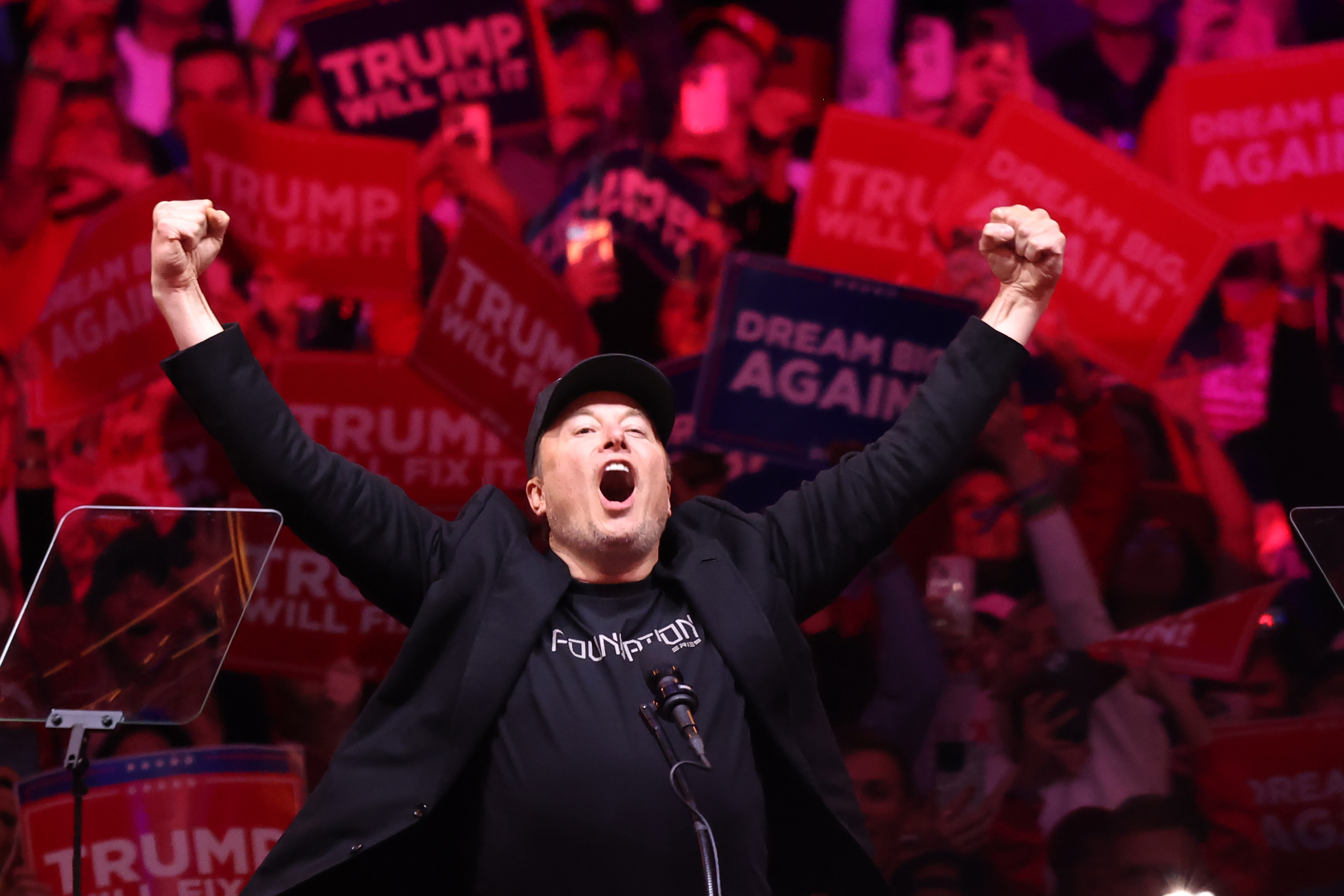
Tesla is immune or indifferent to some of these complications, with no factories in Mexico or gamesmanship around fleet emissions to consider. It would clearly be hurt, however, by the loss of EV incentives, compounding the abrupt slowdown in sales since early 2023. So why the big jump in the stock? Because Tesla's value is now largely a function of potential robotaxi riches. Musk's embrace of Trump, with a possible White House role in the offing, holds out the prospect of laxer regulation of the company's vast experiment in wannabe-autonomous driving on public roads (see this). Is this politics-inflected vibe worth an extra $100 billion or so on top of an existing $800 billion pricing in world domination by Tesla already? Seems like a stretch but, then again, if you're already all in on the idea of Tesla's dominance, maybe not.
To a far lesser extent, there may be some similarly magical thinking at work with GM and Ford, too. The immediate narrative of tax cuts, deregulation and an engine-friendly White House eclipse the nuances. There's a chance Trump won't make good on everything he says. His penchant for bluster and contradiction means that isn't an entirely crazy bet — but it's certainly a gamble.

-
Getting To Work Costs Women More | The Reason Why

It is not just about women paying more than men. It is about women paying much more in cities than in villages.
-
AI Bias In Investing Cannot Be Eliminated, But It Can Be Governed
Framing is a particularly important example as identical financial information presented in terms of gains rather than losses can lead an LLM to reach a different assessment.
-
Joining The Dots | Dark Skies, Steady Diya: Why Hope Holds This Diwali
With war, a weak rupee and foreign outflows weighing on sentiment, policymakers at the NDTV World Summit and market veterans at NDTV Profit Ignite: Diwali Edition offered the same advice: stay invested and filter out the noise.
-
The Curious Case of Equitas Small Finance Bank And A CEO Who Quit For Stock
PN Vasudevan believes persistent investor concerns over a perceived conflict of interest had become a governance overhang on Equitas Small Finance Bank's stock, even as the lender improved profitability and asset quality.
-
Talking Points This Week: AI Cash Burn, A Tiger Comeback And An India That Still Finds Its Own Path
India is not immune to higher oil or tighter global liquidity, yet its earnings base is broader, its domestic policy levers are still available.
-
Foreign Investors Own Half Of HDFC Bank and ICICI Bank. An LTCG Cut Could Matter Most Here
Foreign portfolio investors have US$115 billion parked in HDFC Bank, ICICI Bank. If the government cuts long-term capital gains tax, Jefferies says returning foreign money could land here first.
-
'Never Seen This Level Of Negativity': Sandeep Tandon Says The Next Rally May Be Closer Than You Think
Veteran investor Sandeep Tandon says foreign selling is easing, large-caps are due a comeback and mid-caps are crowded, while he turns positive on gold, power and pharma this Diwali.
-
Indians Stay With Family, Not In Hotels | The Reason Why
India still lacks enough clean, reliable and affordable hotels for budget-conscious travellers.
-
The Economic Imperative: Analysing The Material Driving Force Behind India-Canada Strategic Reset
This economic complementarity is further reinforced by deep institutional investment ties and talent mobility, which form the bedrock of the bilateral framework.
-
Medicine Pricing: Where Must Profit Stop?
India must confront excessive margins, hidden incentives and regulatory gaps that threaten the integrity of medicine.










