Tech Companies Lead Ranking of Most Valuable Brands
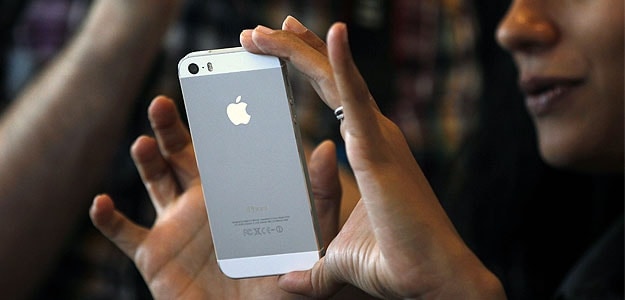
The “tech-ing” of Madison Avenue continues apace, according to the results of a closely followed annual report about how much brands are worth, as the brands of leading technology companies crowd the top ranks and increase substantially in value.
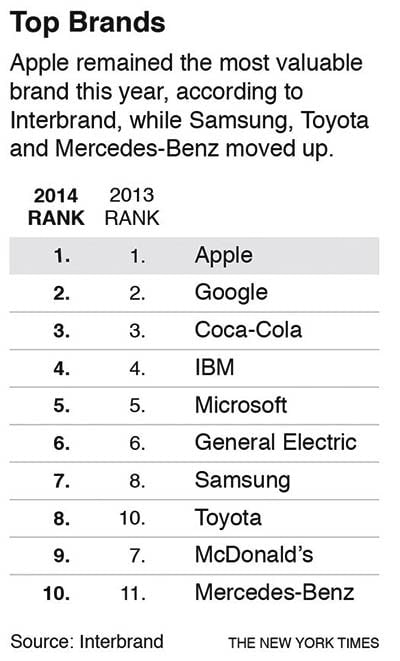
The 2014 edition of what is known as the Interbrand Best Global Brands report shows Apple in first place, as the world's most valuable brand, for a second straight year. Apple took the top spot last year from Coca-Cola, which fell to No.3; Coca-Cola remained in third place this year, and the No. 2 brand last year, the technology powerhouse Google, kept that spot.
The report, to be issued Thursday, presents a table of the top 100 valuable global brands. The Apple brand is valued at $118.9 billion, up 21 percent from last year. The Google brand, at $107.4 billion, rose in value by 15 percent from last year. Those twin peaks represent the first time two brands have each earned a value of more than $100 billion in a Best Global Brands report.
Despite some critics who were “suggesting that Apple had lost its luster,” said Jez Frampton, global chief executive of Interbrand, a corporate identity and brand consultancy that is part of the Omnicom Group, “we've still got Apple and Google slugging it out at the top.”
(Google was No. 1 on another list, known as the BrandZ Top 100 Most Valuable Global Brands report, released in May by Millward Brown Optimor, a unit of WPP. Google toppled Apple from first place after three years in the BrandZ report as Apple fell to No. 2.)
Four of the top 10 brands in the 2014 Interbrand report are technology brands. In addition to Apple and Google, they are Microsoft, at No. 5, unchanged from last year, and Samsung, No. 7, up a notch from 2013. IBM, No. 4, the same as last year, is classified by Interbrand as a business services brand; otherwise, half the top 10 brands would be technology brands.
The technology category was the most valuable overall, with a total value of $493.2 billion; other major brand categories include automotive, financial services and luxury. And Facebook - which had the highest percentage increase in value from last year, 86 percent - is, of course, also a technology brand. In only its second year on the list, Facebook climbed to No. 29 from No. 52 in 2013, and, “It's still growing,” Frampton said.
Also, “Twitter is starting to get closer to appearing on the table,” he said.
“On one hand, the new tech brands are doing great,” Frampton said, “and you have to consider they are at the real beginning of their lives as businesses.” On the other hand, “will we see a new tech brand perform like a Coca-Cola or a Mercedes-Benz?” he asked. “Their longevity is unproven.” (Mercedes-Benz climbed a notch, from No. 11 last year to 10th place.)
And potential pitfalls may challenge rising technology brands, as shown by the performances of some of their troubled brethren. For instance, Nokia suffered the largest decline in value among the top 100 of any type of brand, dropping 44 percent from last year to $4.1 billion, and plunged in the rankings to 98th place from 57th in 2013.
Nintendo, although classified by Interbrand as an electronics company, also has technology trappings, and it, too, fell precipitously, to No. 100 from No. 67 last year. Its brand value declined 33 percent from 2013 to $4.1 billion.
Another area where technology brands have “all got to be careful,” Frampton said, is in how issues like data security and the use of behavioral data for marketing purposes affect consumer confidence.
“Our relationship in brands is our fundamental trust in them, and if they deliver in accordance with their promises,” he said. “If it looks like a brand is taking advantage of you, that could cause problems in the future.”
The report is the 15th annual look at worldwide brand value by Interbrand, which began compiling the Best Global Brands report in 2000. The rankings and valuations are determined by factors that include the role a brand plays in influencing consumers, a brand's financial performance and the strength a brand has to command a premium price or to help its parent make money. Stock-market values “don't affect our valuations,” Frampton said.
Among brands outside the realm of technology, the highest rankings were achieved by - in addition to Coca-Cola, IBM and Mercedes-Benz - General Electric, classified as a diversified company (although it has technology aspects), at No. 6, the same as in 2013; Toyota, No. 8, up from No. 10 last year; and McDonald's, No. 9, down from No. 7 in 2013.
The biggest gains in value achieved by nontechnology brands compared with last year were for Audi, No. 45, up 27 percent; Amazon, classified as a retail brand, No. 15, up 25 percent; and, each with an increase of 23 percent, Volkswagen, No. 31, and Nissan, No. 56.
Of the five brands that made the Best Global Brands list for the first time, one is a technology brand: Huawei, a Chinese brand, at No. 94. It is, Frampton said, “our very first Chinese brand on the table.”
The other four newcomers are: DHL, in 81st place; Land Rover, 91st; FedEx, 92nd; and Hugo Boss, 97th.
© 2014, The New York Times News Service

-
Gold Is Rs 22,000 Cheaper Than A Month Ago. Should You Buy Amid The Wedding Season?

Gold's potential slide to $3,500 could save around Rs 4,700 per 10 grams, but a soft inflation print could just as easily push prices back up. One way to split the risk is to buy in parts, some now and the rest after the Fed's Dec. 9 decision.
-
AI Agents Are Gaining Power. Who Governs Them?
Artificial intelligence agents promise to transform productivity by moving machines from assisting decisions to executing them. But as organisations delegate greater authority to these AI-agents, they must first establish who controls that authority and who remains accountable when things go wrong.
-
Why Swapping Your Old Gold Can Trigger A Rs 5 Lakh Tax Bill, And How You Can Avoid It Legally
Swapping old gold for new is taxed as a sale and a fresh purchase. Getting your own gold remade can cut most of that bill, though it has its own costs.
-
The AI Trade is Done. The Real Opportunity for Investors Starts in 2027 | Unhedged Position
As pureplay AI stocks plunge and circular, capex-led financing unwinds, 2027 is set to be a year of reckoning for AI companies. Yet the bust clears the way for a better opportunity for investors in 2027 -- shifting the spotlight from AI builders to the companies using AI.
-
Leadership As Mission: Why The Age Of AI Demands More Human Leadership
Debjani Ghosh examines how AI is changing leadership, arguing that its success must be measured by its impact on people and the accountability of those guiding its use.
-
We May Need Another Tukaram Mundhe To Fight Air Pollution | The Reason Why
Developers may install basic measures such as sprinklers and green nets, resume work, and continue violating rules when this equipment stops working.
-
Extracting Value From Battery Scrap Could Be Challenging For India | The Reason Why
A discarded lithium-ion battery still contains valuable materials such as lithium, nickel and cobalt. These can be recovered and reused. When such batteries are crushed and shredded, they produce a dark powder called black mass.
-
One El Nino, India Can Handle. Two Could Break The Granary
India's grain stocks can absorb one bad year, but a second El Nino could drain the buffer in two to three years, economists say.
-
India's Troika Of Good Luck | Joining The Dots
As Jensen Huang's exit drags Nvidia down, a cooling AI trade and resilient earnings have revived investor interest in India. A likely RBI rate hike looms.
-
Talking Points This Week: Leadership Shock At Nvidia, Earnings Strength, And The Fog Over Hormuz
The Anthropic IPO pricing and first trading day, Nvidia's upcoming earnings, and any fresh signals from Iran will set the tone for the following week.









