Tax Cuts, Factory Incentives: What To Watch For In Budget 2023
Union budget on Wednesday will test the government's resolve to stay fiscally prudent as expectations of lower taxes, wider social security net and further boost to production gather steam before national elections.
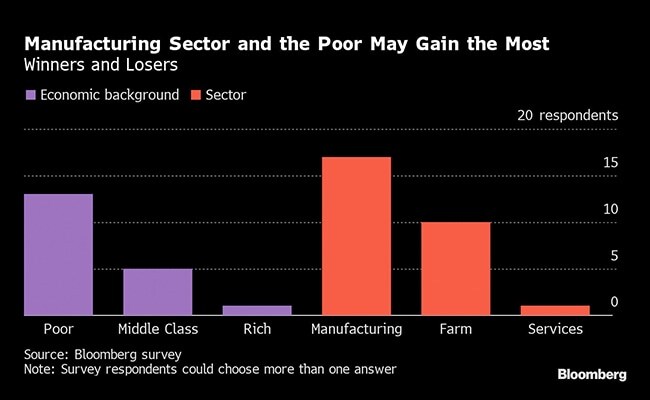
Finance Minister Nirmala Sitharaman may tweak income-tax slabs to provide relief to the nation's vast middle class and increase spend on the poor through programs such as rural jobs, while ramping up financial incentives for local manufacturing, according to economists and reports in local media.
Social welfare programs would get "appropriate" allocation as "the gap between have and have nots has widened," said India Ratings & Research Pvt. economist Devendra Kumar Pant. Inflation has eroded spending power and relief in tax "can provide the much-needed thrust to the consumption demand."
Prime Minister Narendra Modi's final full-year spending plan before 2024 polls comes amid rising interest rates and slowing global growth, which could make him desist from outright populism. Economists in a Bloomberg survey see fiscal deficit narrowing to 5.9% of gross domestic product, from 6.4% this year, needing another year of record borrowing.
While markets will be closely watching for the budget speech at 11 am to see what Asia's third-biggest economy has in store for investors, US short seller Hindenburg's scathing report on billionaire Gautam Adani's conglomerate has also put spotlight on the country, and the issue may reverberate in the budget session of parliament.
Here are some of the measures to look out for in the budget:
Tax Tweaks
Sitharaman's recent comments on knowing the "pressures of the middle class" have added to speculation she would put some money in the pockets of taxpayers. But there are no free lunches. "Any tinkering with rates at the lower income brackets will be compensated by increasing the cess/surcharge for the upper income brackets," Yes Bank economists led by Indranil Pan said, projecting a 15% rise in tax receipts next year.
She may also raise import duties on items such as private jets, helicopters, high-end electronic items and jewelery to encourage domestic manufacturing, according to The Economic Times.
Social Sector
India's jobless rate jumped to a 16-month high of 8.3% last month, underscoring the challenge to create jobs for the world's biggest population. DBS Group economist Radhika Rao sees the spend on rural job guarantee topping this year's allocation of 730 billion rupees ($9 billion), with crop insurance, rural road infrastructure and low-cost housing also getting attention.
India's world-beating growth masks rising inequality with 21 wealthiest billionaires possessing more wealth than 700 million Indians, according to Oxfam India. The budget may widen the ambit of small savings plans for the elderly and the girl child, said Soumya Kanti Ghosh, an economist with State Bank of India.
Manufacturing
With India positioning itself as an alternative to China in the global supply chain, manufacturers willing to set up factories in the country expect more financial benefits from the government. The budget may see production-linked incentives getting extended to sectors such as shipping containers and toys, according to Hindustan Times.
Strategies can be finetuned to provide a push to manufacturing activities and employment generation through deepening and widening of output-linked benefits, Yes Bank analysts said.
Budget wishlist for some of the other sectors includes:
- Extension of long term capital gains tax to immovable property, unlisted shares
- Compensation to oil retailers for selling fuel below market prices
- Reduction in taxes on cryptoassets announced in last budget
- Cut in import taxes on gold to 10% to rein in illegal shipments
- Increase in defense budget amid border tensions with China
- Higher capital allocation for banks, more freedom to raise capital
(Except for the headline, this story has not been edited by NDTV staff and is published from a syndicated feed.)

-
Indians Are Travelling, But Not Every Journey Is A Holiday | The Week In Whys

Pilgrims, patients and working women are the real travellers, and the system hasn't quite caught up with them.
-
Getting To Work Costs Women More | The Reason Why
It is not just about women paying more than men. It is about women paying much more in cities than in villages.
-
AI Bias In Investing Cannot Be Eliminated, But It Can Be Governed
Framing is a particularly important example as identical financial information presented in terms of gains rather than losses can lead an LLM to reach a different assessment.
-
Joining The Dots | Dark Skies, Steady Diya: Why Hope Holds This Diwali
With war, a weak rupee and foreign outflows weighing on sentiment, policymakers at the NDTV World Summit and market veterans at NDTV Profit Ignite: Diwali Edition offered the same advice: stay invested and filter out the noise.
-
The Curious Case of Equitas Small Finance Bank And A CEO Who Quit For Stock
PN Vasudevan believes persistent investor concerns over a perceived conflict of interest had become a governance overhang on Equitas Small Finance Bank's stock, even as the lender improved profitability and asset quality.
-
Talking Points This Week: AI Cash Burn, A Tiger Comeback And An India That Still Finds Its Own Path
India is not immune to higher oil or tighter global liquidity, yet its earnings base is broader, its domestic policy levers are still available.
-
Foreign Investors Own Half Of HDFC Bank and ICICI Bank. An LTCG Cut Could Matter Most Here
Foreign portfolio investors have US$115 billion parked in HDFC Bank, ICICI Bank. If the government cuts long-term capital gains tax, Jefferies says returning foreign money could land here first.
-
'Never Seen This Level Of Negativity': Sandeep Tandon Says The Next Rally May Be Closer Than You Think
Veteran investor Sandeep Tandon says foreign selling is easing, large-caps are due a comeback and mid-caps are crowded, while he turns positive on gold, power and pharma this Diwali.
-
Indians Stay With Family, Not In Hotels | The Reason Why
India still lacks enough clean, reliable and affordable hotels for budget-conscious travellers.
-
The Economic Imperative: Analysing The Material Driving Force Behind India-Canada Strategic Reset
This economic complementarity is further reinforced by deep institutional investment ties and talent mobility, which form the bedrock of the bilateral framework.










