"Strong Desire" To Finalise Free Trade Deal With India: Israel Minister
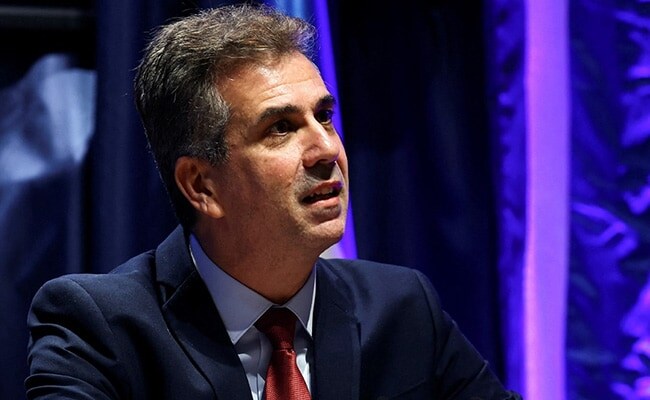
Israel is keen to finalise an FTA with India as there is a huge scope of trade between the two nations, Foreign Minister Eli Cohen has said, and expressed hope that the agreement will further strengthen bilateral economic ties.
From a humble beginning of $200 million in bilateral trade (primarily in diamonds) in 1992 when full diplomatic relations were established between the two countries, merchandise trade has diversified and reached $7.86 billion (excluding defence) during the period 2021-2022.
In addition, bilateral trade in services in 2021 was $1.1 billion and in FY 2022-23, bilateral merchandise trade from April to December 2022 stood at $8.09 billion (excluding defence).
"The scope for trade opportunities between our countries is huge and there is a strong desire to finalise an FTA that hopefully will further strengthen our economic ties...I believe the scope of the FTA is far larger than trade numbers. We should discuss it with the vision of bilateral relations in mind", he stressed just ahead of his visit to India on Tuesday.
However, Mr Cohen decided to cut short the trip hours after landing in New Delhi in view of certain developments in Israel.
With air traffic between the two countries getting a boost with the Gulf countries agreeing to open their airspace to Israeli airlines, MR Cohen described it as a "game changer" which also brings out India's importance in the region.
"Although the Corona epidemic temporarily reduced the number of direct flights, now we are talking about increasing the number of flights and increasing the destinations," Mr Cohen noted.
"The launch of more direct flights will increase the connectivity between our nations to facilitate the movement of tourists, business people and students. This boost to regional connectivity has also benefited the people of India. The thriving Indian diaspora throughout the Gulf can now fly directly from the UAE to Israel or from Israel to Bahrain," the minister said.
He also highlighted the immense impact it has on boosting trade relations in the region.
The Indian student community, largely composed of researchers at PhD and post-doctoral levels, forms the single largest student community from overseas.
Mr Cohen intends to deepen this link by bringing in more students from India to Israel as academic cooperation between the two countries has "inexhaustible potential".
"We need to make a greater effort to be attractive to a larger number of Indian students. Professional officials are examining the issue with the universities and the Council for Higher Education. We are very interested in a large number of foreign students coming to Israel, and certainly students from India. This will bring the scientific communities of the two countries closer together in the long term," he said.
Asked as to how India's Presidency of the G20 and an invite for New Delhi to the G-7 summit can be helpful in strengthening Indo-Israel ties, he said, "We are confident that the agenda that India promotes in these forums is for the benefit of the global economy, of which Israel is a part".
"The frequent consultations between various parties in Israel and India touch on many areas, but in issues of the G20 and G7 India has a unique role also due to its size and economic strength and its international importance", he asserted.
On India's role in the Middle East, the Israeli foreign minister said: "Regarding India's role in the MEA (Middle East Area), we see a growing involvement of India in many places in the world, including in the MEA (Middle East Area), including getting closer to the United Emirates, Saudi Arabia, Egypt and more. This is definitely a positive process because, as mentioned, India has a positive influence on the atmosphere of cooperation in the region." On the question of defence ties and Israel's participation in the flagship Make in India programme, Mr Cohen said that the defence ties have been "a key pillar of the growing partnership between the two nations".
"Our relations are based on three basic foundations: shared values, mutual interests and common challenges. With such well-synchronised defence cooperation, Israel was among the first countries to take up the call for the 'Make in India' initiative and start joint projects with a manufacturing base in India," the Israeli minister emphasised.
"We have no doubt in Israel that R&D serves as a growth engine for the local industry. That is why we are willing to create more platforms of joint R&D to pinpoint shared challenges, discuss and find solutions together, and even manufacture them together. Both sides have a lot to gain from this collaboration," he added.
(Except for the headline, this story has not been edited by NDTV staff and is published from a syndicated feed.)

-
Getting To Work Costs Women More | The Reason Why

It is not just about women paying more than men. It is about women paying much more in cities than in villages.
-
AI Bias In Investing Cannot Be Eliminated, But It Can Be Governed
Framing is a particularly important example as identical financial information presented in terms of gains rather than losses can lead an LLM to reach a different assessment.
-
Joining The Dots | Dark Skies, Steady Diya: Why Hope Holds This Diwali
With war, a weak rupee and foreign outflows weighing on sentiment, policymakers at the NDTV World Summit and market veterans at NDTV Profit Ignite: Diwali Edition offered the same advice: stay invested and filter out the noise.
-
The Curious Case of Equitas Small Finance Bank And A CEO Who Quit For Stock
PN Vasudevan believes persistent investor concerns over a perceived conflict of interest had become a governance overhang on Equitas Small Finance Bank's stock, even as the lender improved profitability and asset quality.
-
Talking Points This Week: AI Cash Burn, A Tiger Comeback And An India That Still Finds Its Own Path
India is not immune to higher oil or tighter global liquidity, yet its earnings base is broader, its domestic policy levers are still available.
-
Foreign Investors Own Half Of HDFC Bank and ICICI Bank. An LTCG Cut Could Matter Most Here
Foreign portfolio investors have US$115 billion parked in HDFC Bank, ICICI Bank. If the government cuts long-term capital gains tax, Jefferies says returning foreign money could land here first.
-
'Never Seen This Level Of Negativity': Sandeep Tandon Says The Next Rally May Be Closer Than You Think
Veteran investor Sandeep Tandon says foreign selling is easing, large-caps are due a comeback and mid-caps are crowded, while he turns positive on gold, power and pharma this Diwali.
-
Indians Stay With Family, Not In Hotels | The Reason Why
India still lacks enough clean, reliable and affordable hotels for budget-conscious travellers.
-
The Economic Imperative: Analysing The Material Driving Force Behind India-Canada Strategic Reset
This economic complementarity is further reinforced by deep institutional investment ties and talent mobility, which form the bedrock of the bilateral framework.
-
Medicine Pricing: Where Must Profit Stop?
India must confront excessive margins, hidden incentives and regulatory gaps that threaten the integrity of medicine.










