Stocks Sink Most In Six Months After Recent Runup In Treasury Yields
(Bloomberg) -- A bad week on Wall Street turned dismal Thursday after the relentless surge in Treasury yields sapped demand for risk assets. In the end, US stocks suffered the biggest drop in six months as investors recalibrate for a world where rates sit at levels not seen in a generation.
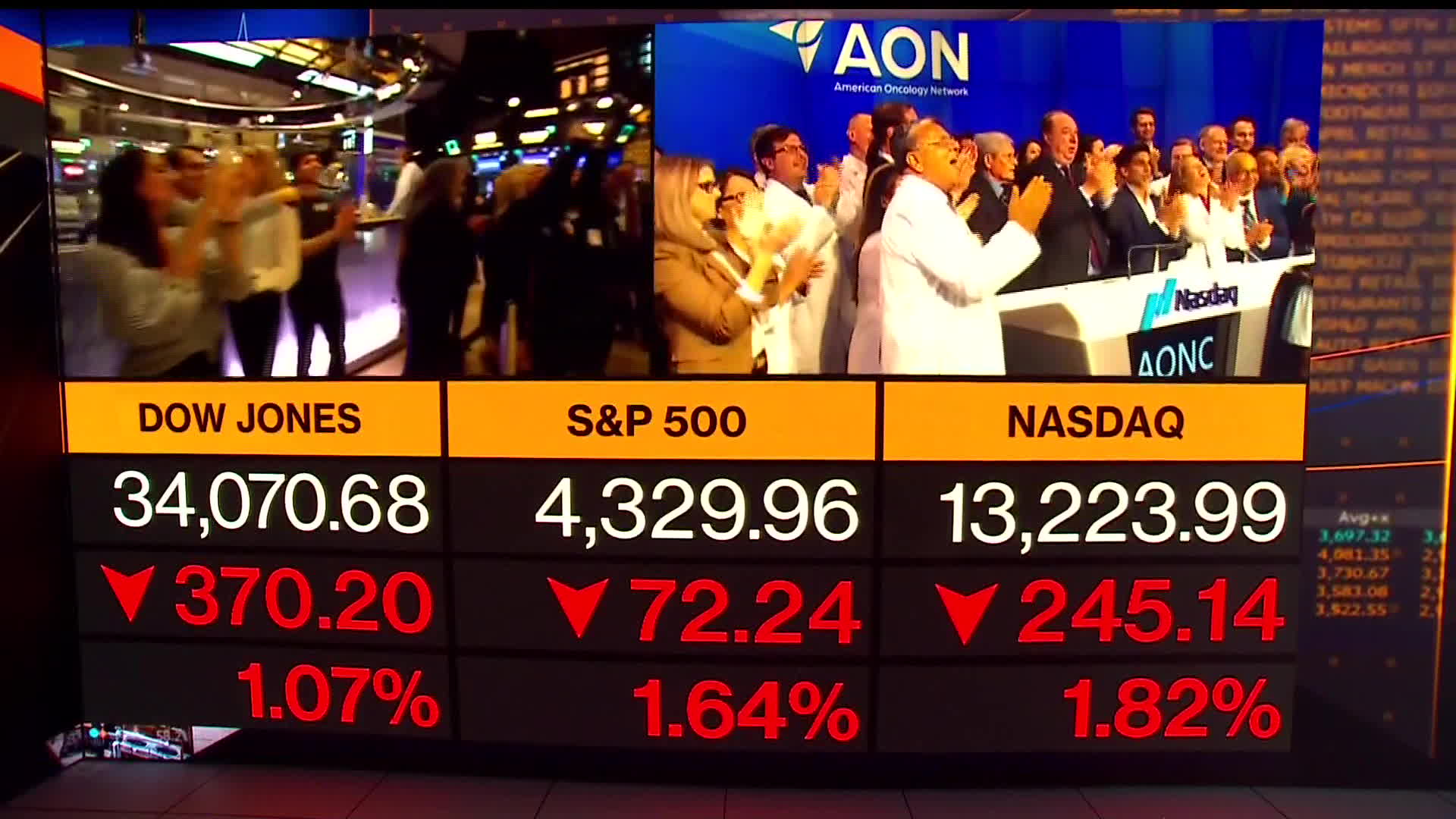
The S&P 500 plunged 1.6% and the Nasdaq 100 fell almost 2%. The two indexes are on track for the worst quarter in a year. The 10-year Treasury yield pushed toward 4.5%, up more than 30 basis points in just three weeks. Leading the way down for equities were profitless technology companies, a group whose lofty valuations have become harder to justify as investors turn to other asset classes for returns.
Stocks had been able to withstand higher rates for months as investors plowed cash into big technology firms. But the latest move in Treasuries, sparked by the Federal Reserve's signal that policy rates will remain elevated well into next year, has forced a reconsideration of investment theses across Wall Street — especially among money managers who started chasing the big-tech rally earlier this quarter.
“After the run in tech stocks this year and given lofty valuations, it doesn't pay to step on the gas and add exposure right now,” said Adam Phillips, managing director of portfolio strategy at EP Wealth Advisors, whose firm has rotated out of so-called growth stocks and into dividend-paying value shares. “If you're getting yield in other areas, why subject clients to additional risks in the stock market?”
In what's increasingly looking like bad timing, investors plowed $26.4 billion into US equities in the week ended Sept. 13, the most since March 2022, with about $1.3 billion funneling into the tech sector, according to EPFR Global data cited by Bank of America Corp. The Nasdaq 100 Index, which had its best first half on record, has slumped more than 5% this month.
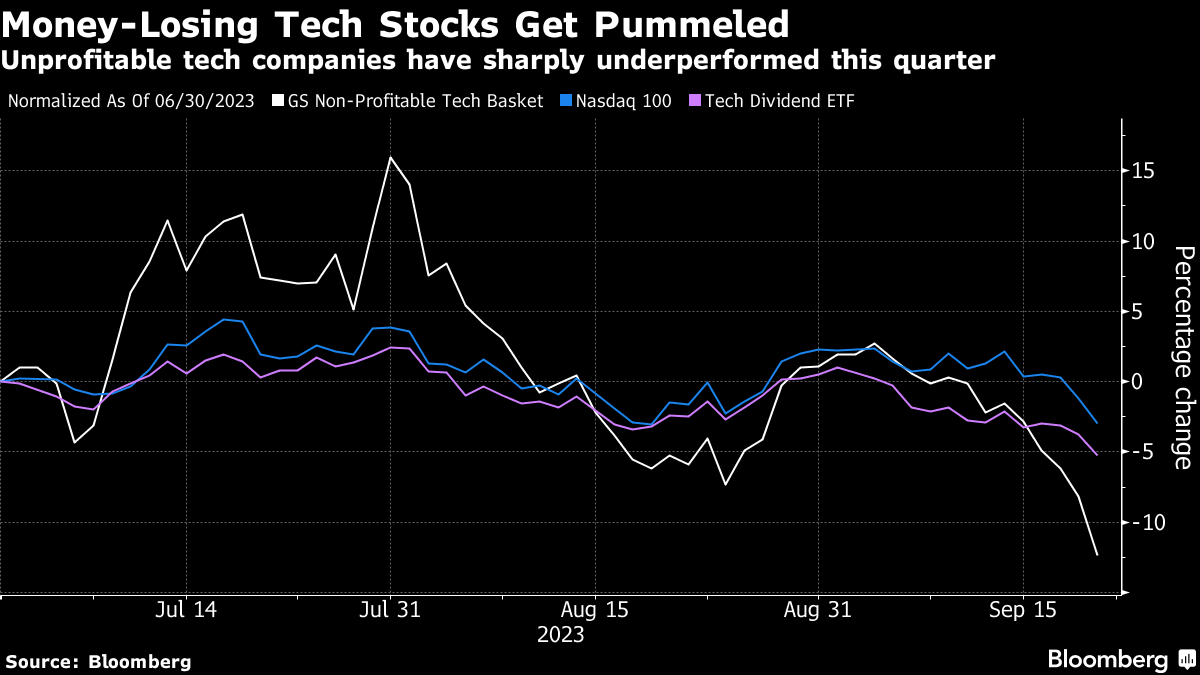
The selloff has been harsher for money-losing companies, a group that EP Wealth's Phillips is avoiding, at least for now. A Goldman Sachs Group Inc. basket of unprofitable tech companies, which includes firms like Roku Inc., Peloton Interactive Inc. and Lyft Inc., has plunged 21% since its peak in late July, including a drop of 4.5% rout on Thursday.
Stock bulls have more than just higher rates to contend with, as crude prices soar toward $100 a barrel and the US dollar continues to strengthen against major peers. Still, they point to last October, when a similar surge in yields sent the S&P 500 to its bear-market low. The index then rallied the first seven months of the year and is still 23% above that 2022 low.
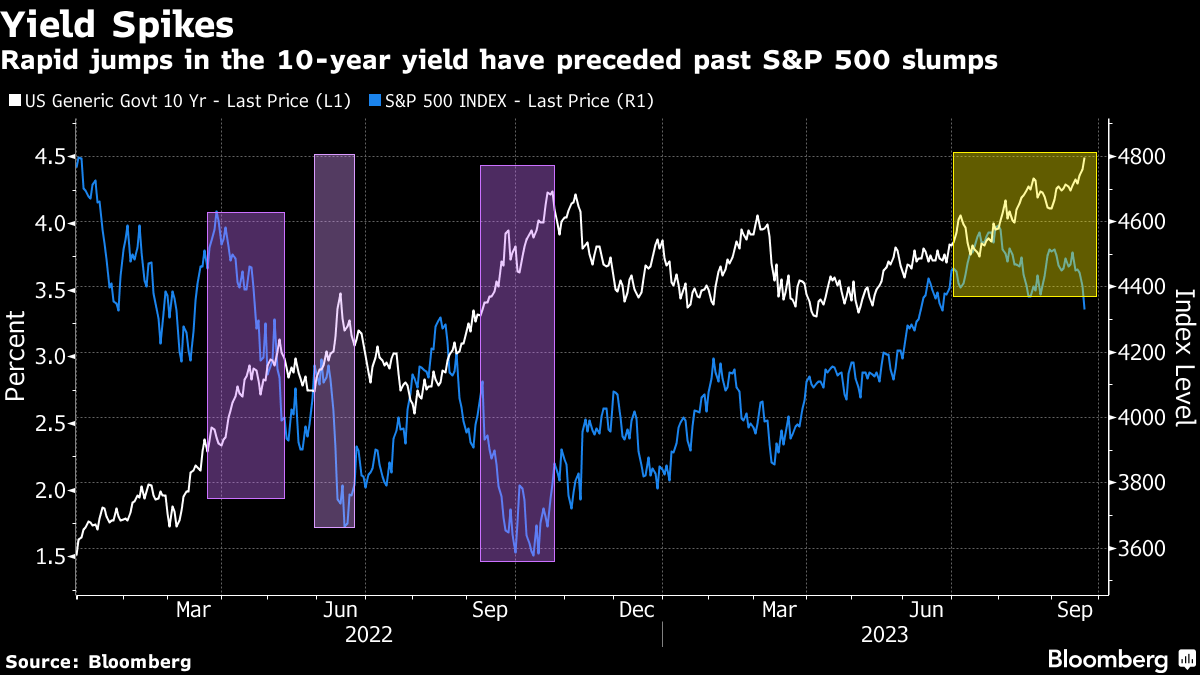
Their argument is that prior runups in yields during the Fed's tightening cycle have invariably been short-lived. Every time the 10-year yield has climbed above 4% in the past year, it's retreated back below 3.5% in short order.
Bears argue that this time is different, with Fed officials now split on whether they'll need to raise rates one more time this year — and in agreement that any cuts won't come until well into 2024. That's put pressure on longer-dated Treasuries to an extent not seen in 16 years. Rising yields could slow investment broadly by increasing borrowing costs, while also threatening the recent resurgence in stocks by increasing the appeal of bonds as a safe alternative.
A line in the sand for traders is if the 10-year yield climbs to at least 4.5% or higher and stays there for a sustained period, which would likely force stocks with lofty valuations to recalibrate, according to Yung-Yu Ma, chief investment officer at BMO Wealth Management. Technology companies are particularly susceptible to fears of rising rates and yields because many of them are valued on projected profits delivered years in the future.
“That would give investors enough pause to raise concerns that a significant shift in yields is taking place that would rattle stocks and other asset classes broadly,” Ma said. “If yields stay comfortably under this level, investors will still feel like they're getting a reasonable return in fixed income, but it's not so high that it starts to add additional pressure on investors' desire to own stocks or take risk.”
What's more, speculators once again held large net short positions in 10-year Treasury notes, according to data compiled by the Commodity Futures Trading Commission. That means investors are placing bets to short the bond market on expectations that yields will rise, though such extremes could end up causing yields to drop because of stretched positioning, said Todd Sohn, managing director of ETF and technical strategy at Strategas Securities LLC.
“There's agitation that there may be another leg up in yields and it will impact equities negatively,” Sohn said. “But if it ends up being a head fake and yields move back lower again, that would ultimately support stocks.”
More stories like this are available on bloomberg.com
©2023 Bloomberg L.P.

-
Gold Is Rs 22,000 Cheaper Than A Month Ago. Should You Buy Amid The Wedding Season?

Gold's potential slide to $3,500 could save around Rs 4,700 per 10 grams, but a soft inflation print could just as easily push prices back up. One way to split the risk is to buy in parts, some now and the rest after the Fed's Dec. 9 decision.
-
AI Agents Are Gaining Power. Who Governs Them?
Artificial intelligence agents promise to transform productivity by moving machines from assisting decisions to executing them. But as organisations delegate greater authority to these AI-agents, they must first establish who controls that authority and who remains accountable when things go wrong.
-
Why Swapping Your Old Gold Can Trigger A Rs 5 Lakh Tax Bill, And How You Can Avoid It Legally
Swapping old gold for new is taxed as a sale and a fresh purchase. Getting your own gold remade can cut most of that bill, though it has its own costs.
-
The AI Trade is Done. The Real Opportunity for Investors Starts in 2027 | Unhedged Position
As pureplay AI stocks plunge and circular, capex-led financing unwinds, 2027 is set to be a year of reckoning for AI companies. Yet the bust clears the way for a better opportunity for investors in 2027 -- shifting the spotlight from AI builders to the companies using AI.
-
Leadership As Mission: Why The Age Of AI Demands More Human Leadership
Debjani Ghosh examines how AI is changing leadership, arguing that its success must be measured by its impact on people and the accountability of those guiding its use.
-
We May Need Another Tukaram Mundhe To Fight Air Pollution | The Reason Why
Developers may install basic measures such as sprinklers and green nets, resume work, and continue violating rules when this equipment stops working.
-
Extracting Value From Battery Scrap Could Be Challenging For India | The Reason Why
A discarded lithium-ion battery still contains valuable materials such as lithium, nickel and cobalt. These can be recovered and reused. When such batteries are crushed and shredded, they produce a dark powder called black mass.
-
One El Nino, India Can Handle. Two Could Break The Granary
India's grain stocks can absorb one bad year, but a second El Nino could drain the buffer in two to three years, economists say.
-
India's Troika Of Good Luck | Joining The Dots
As Jensen Huang's exit drags Nvidia down, a cooling AI trade and resilient earnings have revived investor interest in India. A likely RBI rate hike looms.
-
Talking Points This Week: Leadership Shock At Nvidia, Earnings Strength, And The Fog Over Hormuz
The Anthropic IPO pricing and first trading day, Nvidia's upcoming earnings, and any fresh signals from Iran will set the tone for the following week.









