Investors Fear Market Fallout Of State Lockdowns To Fight Covid

Investors are bracing for market fallout as state after state locks itself down in India to contain the spread of the coronavirus as infections and deaths surge.
More than two thirds of states are shut if assessed by their contribution to national output, analysts at Jefferies calculated last week. Tamil Nadu, which houses foreign manufacturers including BMW and Dell, will also close from Monday, while Delhi extended its lockdown for another week. The measures come as pressure builds on Prime Minister Narendra Modi to impose strict nationwide curbs as he did last year.
All of that is forcing a reassessment among investors who had hoped that less-severe curbs would soften the blow to economic growth. Earlier in May, India's central bank assured markets that it expects the dent in aggregate demand to be moderate in comparison with a year ago, with "containment measures being localized and targeted."
The news of strict lockdowns in several states may hurt sentiment ahead, Ajit Mishra, vice president for research at Religare Broking Ltd., wrote in a report. Investors will be watching key macroeconomic data including inflation and factory output this week as well as the vaccine drive, he said.
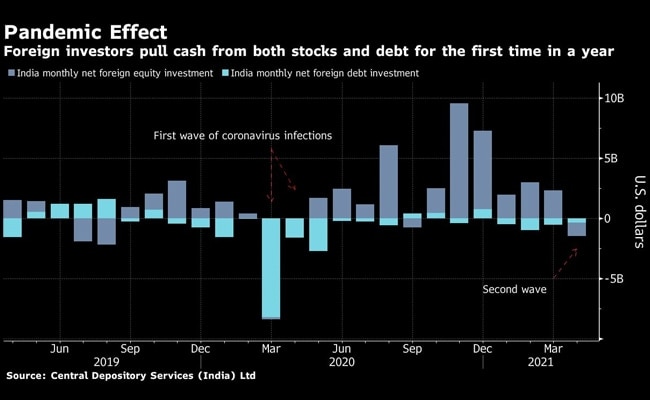
Vaccine shortages have complicated efforts to tame the outbreak, leaving investors assessing Modi's next moves and guessing how long states will have to remain shut. Amid the uncertainty, foreign investors pulled $1.9 billion from India's stocks and debt in April, the biggest outflow in a year, according to data compiled by Bloomberg.
"While India has refrained from a national lockdown thus far given its huge economic costs, the scales are tipping fast towards humanitarian benefits of curbing mass transmission, as new infections continue to rise with no peak in sight," said Chang Wei Liang, an analyst at DBS Bank. "Even without a lockdown, mobility data for Indian cities are already showing that less and less people are moving out of their homes. This implies a natural brake to retail spending and business investment, until mass viral transmission ceases."
Here's how the crisis is impacting markets:
Sovereign Bonds
Recent interventions from the Reserve Bank of India have kept yields on 10-year sovereign bonds in check. But, the lockdowns could make it hard to keep borrowing costs low for much longer
Any revenue shortfall would stoke fears of a further rise in government borrowings, already near records, adding upward pressure on yields
Earlier this month, the central bank announced the second tranche of its Government Securities Acquisition Programme -- India's version of quantitative easing -- under which it will buy Rs 35,000 crore ($4.8 billion) of sovereign bonds on May 20.
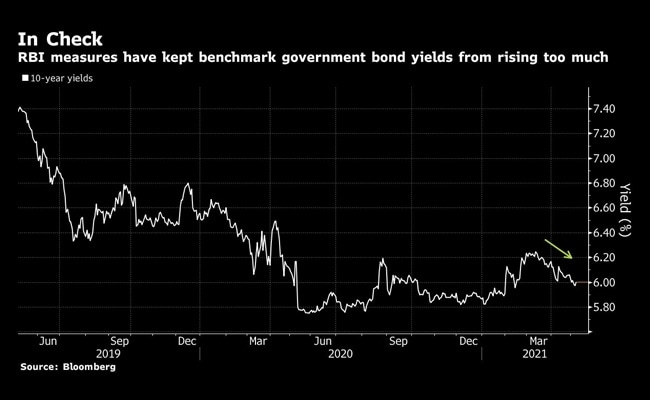
The lockdowns risk higher prices for everything from essential drugs to cars, due to the disruption of supply chains. Consumer-price inflation was already on course to test the upper limit of the RBI's 2%-6% target, and recent gains in wholesale prices signal more pressure. If those strains build, the RBI may struggle to sell bonds to investors at current yields
Rupee
Relative progress fighting the pandemic has been an important factor in global currency markets. India and South Africa present a case study in that among the so-called Fragile Five emerging-markets: Turkey, Brazil, South Africa, India and Indonesia
India's rupee is down about 0.5% against the dollar this quarter even after a recent rebound, while South Africa's rand has gained 5.1%. Read more about the rupee outlook
India is facing the world's worst outbreak, contributing to half of the fresh infections in the world, while South Africa has seen new cases fall about 90% from a recent peak in January. India reported 669 infections per 100,000 people over the past month, about 10 times that of South Africa, according to Bloomberg calculations based on data compiled by Johns Hopkins University
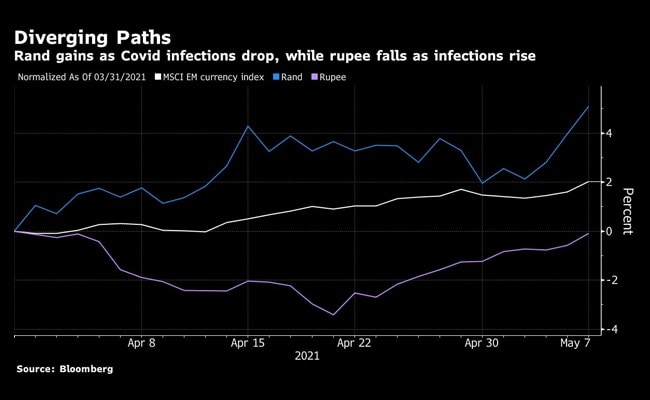
The rupee has slipped down the rankings relative to Asian peers after leading the pack in the first quarter. Any national lockdown could deal a further blow
Stocks
Jefferies forecasts India's economy will grow 10.2% in the year through March 2022, down 3 percentage points from its initial outlook. The figure already must be taken with a grain of salt given the contraction in the year-ago period. Any slowdown could weigh on corporate earnings
Analysts have started to cut price targets for stocks of some of the biggest banks and automobile giants
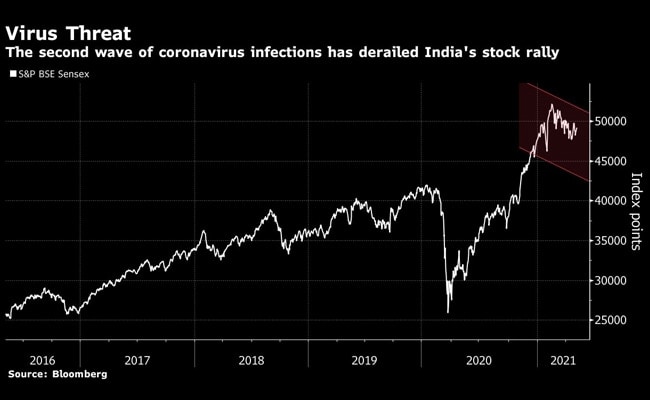
Markets will correct if the government announces a nationwide lockdown," said Naveen Kulkarni, chief investment officer at Axis Securities Ltd. "However, the critical factor will be the duration. The longer any lockdown is, the greater will be the correction."
Corporate Bonds
Goldman Sachs turned neutral on Indian credits last month, expecting limited room for outperformance
Citing headwinds due to lockdowns, research firm CreditSights also changed its recommendation last month on local companies including Indian Oil Corp. and Reliance Industries Ltd. to underperform
DBS Bank warned that the market is getting complacent after India's dollar bonds showed some signs of recovery after a sell-off in the first half of April
Investors may be too optimistic given the likelihood of a more persistent impact from the pandemic fallout on the finances of companies and households, it said
(Except for the headline, this story has not been edited by NDTV staff and is published from a syndicated feed.)

-
Gold Is Rs 22,000 Cheaper Than A Month Ago. Should You Buy Amid The Wedding Season?

Gold's potential slide to $3,500 could save around Rs 4,700 per 10 grams, but a soft inflation print could just as easily push prices back up. One way to split the risk is to buy in parts, some now and the rest after the Fed's Dec. 9 decision.
-
AI Agents Are Gaining Power. Who Governs Them?
Artificial intelligence agents promise to transform productivity by moving machines from assisting decisions to executing them. But as organisations delegate greater authority to these AI-agents, they must first establish who controls that authority and who remains accountable when things go wrong.
-
Why Swapping Your Old Gold Can Trigger A Rs 5 Lakh Tax Bill, And How You Can Avoid It Legally
Swapping old gold for new is taxed as a sale and a fresh purchase. Getting your own gold remade can cut most of that bill, though it has its own costs.
-
The AI Trade is Done. The Real Opportunity for Investors Starts in 2027 | Unhedged Position
As pureplay AI stocks plunge and circular, capex-led financing unwinds, 2027 is set to be a year of reckoning for AI companies. Yet the bust clears the way for a better opportunity for investors in 2027 -- shifting the spotlight from AI builders to the companies using AI.
-
Leadership As Mission: Why The Age Of AI Demands More Human Leadership
Debjani Ghosh examines how AI is changing leadership, arguing that its success must be measured by its impact on people and the accountability of those guiding its use.
-
We May Need Another Tukaram Mundhe To Fight Air Pollution | The Reason Why
Developers may install basic measures such as sprinklers and green nets, resume work, and continue violating rules when this equipment stops working.
-
Extracting Value From Battery Scrap Could Be Challenging For India | The Reason Why
A discarded lithium-ion battery still contains valuable materials such as lithium, nickel and cobalt. These can be recovered and reused. When such batteries are crushed and shredded, they produce a dark powder called black mass.
-
One El Nino, India Can Handle. Two Could Break The Granary
India's grain stocks can absorb one bad year, but a second El Nino could drain the buffer in two to three years, economists say.
-
India's Troika Of Good Luck | Joining The Dots
As Jensen Huang's exit drags Nvidia down, a cooling AI trade and resilient earnings have revived investor interest in India. A likely RBI rate hike looms.
-
Talking Points This Week: Leadership Shock At Nvidia, Earnings Strength, And The Fog Over Hormuz
The Anthropic IPO pricing and first trading day, Nvidia's upcoming earnings, and any fresh signals from Iran will set the tone for the following week.









