Nifty, Sensex On The Back Foot, Tracking Losses On Wall Street
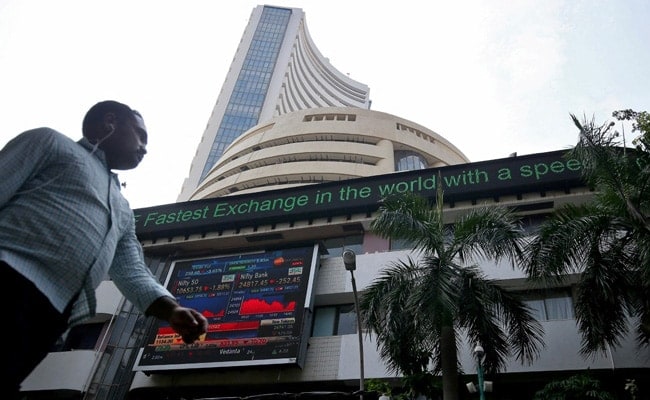
Sensex and Nifty opened in the red as a two-day rally in global equities conceded to market expectations that the Federal Reserve would have to do a lot more to contain inflation and that the battle with rising prices was far from over.
Indian equity benchmarks had closed sharply higher on Thursday after a mixed session on Wednesday.
Early on Friday, the 30-share Sensex index was down 206.58 points, or 0.35 per cent, to trade at 59,126.02 and the NSE Nifty was 54.90 points, or 0.33 per cent, lower at 17,604.10, as technology and automobile stocks declined amid weakness in other Asian markets, while investors awaited domestic inflation data.
Tech Mahindra was the top loser in the Sensex pack, slipping 1.34 per cent, followed by Nestle India, Maruti, Infosys, UltraTech Cement, TCS and Sun Pharma.
On the other hand, Tata Steel, PowerGrid, SBI, NTPC, IndusInd Bank, ICICI Bank and Titan were the gainers.
Nifty's IT index, which firmed up 1.79 per cent on Thursday, declined 0.51 per cent, while the auto index fell 0.24 per cent.
That even as Foreign institutional investors (FIIs) continued to remain net buyers in the Indian capital market, They purchased shares worth Rs 2,298.08 crore on Thursday, according to the latest exchange data.
The focus will now be on key domestic macroeconomic data points - index of industrial production (IIP), consumer price index (CPI) and trade balance numbers due later on Friday for further cues.
Global cues pointed to weak sentiment for risk assets, driven by overnight losses on Wall Street.
Asian stocks tracked Wall Street losses and the yen fell on Friday as investors remained filled with uncertainty over how aggressively the Federal Reserve would raise interest rates to tackle inflation despite softer numbers earlier this week.
MSCI's broadest index of Asia-Pacific shares outside Japan fell 0.10 per cent, and Australia's AXJO was down 0.62 per cent.
Japan's Nikkei was the major outlier, surging 2.37 per cent to its highest level since January as markets reopened following a national holiday.
Overnight, after adding more than 2 per cent on Wednesday and rising more than 1 per cent to a three-month high earlier on Thursday, the S&P ended in the red, and Nasdaq turned negative.
Other major indexes closed out Thursday with marginal gains, the pan-European STOXX 600 index closed up 0.06 per cent, and MSCI's gauge of stocks across the globe finished up 0.07 per cent.
Robert Phipps, a Director at Per Stirling Capital Management, expects the Fed to be cautious about slowing the tightening cycle until inflation shows more improvement.
"The Fed's learned their lesson. They're not going to take their foot off the brakes until it's obvious to everybody that inflation is returning to their 2 per cent target," Mr Phipps, told Reuters.
San Francisco Fed President Mary Daly, in an interview with the Financial Times, earlier said that it was far too early for the central bank to declare victory in its fight against inflation and that a half-percentage point rate rise in September was her baseline.
Ms Daly's comments followed similar cautions from Minneapolis Federal Reserve Bank President Neel Kashkari and Chicago Fed President Charles Evans on Wednesday.
"Even if they're seeing slowing inflation and a slowing of the economy, they will still hike rates. Why? Because inflation still has an 8 per cent handle on it. It's still far too high," Padhraic Garvey, Regional Head of Research, Americas at ING, told Reuters.

-
We May Need Another Tukaram Mundhe To Fight Air Pollution | The Reason Why

Developers may install basic measures such as sprinklers and green nets, resume work, and continue violating rules when this equipment stops working.
-
Extracting Value From Battery Scrap Could Be Challenging For India | The Reason Why
A discarded lithium-ion battery still contains valuable materials such as lithium, nickel and cobalt. These can be recovered and reused. When such batteries are crushed and shredded, they produce a dark powder called black mass.
-
One El Nino, India Can Handle. Two Could Break The Granary
India's grain stocks can absorb one bad year, but a second El Nino could drain the buffer in two to three years, economists say.
-
India's Troika Of Good Luck | Joining The Dots
As Jensen Huang's exit drags Nvidia down, a cooling AI trade and resilient earnings have revived investor interest in India. A likely RBI rate hike looms.
-
Talking Points This Week: Leadership Shock At Nvidia, Earnings Strength, And The Fog Over Hormuz
The Anthropic IPO pricing and first trading day, Nvidia's upcoming earnings, and any fresh signals from Iran will set the tone for the following week.
-
Signature Play: The Classic Cocktail Is Dead. Or Is It?
Classic cocktails are disappearing from India's cocktail menus. But they're still being ordered, taught to bartenders and borrowed from. So, who's really having the last drink?
-
A New Samvat Wishlist: Inclusive Prosperity And Human Development
India has strengthened its economic foundations through infrastructure, digital access and enterprise. Its next growth chapter must deepen productivity, create better livelihoods and widen participation in prosperity.
-
Love, Sex Aur Dhokha: The Audacious Plot To Spy On Jensen Huang
A Taipei dinner, a Singapore chip buyer and a suspected Chinese asset: inside the alleged spy operation that got close to NVIDIA's Jensen Huang.
-
Ten Things I Learnt This Samvat
Patience can be a trap. Cheap stocks can stay cheap. Leverage can wipe you out. What did Samvat 2082 teach us? Niraj Shah writes on 10 lessons from the year gone by.
-
Talking Points This Week: Tech Nerves, FII Buying, And A Faraway Banking Shock
The global markets are not shining this Diwali. The exception in the large markets is, India.









