Stock Bears Are Going Extinct. Time To Worry?

It's that time of year when Wall Street soothsayers look ahead 12 months and try to divine the path of US stocks. Last year at this time, no one writing for a major sell-side firm thought stocks would perform anywhere near as well as they did, up 23% in 2024. The median prognosticator thought we would probably move sideways, and a few bears were calling for a meaningful selloff. The same was basically true of the forecasts the year before that. In retrospect, that failure of imagination almost looked like a contrarian bullish sign.
In any case, something has clearly changed in Wall Street's mindset. This year, the median strategist expects the S&P 500 Index to end 2025 at 6,600, an implied upside of 12% at the time of writing. The more bullish strategists of recent years have been emboldened, while the erstwhile bears have mostly been converted (this year's tally offers just two strategists predicting a destination below 6,000, among them only one uber bear, Peter Berezin of BCA Research). Given the extraordinary two-year run in the S&P 500, this development seems natural, though it also points to new investor perils for the year ahead.
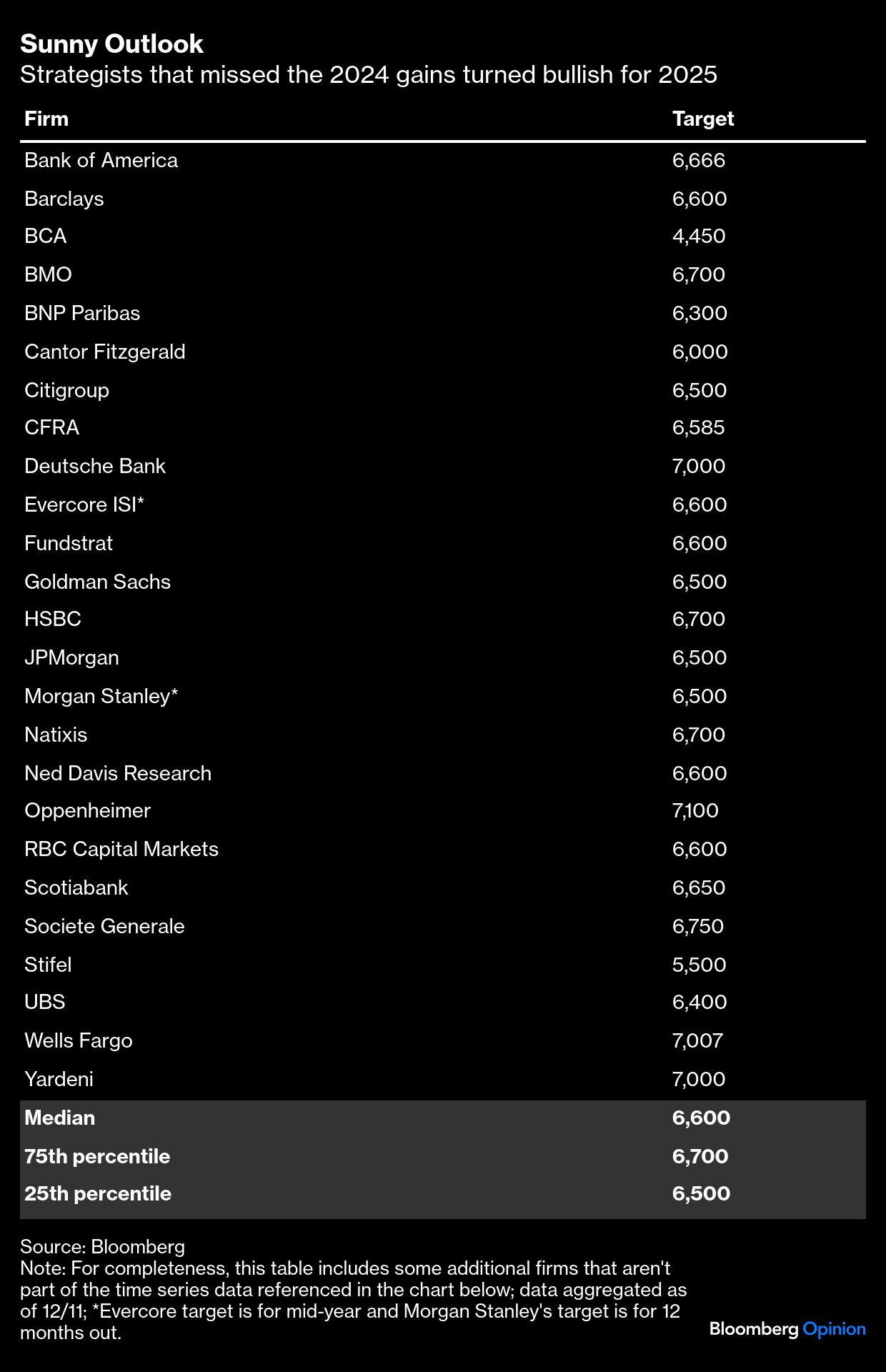
From a behavioral perspective, it all smells a lot like recency bias, the tendency to let recent events hold outsize influence over our views of the future. But there's also a rational, real-world basis for the sunnier outlooks, and it would be a mistake to dismiss it as pure psychology.
The generative artificial intelligence buzz of 2022 has proved much more than flash-in-the-pan hype, yielding hundreds of billions in capital expenditures and, for Nvidia Corp., a previously unimaginable run of revenue growth. More broadly, the success of the Magnificent 7 growth companies has transformed the way that sellside strategists view their jobs. At 33% of the S&P 500 by weight, any outlook has to incorporate a detailed vision for the future of those companies: Apple Inc., Microsoft Corp., Nvidia, Amazon.com Inc., Meta Platforms Inc. and Tesla Inc. In most cases, they have become diversified, dominant and efficient cash-generation machines the likes of which US investors have rarely encountered in their lifetimes. (Tesla is something of its own case, with a valuation driven more by a narrative than real profits. Yet Chief Executive Elon Musk has President-elect Donald Trump's ear, a competitive advantage that's essentially priceless.)
In addition to the Mag 7, the US economy has emerged as a singular powerhouse among developed markets. The economy has strung together productivity-driven growth unlike anything since the early 2000s, and that's kept consumption and labor market numbers favorable despite countless doomsday predictions. Miraculously, inflation has ebbed at the same time.
Granted, there are new risks that come with the territory. First, when everyone has bought into the bullish story, who's left to invest and push up prices? I doubt we've reached a point of investor saturation, but we may be getting a bit closer. Second, everyone's portfolios have become overly concentrated in those same “Mag 7” stocks, and their valuations have drifted higher to the point that they're already discounting many of the companies' superpowers. The analysts that cover them estimate that their growth prospects have moderated from extraordinary to simply great. You would still need some catalyst to trigger a selloff — a rebound in inflation; an intensifying US-China trade clash; or the onset of an artificial intelligence “winter,” for instance — but the risk is impossible to discount completely.
BCA's Berezin, the most bearish strategist in data compiled by Bloomberg, based his market prediction on the expectation of a US recession. Among other things, he said that Trump could spark a trade war that weighs on business investment, and he warned about the potential outbreak of a “bond market riot” against deficit-funded tax cuts. In Berezin's scenario, those events could collide with an economy where credit card and auto loan delinquencies are already on the rise. “I'm not a perma-bear; this is really the first time in my career that I've been really outspoken bearish,” Berezin told me. “The market needs to hear a more sober bearish voice, because they're so rare these days.”
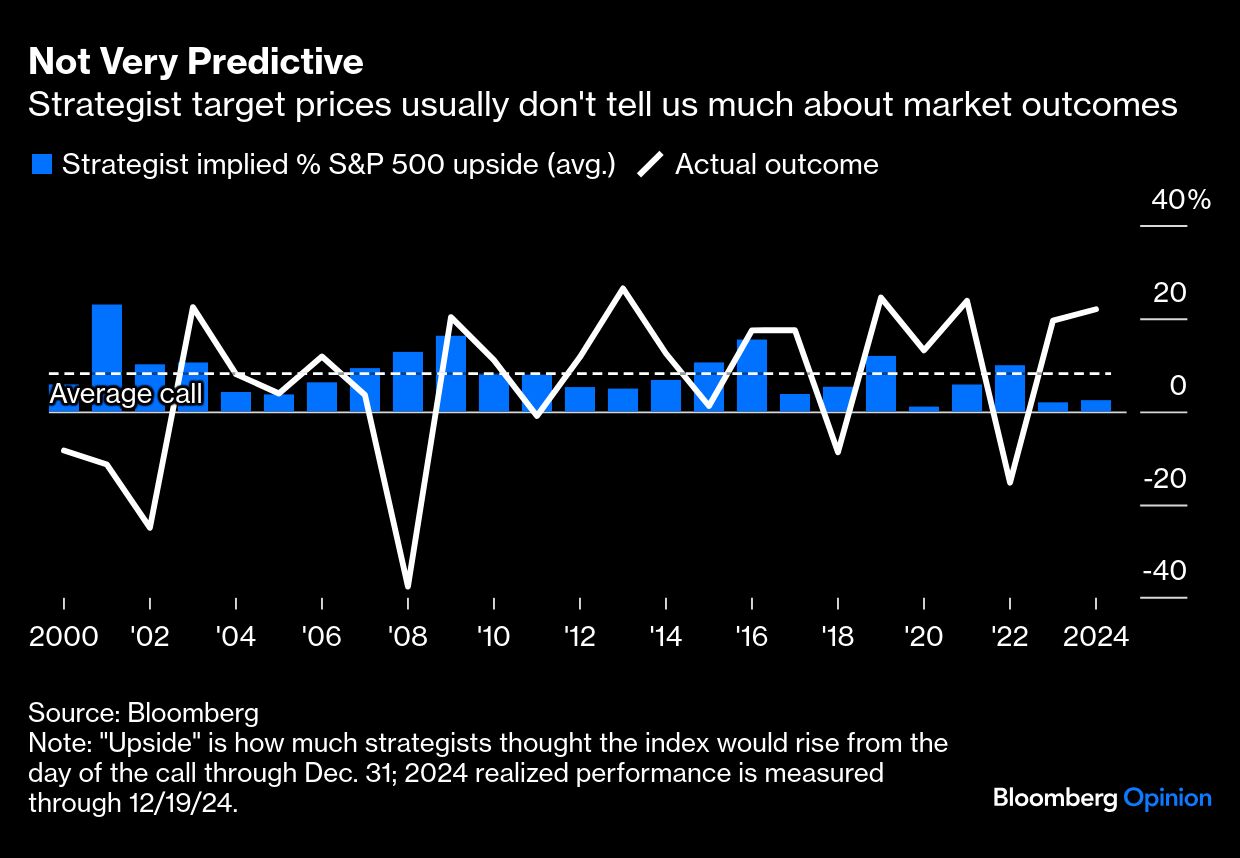
As I've written before, it's important to recognize 12-month stock projections as the educated guesses that they ultimately are. Strategists have rightly learned that stocks usually go up, and the average outlook in Bloomberg data is always positive. But the average point estimate is rarely particularly insightful and frequently proves a total flop.
As examples, strategists on average were relatively bullish throughout the dot-com bust and ahead of the 2008 financial crisis. More recently, they expected a relatively good year in bear-market 2022 and failed to foresee the go-go years of 2023 and 2024. Go figure. Strategists just don't have crystal balls, and they sure can't predict recessions or pandemics. They're a collection of fallible humans trying to deliver on an impossible task. That doesn't mean they aren't insightful, and I remain an avid consumer of their prose, especially their ideas on risk management, asset allocation and emerging investing themes. As for the targets themselves, they're mostly just a piece of the broader market-sentiment puzzle.
Given everything, the logical answer is to stay invested but hedge your bets with some combination of bonds, options and less volatile US equities. Stocks usually go up, and there's still a lot to like about the setup for 2025. But if there's one thing that the past couple of years has shown us, it's that the market is always capable of doing the unimaginable, so we should keep our wits about us.

-
Indians Stay With Family, Not In Hotels | The Reason Why

India still lacks enough clean, reliable and affordable hotels for budget-conscious travellers.
-
The Economic Imperative: Analysing The Material Driving Force Behind India-Canada Strategic Reset
This economic complementarity is further reinforced by deep institutional investment ties and talent mobility, which form the bedrock of the bilateral framework.
-
Medicine Pricing: Where Must Profit Stop?
India must confront excessive margins, hidden incentives and regulatory gaps that threaten the integrity of medicine.
-
Why Amazon And Flipkart Are Struggling To Beat Meesho In India's Smaller Cities
With 274 million users and lowest-cost logistics, Meesho is defending its value commerce crown against giants like Amazon and Flipkart.
-
High US Salaries, No Green Card Certainty: The Financial Calculation Facing Indian H-1B Families
The suspension of PERM processing at eight technology employers does not cancel existing H-1B visas. What it does is force a question many Indian families have been avoiding: is the US salary worth tying your career and family plans to one employer?
-
Swiggy vs Eternal: Food Delivery's Two Rivals Are No Longer In The Same Race
Eternal is building a private AI assistant, dark.ai. Swiggy is still working out how to make Instamart pay, with an operating loss of Rs 895 crore in the July-September quarter while Blinkit stayed profitable.
-
Where You Live Shapes How You Get To Work | The Reason Why
Two-wheelers are the most popular way to get to work in India, accounting for nearly 43% of workplace commutes.
-
Unhedged Position: Can India See An Indonesia-Style Time Correction?
The Nifty is trading below levels it first clocked in 2024. Is there, then, as I have suggested in the headline, potential that the current time correction drags on painfully for the next three-five, even ten years?
-
Navigating Friction And Energy Realities: An Analysis Of Marco Rubio's October Visit To India
Occurring at a critical juncture marked by stalled trade negotiations and escalating geopolitical pressures over global energy supplies, the visit offers a profound window into modern US-India relations.
-
India Exports Capital. Why Not Export Trusteeship?
The big question, then, is whether India can build an institution that global borrowers, investors, banks, and lawyers can trust, even without an Indian connection.










