States’ Off-Balance-Sheet Borrowings Have Hit A Decadal High: Crisil Ratings
Off-balance-sheet borrowings of states are likely to have hit a decadal high, according to Crisil Ratings.
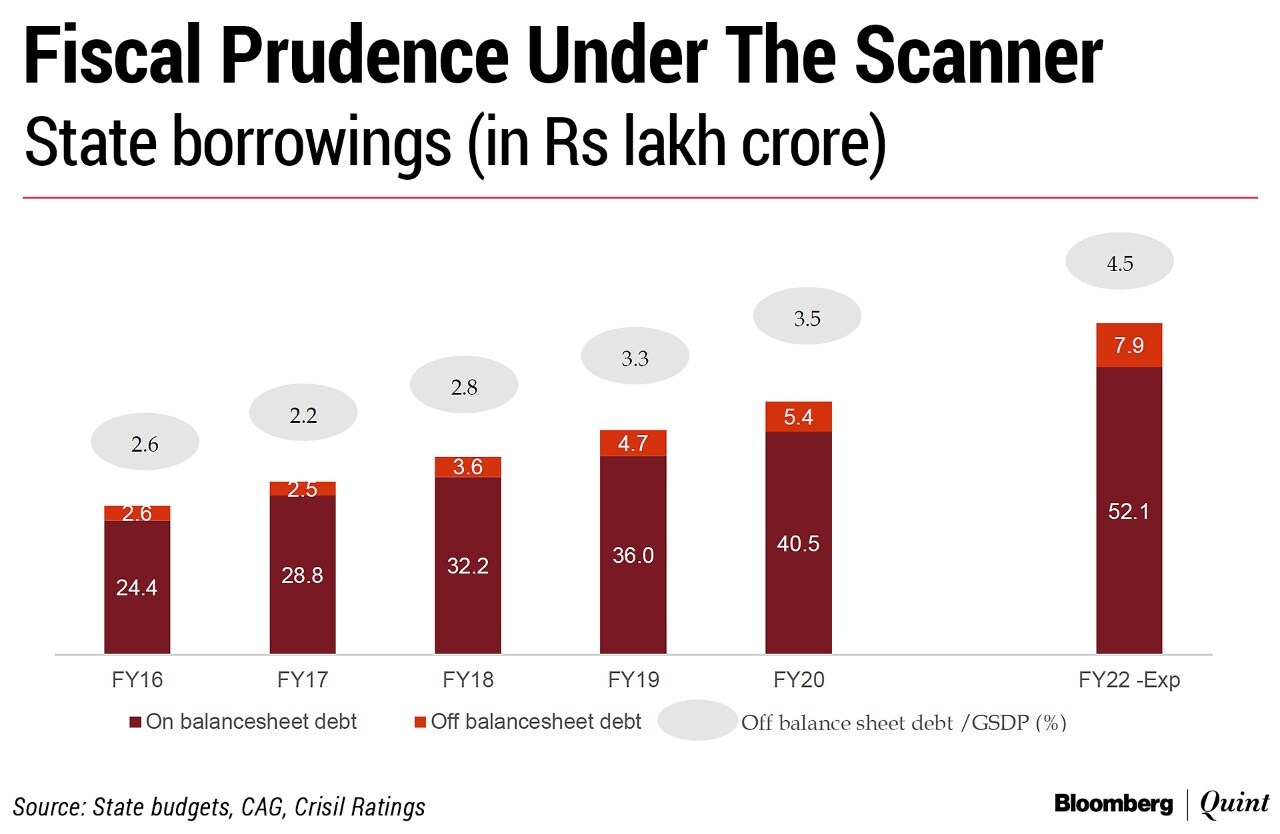
That's estimated to have reached 4.5% of gross state domestic product or Rs 7.9 lakh crore in the fiscal ended March 2022, a rise of roughly 100 basis points from FY20, the ratings agency said in a May 4 report. Crisil analysed 11 states that account for about 75% of the aggregate GSDP.
These borrowings have been raised by entities owned by states, which also guarantee the loans.
The reasons for the rise in off-balance-sheet borrowings, according to the report, are twofold.
Constrained revenue growth due to the pandemic-induced slowdown and increasing revenue expenditure have led to their fiscal deficits rising to close to 4% of GSDP, well above the historical level of 2-3% seen for most part of the last decade. This has reduced the wherewithal of states to directly fund the entities they own.
Even if states wanted to do so by borrowing more, they can't without the explicit approval of, and beyond the limits set by, the central government. But states don't need prior central consent to guarantee the loans and advances, and bonds issued by its entities. Also, the ceiling on guarantees is self-determined and varies by state. This has led to greater reliance on off-balance-sheet borrowings.
The power sector, primarily distribution companies, accounts for almost 40% of the outstanding state guarantees, Anuj Sethi, senior director at the ratings agency, was quoted as saying in the report. “These were taken to repay the dues of power generation and transmission companies with discoms continuing to make cash losses. With most of them expected to continue reporting losses this fiscal as well, due to higher coal costs, states will have to provide higher support for timely servicing of the guaranteed facilities.”
Other beneficiaries of these guarantees are state-level entities involved in irrigation infrastructure development, drinking water supply, and food and civil supplies. “Cumulatively, they are recipients of about 30% of such guarantees. However, as these entities are working to build social infrastructure and funding social welfare schemes of their governments, their own cash flows are limited.”
Cash flow support will be required for 50-55% of the outstanding guarantees, said Aditya Jhaver, director at Crisil Ratings. “4-5% of the annual revenue of states will be consumed for servicing these obligations this fiscal. This is more than double of the mark seen four-five years back and hence will partly constrain their flexibility to fund capex in the near future.”
“Fiscal prudence of the states to budget for these guaranteed obligations and allocating funds to the state-level entities in a time-bound manner will be critical,” the report said. But improvement in states' cash flows through higher collections of goods and services tax and reduction in losses at power distribution companies through cost-reflective tariffs and enhanced commercial orientation can provide some breathing space to states.
The 11 states studied by Crisil Ratings are Maharashtra, Gujarat, Karnataka, Tamil Nadu, Uttar Pradesh, Telangana, Rajasthan, West Bengal, Madhya Pradesh, Andhra Pradesh and Kerala.

-
Signature Play: The Classic Cocktail Is Dead. Or Is It?

Classic cocktails are disappearing from India's cocktail menus. But they're still being ordered, taught to bartenders and borrowed from. So, who's really having the last drink?
-
A New Samvat Wishlist: Inclusive Prosperity And Human Development
India has strengthened its economic foundations through infrastructure, digital access and enterprise. Its next growth chapter must deepen productivity, create better livelihoods and widen participation in prosperity.
-
Love, Sex Aur Dhokha: The Audacious Plot To Spy On Jensen Huang
A Taipei dinner, a Singapore chip buyer and a suspected Chinese asset: inside the alleged spy operation that got close to NVIDIA's Jensen Huang.
-
Ten Things I Learnt This Samvat
Patience can be a trap. Cheap stocks can stay cheap. Leverage can wipe you out. What did Samvat 2082 teach us? Niraj Shah writes on 10 lessons from the year gone by.
-
Talking Points This Week: Tech Nerves, FII Buying, And A Faraway Banking Shock
The global markets are not shining this Diwali. The exception in the large markets is, India.
-
Midterm Rally Lasted A Day. The Hard Reality Of A Divided US May Last Two Years | Opinion
Between a contested AI boom, a debt ceiling that arrives in 2027 and a president with every incentive to act alone, the next two years may prove more volatile than the first day's rally suggests.
-
Blue Wave Will Derail the AI Trade but Won't Dismantle the AI Era | Unhedged Position
The Democrats' sweep of the US Congress will see politics collide with economic forces both over the long and short term.
-
It's Time To Take The GST Council's Bet On Trust Global
Payment records can prove India's services exports, and clear, proportionate rules can bring foreign digital sellers into the tax net.
-
Opinion | India at 38: From Innovation Overperformer to Innovation Powerhouse
India now has 453 VC-backed deep science startups, 18 of them late-stage, after 117 percent growth since 2020. Laurus Labs, at USD 9.3 billion, is the most valuable deep science company in any middle-income economy outside China.









