Startup Street: Making Supreme Court Judges' Lives Easier With AI

In April, the Supreme Court of India launched its artificial intelligence portal to reduce the burden on judges by making legal research and review easier. Few know, however, that a small startup helped build it.
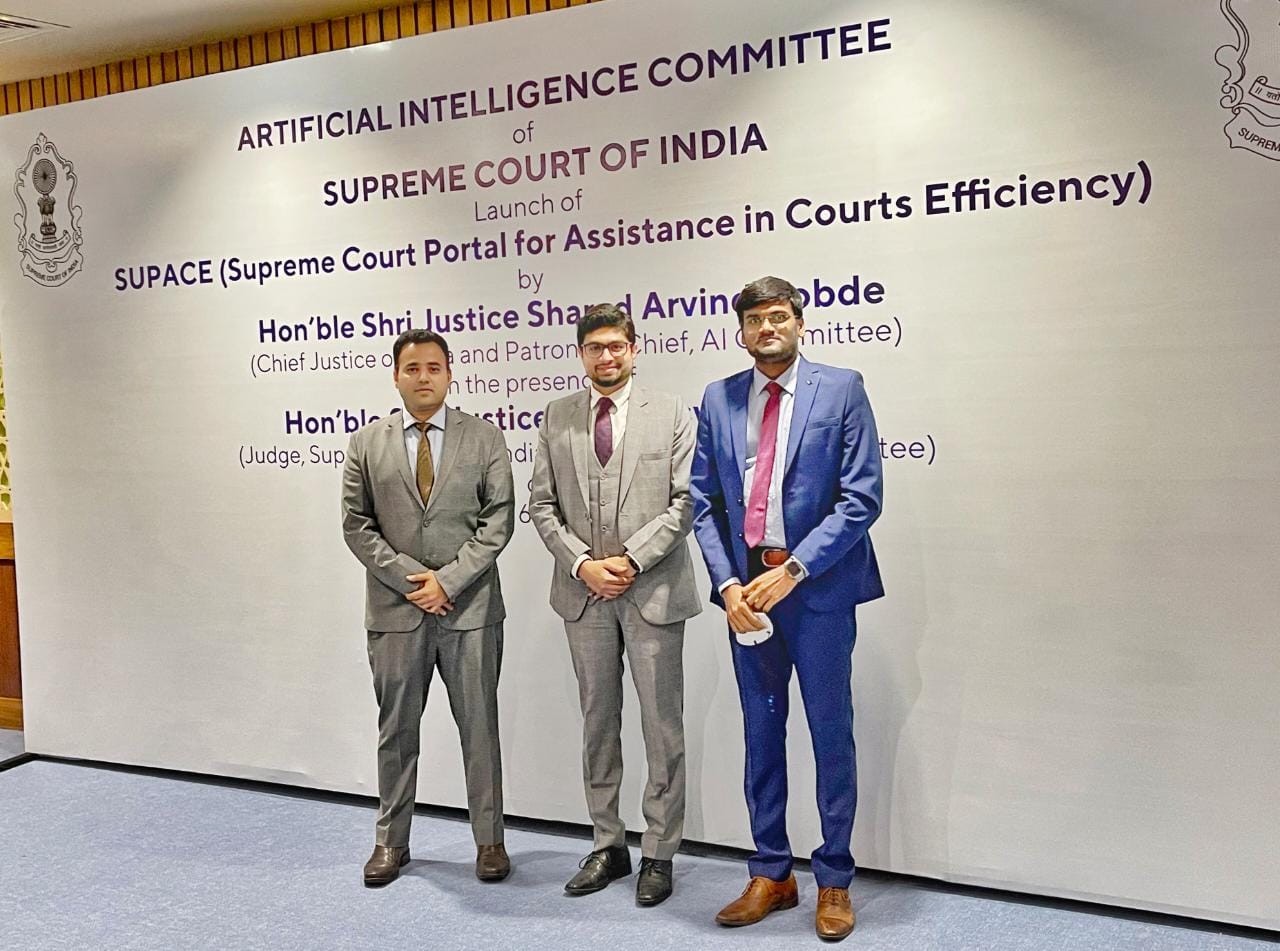
ManCorp Innovation Labs was behind the development of the automation platform called SUPACE—Supreme Court Portal for Assistance in Courts Efficiency—that India's apex decision making body has deployed. The portal was unveiled to assist in improving efficiency and speeding up resolutions.
"Most of the legal fraternity still work traditionally and use general tech tools at a time when other high value services have specialised offerings. Accountants have Tally, architects have AutoCad," Co-founder and Chief Executive Manthan Trivedi told BloombergQuint. "We saw an opportunity to create something similar for lawyers and judges."
The feature-rich portal is intended to make judges and staff save time spent on scouring volumes of documents. It has an AI-powered chatbot that can read scanned documents and extract the relevant facts. It can automatically provide synopsis to documents and has an integrated workflow system. Besides, Trivedi said there are other rudimentary tasks that the portal can automate for the judges.
"Over time, the machine can learn from experience," he said. "And as we provide more data, the program learns and makes predictions about the document, thereby making the underlying system more intelligent with every use."
ManCorp's journey didn't start with the Supreme Court project. The startup, founded by Harvard dropout Trivedi along with Rathin Deshpande and Vishnu Gite, was initially conceived as a think tank and research lab for artifical intelligence. The goal was to develop AI-powered technology solutions. "Legal and judicial space just happened to be the first problem we attempted to solve."
From left to right: Rathin Deshpande, Manthan Trivedi and Vishnu Gite (Source: ManCorp)
The startup has earlier developed software for the High Courts of Patna and Jharkhand. It built a smart case allocation system for the Patna High Court which suggests allocation of cases to specific benches and Judges based on their track record of expertise in the subject matter. For Jharkhand High Court, it built a chatbot for automated document review.
"The projects implemented at the High Courts of Jharkhand and Patna were pilots of small features, which upon their success, were integrated and adopted by the Supreme Court of India under its flagship AI portal SUPACE," he said.
Trivedi sees further applications of this technology in other aspects of law, too. "There is huge potential of applying AI in complementing decision making in almost all legal fields including litigation management, contracts, motor vehicular claims, taxation, negotiable instruments cases."
But he draws the line at letting AI make legal decisions. "AI is a means to improve human decision making by allowing them to make informed choices," he said. "Just like in human decision making even with AI we must be careful in reducing bias and increasing internal regulation for better complimentary function."
Even then Chief Justice SA Bobde, who had pushed for the development of SUPACE, had said that AI should be kept away from decision making.
The worries are partially also due to the lack of regulation around artifical intelligence. "One of the inherent features of any technology is that it constantly evolves at a rapid pace. Its regulation, historically, has to catch up to this constant evolution," Trivedi said. "This regulatory lag creates a space and ushers a responsibility on deep tech company to self-regulate. However, that requires strong commitment of companies to values like transparency, data protection, privacy, accountability and user autonomy."
Trivedi said he hopes to see a mix of internal and external regulation of deep tech and artificial intelligence in the future.
ManCorp has a team of 40, of which around 30 are part of the technical team at the research and development office in Pune. The rest are at the administrative office in Delhi. The startup, which has been bootstrapped till now, is hunting for investors for a seed funding round.
Trivedi said they're also open to deploying their technology to other sectors and not remain confined to just law. "All our technologies are solutions that can be customised for many different use cases," he said. "Our focus has always been to develop technologies that can help solve a problem at large rather than building something that caters to a single market."

-
India's Troika Of Good Luck | Joining The Dots

A weaker Trump, a cooling AI trade and resilient earnings have put Indian markets back in favour. Rising inflation could spoil the party.
-
Talking Points This Week: Leadership Shock At Nvidia, Earnings Strength, And The Fog Over Hormuz
The Anthropic IPO pricing and first trading day, Nvidia's upcoming earnings, and any fresh signals from Iran will set the tone for the following week.
-
Signature Play: The Classic Cocktail Is Dead. Or Is It?
Classic cocktails are disappearing from India's cocktail menus. But they're still being ordered, taught to bartenders and borrowed from. So, who's really having the last drink?
-
A New Samvat Wishlist: Inclusive Prosperity And Human Development
India has strengthened its economic foundations through infrastructure, digital access and enterprise. Its next growth chapter must deepen productivity, create better livelihoods and widen participation in prosperity.
-
Love, Sex Aur Dhokha: The Audacious Plot To Spy On Jensen Huang
A Taipei dinner, a Singapore chip buyer and a suspected Chinese asset: inside the alleged spy operation that got close to NVIDIA's Jensen Huang.
-
Ten Things I Learnt This Samvat
Patience can be a trap. Cheap stocks can stay cheap. Leverage can wipe you out. What did Samvat 2082 teach us? Niraj Shah writes on 10 lessons from the year gone by.
-
Talking Points This Week: Tech Nerves, FII Buying, And A Faraway Banking Shock
The global markets are not shining this Diwali. The exception in the large markets is, India.
-
Midterm Rally Lasted A Day. The Hard Reality Of A Divided US May Last Two Years | Opinion
Between a contested AI boom, a debt ceiling that arrives in 2027 and a president with every incentive to act alone, the next two years may prove more volatile than the first day's rally suggests.
-
Blue Wave Will Derail the AI Trade but Won't Dismantle the AI Era | Unhedged Position
The Democrats' sweep of the US Congress will see politics collide with economic forces both over the long and short term.
-
It's Time To Take The GST Council's Bet On Trust Global
Payment records can prove India's services exports, and clear, proportionate rules can bring foreign digital sellers into the tax net.









