Startup Stories: How Deep Kalra ‘Made His Trip’
My journey started back in early-2000 when Neeraj Bhargava from eVentures reached out to hear my idea around making the most of India's first internet wave. Given the buzz around ‘dotcom', every business plan was getting funding. He liked the pitch and we worked out the term-sheet on a napkin! I got funding of around $2 million and it was just the start I was looking for. I would stay up through the night combing through Expedia and Travelocity. I wanted MakeMyTrip to be the defining portal for people to book travel to India, from India and within India. I was naïve enough to think that I could do it alone, but quickly realised that I needed to get a team in place. Several sleepless nights later, we went live on Oct. 7, 2000.

As an entrepreneur, if you lack self-awareness of your strengths and more importantly your weaknesses, you are likely going to disappoint yourself big time.
You always have to hire people who are smarter than you or complement your skills.
I have leaned on many talented people in my journey, knowing that they do certain things better than I do and complement my skills very meaningfully. I was very fortunate that some of the initial hires were not only incredibly smart, but they also stood by me through the toughest of times.
Big Choices Made In The Early Years
Six months after the launch, we realised that Indians were only searching for flight fares but not booking. They weren't confident about paying online. So, one of the smartest things we did early on was to stop our marketing efforts in India and we decided to focus on the NRI market in the United States and build a profitable business. It worked out well as we hit our initial milestones and were ready for the next million when suddenly eVentures decided to pull the plug on us. They told us the limited partners wanted their money back and I was informed that I could either return the money or buy the company back. I somehow managed to buy back the company with the help of friends and family.
After buying the company back, it was time to talk to the team. We just had enough money to survive for two months. We were about 42 of us then. While there would be no salary cuts for juniors, senior guys would have to take a pay cut, but I promised to compensate the loss of pay with stock. It was a big risk, but I knew I was onto something. The conversion rates were getting better and we were getting a lot of repeat customers; it brought down the cost of customer acquisition. I knew that one year in business was nothing in India because it takes time to build a business here and I had to keep going.
As an entrepreneur, it is very important to celebrate even the smaller wins. In the pursuit of creating something big, we sometimes forget the importance of taking a step back and reflecting on our success. Hence, at the time when we were growing, we would celebrate every small win. If we achieved our six-month target, the entire team would go rafting. We would take a bus or a train, just a bare-bones trip but it was so much fun. People would even pitch in if we were short of funds.
You can never recreate the bonding that happens when you are running a bootstrapped startup.
Handling Turbulence
2001 to 2003 was one of our toughest periods. We never had cash that would last beyond a couple of months. Just as we were emerging from the dotcom bust, 9/11 happened. While it did have a significant impact on the travel industry, we survived with much less damage. It was the beauty of the ‘visiting friends and relatives' segment and we were lucky to be in this segment because demand was inelastic. Customers were visiting parents and friends, coming down for marriages, childbirth, bereavement or travelling for jobs. That didn't stop because of 9/11, so we were minimally impacted. But since we were bootstrapped, we had to make sure that every sale was profitable for the company.
Between 2003 and 2004, we got our next round of angel funding. One of them was an existing customer in the U.S., T Maheshwar, who made his money in the telecom era. He used to regularly book his tickets through us. During one of his bookings, he told one of our agents that he wanted to meet me. I wasn't sure why he wanted to meet, but we met anyway. After the meeting, he ended up writing a cheque of $200,000.
Returning To India
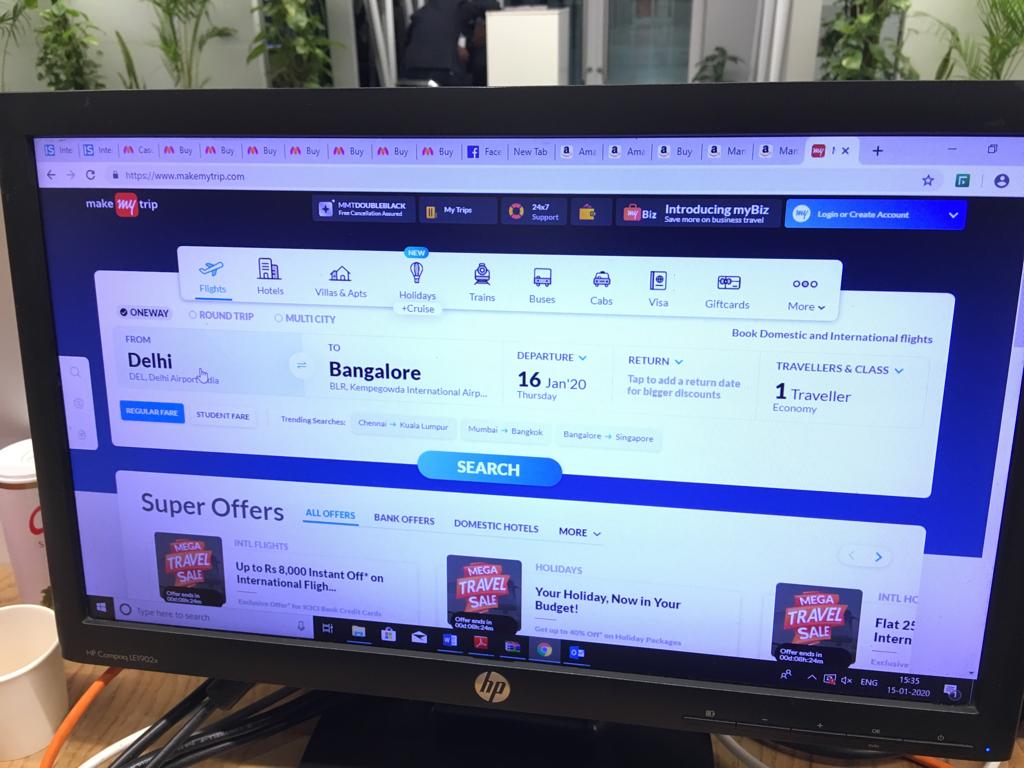
After the eVentures fiasco, when we were left high and dry, I had sworn to never take venture capital funding. In 2005, I changed my mind. One thing was becoming clear, the Indian aviation market was opening up with low-cost carriers being launched. Meanwhile, with Indian Railways launching online reservations, people were also getting increasingly confident about booking tickets online. So, we decided to launch our India operations. Air Deccan ads were everywhere but most agents weren't ready to sell Air Deccan because they didn't make money on those tickets. We solved that problem using technology — meshing the fares of LCCs with the global distribution system. Now everything was on offer and it was a big game-changer.
For the first time, power was moving from the travel agent to the customer.
We were probably the first online travel agency to sell LCCs in the world. As we scaled up the India operations, it made sense to look at funding again.
Going Public, Growing Further
The next four to five years was a great time for us. Our gross merchandise value grew about 20x from about $30 million in 2005 to $600 million by the time we became a listed company. We were profitable. Sanjeev Bikhchandani from Info Edge was on the board and suggested we look at an initial public offering. He told us that Naukri was at a similar stage when they went in for an IPO. Sanjeev is my mentor, philosopher, and guide. Apart from drilling into us that there is nothing more important than solving customer problems, he also helped us go offline in 2008.
The stock surged 90 percent on listing. The IPO changed a lot of things for us. Fundraising became a lot easier and the biggest advantage was the ability to attract top talent.
Through all this I have learned that an entrepreneur needs to focus on building, not selling.
Build a better product that solves a real pain-point, a better experience that will be universally loved. It takes time for businesses to build, and it is usually how an entrepreneur handles the first five to six years that determines the company's success and growth. Some of the best businesses might not have seen the light of the day because some entrepreneurs gave up too early. One should lose sleep on creating value, not valuation. In this unicorn-obsessed startup era, there is nothing wrong with billion-dollar dreams and moonshot ambitions but the lack of appreciation for $100 million success stories is just hype-driven cynicism. Entrepreneurship is a journey and not a destination and, in this journey, one makes choices that could be excruciatingly hard.
Deep Kalra is Founder, Group Chairman, and Group CEO of MakeMyTrip.
The views expressed here are those of the author, and do not necessarily represent the views of BloombergQuint or its editorial team.

-
AI Bias In Investing Cannot Be Eliminated, But It Can Be Governed

Framing is a particularly important example as identical financial information presented in terms of gains rather than losses can lead an LLM to reach a different assessment.
-
Joining The Dots | Dark Skies, Steady Diya: Why Hope Holds This Diwali
With war, a weak rupee and foreign outflows weighing on sentiment, policymakers at the NDTV World Summit and market veterans at NDTV Profit Ignite: Diwali Edition offered the same advice: stay invested and filter out the noise.
-
The Curious Case of Equitas Small Finance Bank And A CEO Who Quit For Stock
PN Vasudevan believes persistent investor concerns over a perceived conflict of interest had become a governance overhang on Equitas Small Finance Bank's stock, even as the lender improved profitability and asset quality.
-
Talking Points This Week: AI Cash Burn, A Tiger Comeback And An India That Still Finds Its Own Path
India is not immune to higher oil or tighter global liquidity, yet its earnings base is broader, its domestic policy levers are still available.
-
Foreign Investors Own Half Of HDFC Bank and ICICI Bank. An LTCG Cut Could Matter Most Here
Foreign portfolio investors have US$115 billion parked in HDFC Bank, ICICI Bank. If the government cuts long-term capital gains tax, Jefferies says returning foreign money could land here first.
-
'Never Seen This Level Of Negativity': Sandeep Tandon Says The Next Rally May Be Closer Than You Think
Veteran investor Sandeep Tandon says foreign selling is easing, large-caps are due a comeback and mid-caps are crowded, while he turns positive on gold, power and pharma this Diwali.
-
Indians Stay With Family, Not In Hotels | The Reason Why
India still lacks enough clean, reliable and affordable hotels for budget-conscious travellers.
-
The Economic Imperative: Analysing The Material Driving Force Behind India-Canada Strategic Reset
This economic complementarity is further reinforced by deep institutional investment ties and talent mobility, which form the bedrock of the bilateral framework.
-
Medicine Pricing: Where Must Profit Stop?
India must confront excessive margins, hidden incentives and regulatory gaps that threaten the integrity of medicine.
-
Why Amazon And Flipkart Are Struggling To Beat Meesho In India's Smaller Cities
With 274 million users and lowest-cost logistics, Meesho is defending its value commerce crown against giants like Amazon and Flipkart.










