SRF Gets 'Sell' Call From Citi On Concerns Over Pricing And Demand

Citi Research has downgraded SRF Ltd. ratings and cut the target price, citing concerns regarding the pricing and demand for refrigerant gas exports. Additionally, they anticipate that the ramp-up of specialty chemicals is likely to be back ended to the second half of the financial year 2025.
The research firm has downgraded SRF to 'sell' from 'buy' and cut the target price to Rs 1,850 from Rs 2,675.
Citi also revised its FY25 and FY26 Ebitda estimates downward by 20-23% due to several factors. These include a slower-than-expected ramp-up of specialty chemical capacities that were commissioned last year, weaker volumes and pricing for refrigerant gas, and lower margins in the packaging film business.
Despite facing headwinds such as inventory rationalisation by key customers and heightened competition from China, the specialty chemicals segment performed relatively better compared to the previous quarter, Citi Research said in a May 10 note.
Given the management's guidance for FY25 revenue growth in the chemicals segment, SRF is currently trading at approximately 25 times the estimated EV/Ebitda for FY25, which is close to its highest forward EV/Ebitda multiple as per consensus estimates, Citi added.
However, with uncertainties looming over the potential impact of the US HFC consumption phase down on SRF's refrigerant gas volumes and pricing, coupled with the expected ramp-up in the specialty chemicals segment likely being deferred to the second half of FY25.
SRF Q4 Earnings Highlights (Consolidated, Year-On-Year)
Revenue down 6% Rs 3,570 crore.
Ebitda down 25.3%Rs 712 crore.
Margin at 19.9% versus 25.4%
Net profit down 25% at Rs 422 crore.
Here's What Brokerages Have To Say
Jefferies
Jefferies maintain 'underperform' rating with a target price of Rs 2,338.55. This implies a downside of 11%.
Capex guidance lowered, net debt comfortable: Capex declined 17% year-on-year FY24 to Rs 22.4 billion undershooting Rs 30 billion capitalised in Chemicals in FY24 management lowered FY25 capex guidance to Rs 2,000 crore.
Management guided to 20%+ growth in revenues in FY25 with growth being back-ended in 2HFY25.
Growth is anchored on Rs 18 billion of new plants that were commissioned during FY24 and traction with 2-3 AIs that they have recently forayed into.
"We have cut segment revenues 4% for FY25E in line with management guidance".
Motilal Oswal Financial Services
The chemicals business is expected to witness major improvement from H2 FY25 onwards.
The packaging business is expected to remain under pressure in the medium term.
The chemical business is expected to witness 20% growth in FY25, with significant growth expected in 2HFY25.
Management plans to incur a total capex of Rs 2,200 crore in FY25
The research firm reduces FY25/FY26E Ebitda by 12%/10%.
Dam Capital
Dam Capital maintain 'buy' with target price of Rs 2,651 and it sees stronger recovery in FY26E as chemical business regains momentum and
SRF's long term growth outlook and its R&D driven model will continue to command premium valuations.
SRF's FY24 results reflect macro challenges with respect to inventory destocking and Chinese dumping across multiple segments.
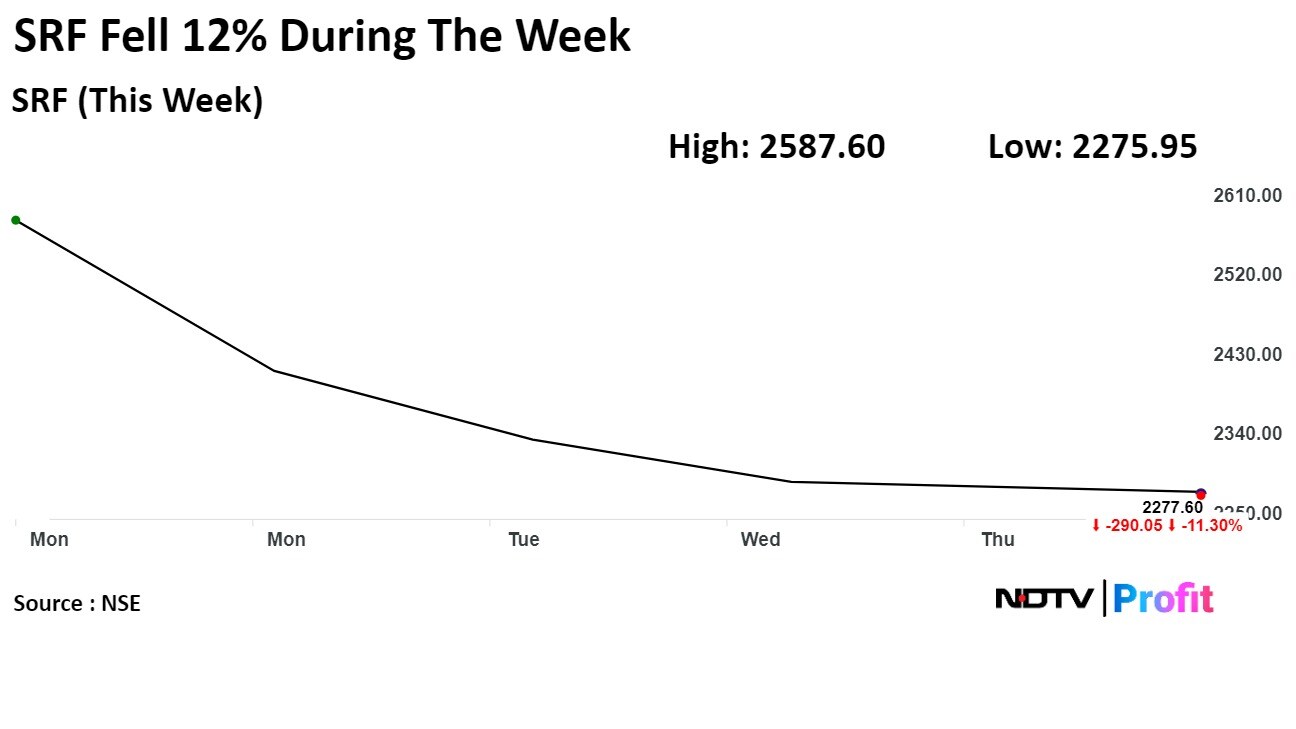
Shares of the company rose as much as 2.45% to Rs 2,347.40 apiece. It was trading 0.53% lower at Rs 2,279.15 apiece as of 1:58 a.m. This compares to a 0.42% advance in the NSE Nifty 50 Index. The stock has seen a 12% plunge since May 6, 2024.
The stock has fallen 11.36% in 12 months and 8.15% on year-to-date basis. Total traded volume so far in the day stood at 2.3 times its 30-day average. The relative strength index was at 28, indicating that stock may be oversold.
Out of 34 analysts tracking the company, 23 maintain a 'buy' rating, four recommend a 'hold,' and seven suggest 'sell', according to Bloomberg data. The average 12-month consensus price target implies a downside of 10.6%.

-
One El Nino, India Can Handle. Two Could Break The Granary

India's grain stocks can absorb one bad year, but a second El Nino could drain the buffer in two to three years, economists say.
-
India's Troika Of Good Luck | Joining The Dots
As Jensen Huang's exit drags Nvidia down, a cooling AI trade and resilient earnings have revived investor interest in India. A likely RBI rate hike looms.
-
Talking Points This Week: Leadership Shock At Nvidia, Earnings Strength, And The Fog Over Hormuz
The Anthropic IPO pricing and first trading day, Nvidia's upcoming earnings, and any fresh signals from Iran will set the tone for the following week.
-
Signature Play: The Classic Cocktail Is Dead. Or Is It?
Classic cocktails are disappearing from India's cocktail menus. But they're still being ordered, taught to bartenders and borrowed from. So, who's really having the last drink?
-
A New Samvat Wishlist: Inclusive Prosperity And Human Development
India has strengthened its economic foundations through infrastructure, digital access and enterprise. Its next growth chapter must deepen productivity, create better livelihoods and widen participation in prosperity.
-
Love, Sex Aur Dhokha: The Audacious Plot To Spy On Jensen Huang
A Taipei dinner, a Singapore chip buyer and a suspected Chinese asset: inside the alleged spy operation that got close to NVIDIA's Jensen Huang.
-
Ten Things I Learnt This Samvat
Patience can be a trap. Cheap stocks can stay cheap. Leverage can wipe you out. What did Samvat 2082 teach us? Niraj Shah writes on 10 lessons from the year gone by.
-
Talking Points This Week: Tech Nerves, FII Buying, And A Faraway Banking Shock
The global markets are not shining this Diwali. The exception in the large markets is, India.
-
Midterm Rally Lasted A Day. The Hard Reality Of A Divided US May Last Two Years | Opinion
Between a contested AI boom, a debt ceiling that arrives in 2027 and a president with every incentive to act alone, the next two years may prove more volatile than the first day's rally suggests.
-
Blue Wave Will Derail the AI Trade but Won't Dismantle the AI Era | Unhedged Position
The Democrats' sweep of the US Congress will see politics collide with economic forces both over the long and short term.