South Korea Exports Accelerate As Shipments To U.S. Overtake China
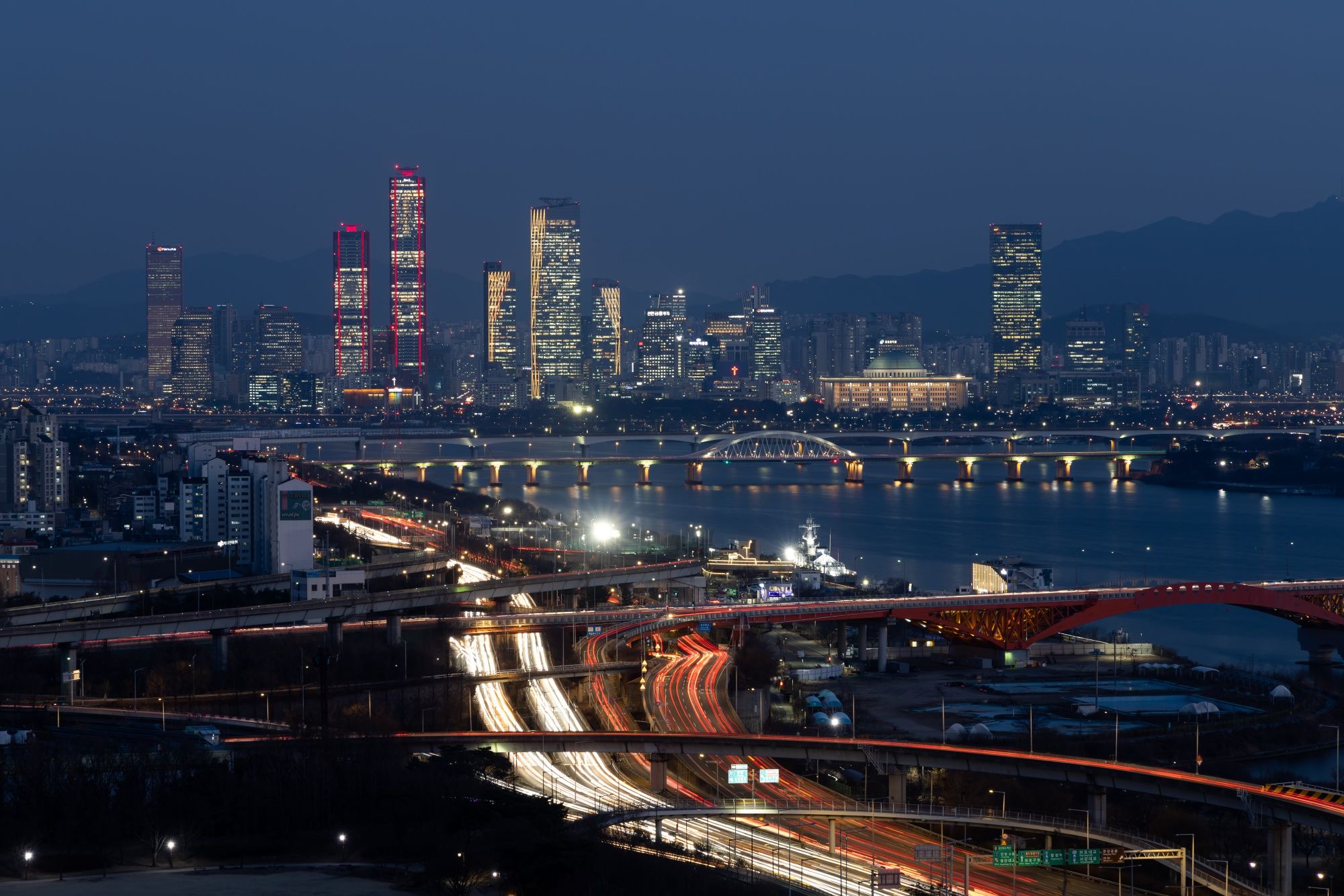
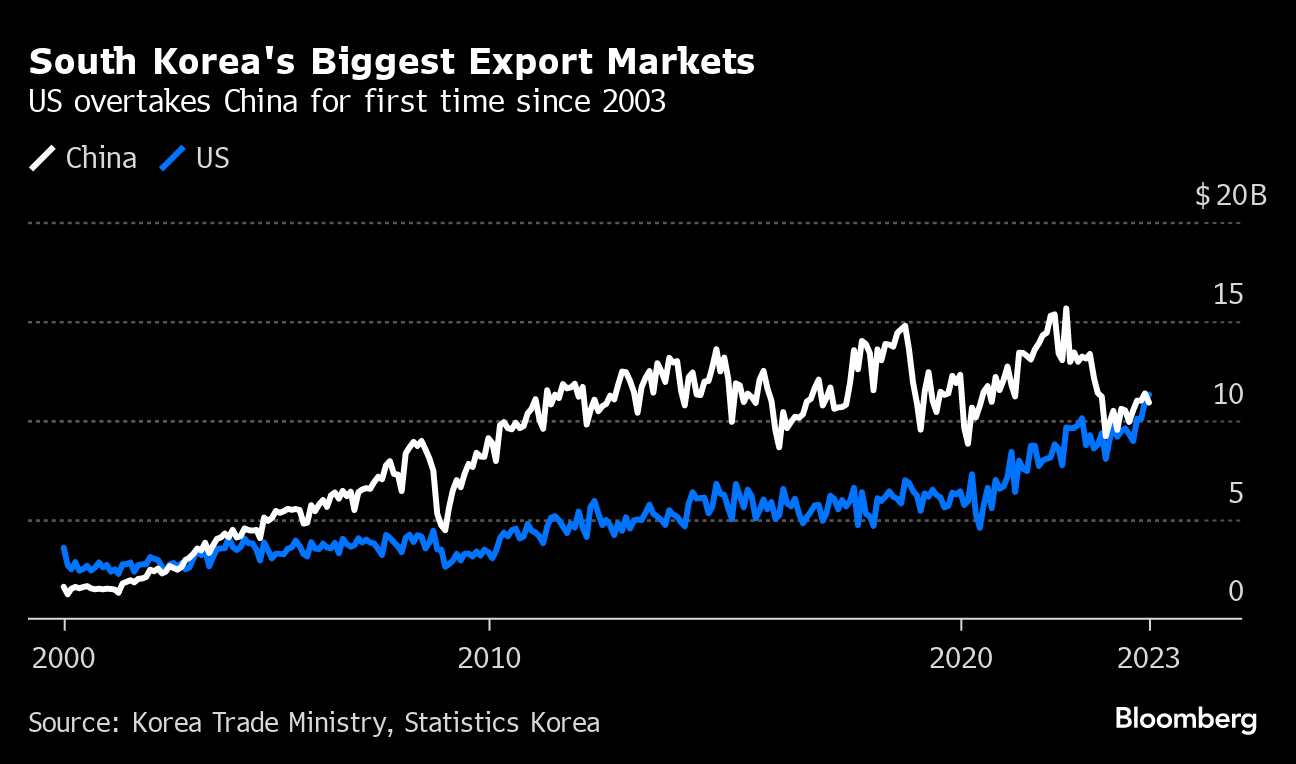
(Bloomberg) -- South Korean exports continued to grow last month, helped by rising demand from the US that overtook China as the biggest market for the first time in two decades.
The value of global shipments adjusted for working-day differences increased 14.5% from a year earlier, according to data released Monday by the trade ministry. Headline exports rose 5.1%, compared with economists' forecasts for a 3.7% increase. Overall imports declined by 10.8%, resulting in a trade surplus of $4.5 billion.
In a sign of closer ties with Washington and Beijing's economic challenges, South Korea sold $11.3 billion in goods to the US compared with $10.9 billion to China in December. Still, one month's data doesn't offer conclusive proof of an enduring shift in trading patterns.
China remains South Korea's biggest trading partner by a large margin given the scale of Seoul's imports from the world's second-largest economy.
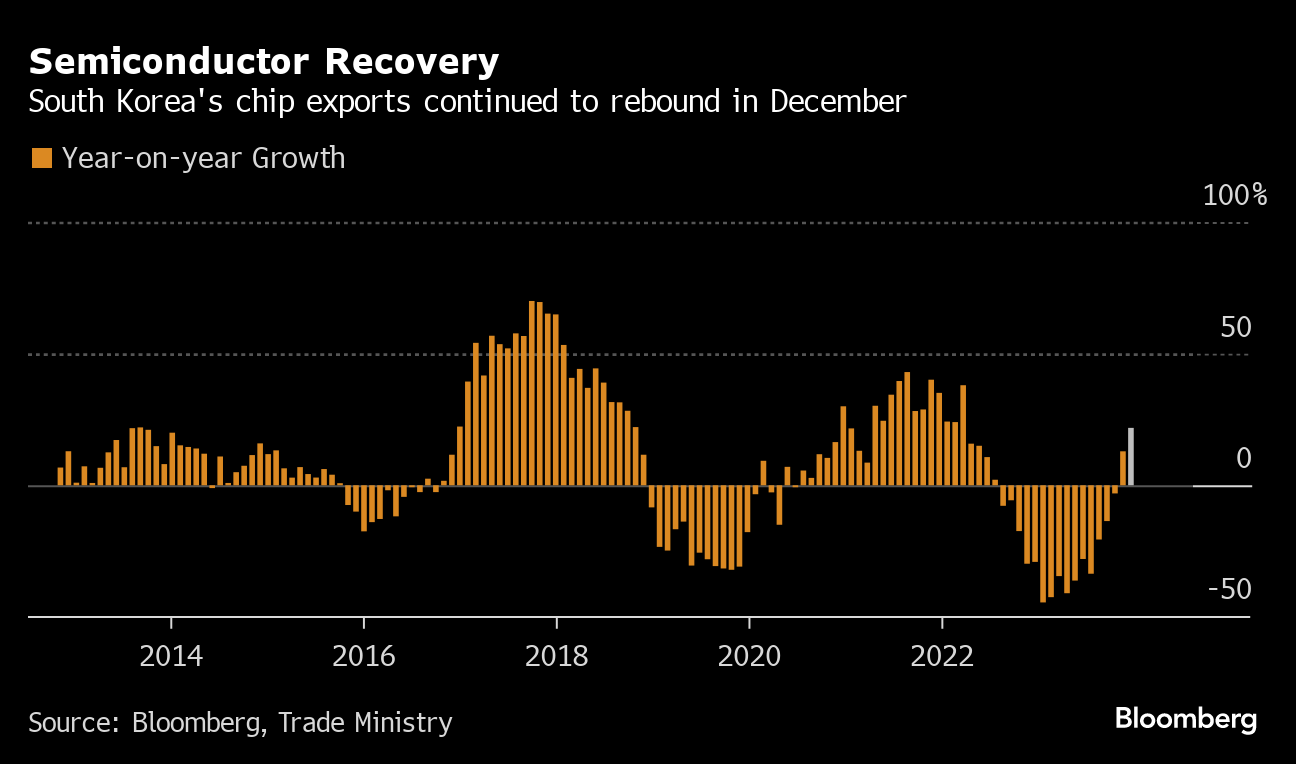
South Korea's exports emerged from a yearlong slump late last year after global demand for its products ranging from electronics and automobiles to petrochemicals and shipbuilding finally started to recover.
Semiconductor exports jumped 21.8% from a year earlier in December as memory-chip prices continued to rebound, the trade ministry said. Prices are rising again on the back of demand for artificial intelligence and other emerging technologies. The impact on economic growth in South Korea and countries including Taiwan and Vietnam will be closely watched in 2024.
Demand for South Korean goods has generally been recovering across the world, indicating consumers may be regaining confidence after a prolonged period of higher interest rates.
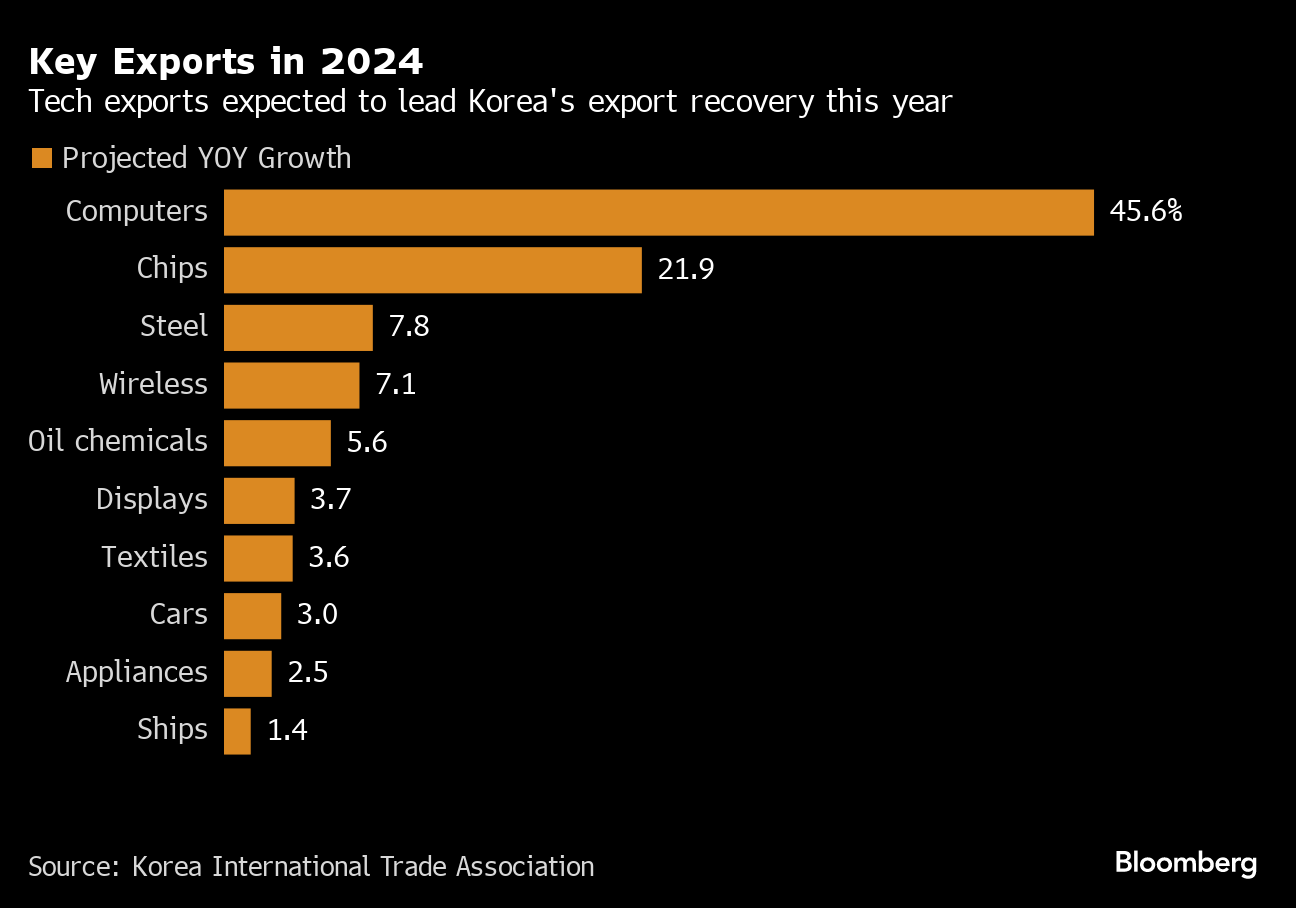
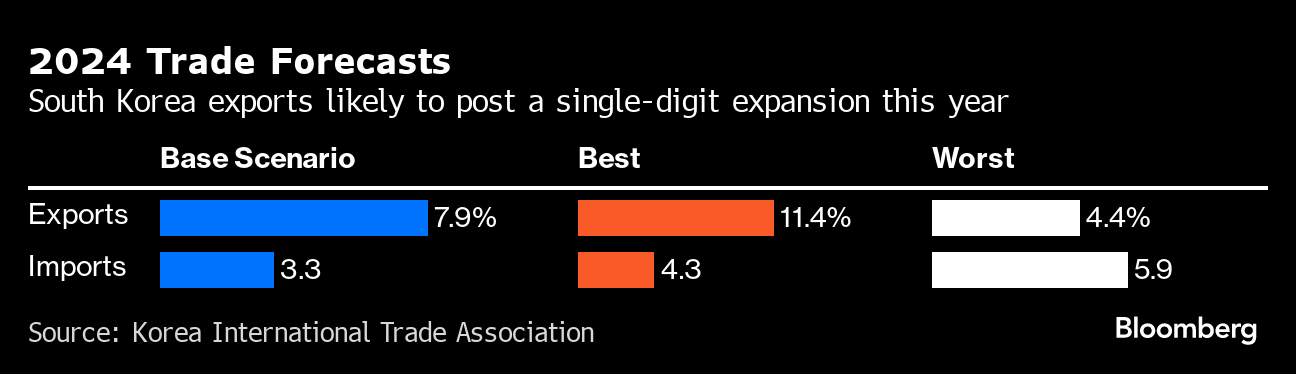
South Korea's exports will probably rise by 7.9% in 2024, reaching $680 billion, according to base-case forecasts by the Korea International Trade Association. The association expects imports to increase 3.3%, with the trade surplus reaching $14 billion.
Still, downside risks remain. Bloomberg Economics forecast last week that global growth will slow to 2.7% in 2024 from 3.1%, the slowest since 2001 excluding the global financial crisis in 2009 and the Covid pandemic in 2020.
“Korean exports are still bottoming out and likely to start a weak recovery trend in 2024,” Pantheon Economics said in a note last month. “Global demand is still soft.”
Geopolitical tensions such as the Israel-Hamas war and growing protectionism add to risks for Korea, while questions remain surrounding the health of the economic recovery in China.
China is also ramping up domestic production of goods as it moves up the value chain. One key area that China is focusing on is semiconductor and smartphone manufacturing, a development that has threatened market shares held by Samsung Electronics Co. and other South Korean exporters.
Exports to China in December slid 2.9% from a year earlier, while shipments to the US rose 20.8%, the ministry said.
The US-China rivalry also casts a shadow over global trade. The US has been looking to generate support for its agenda to reduce dependence on China in global supply chains and limit the country's access to advanced semiconductor technology.
That has placed countries like South Korea and Japan in an awkward spot between their two biggest trading partners. Both Seoul and Tokyo are key military allies of Washington, another important dimension given Beijing's increasing assertiveness in the Indo-Pacific and rising tensions in the region.
(An earlier version of this story corrected the decline in overall imports.)
More stories like this are available on bloomberg.com
©2024 Bloomberg L.P.

-
We May Need Another Tukaram Mundhe To Fight Air Pollution | The Reason Why

Developers may install basic measures such as sprinklers and green nets, resume work, and continue violating rules when this equipment stops working.
-
Extracting Value From Battery Scrap Could Be Challenging For India | The Reason Why
A discarded lithium-ion battery still contains valuable materials such as lithium, nickel and cobalt. These can be recovered and reused. When such batteries are crushed and shredded, they produce a dark powder called black mass.
-
One El Nino, India Can Handle. Two Could Break The Granary
India's grain stocks can absorb one bad year, but a second El Nino could drain the buffer in two to three years, economists say.
-
India's Troika Of Good Luck | Joining The Dots
As Jensen Huang's exit drags Nvidia down, a cooling AI trade and resilient earnings have revived investor interest in India. A likely RBI rate hike looms.
-
Talking Points This Week: Leadership Shock At Nvidia, Earnings Strength, And The Fog Over Hormuz
The Anthropic IPO pricing and first trading day, Nvidia's upcoming earnings, and any fresh signals from Iran will set the tone for the following week.
-
Signature Play: The Classic Cocktail Is Dead. Or Is It?
Classic cocktails are disappearing from India's cocktail menus. But they're still being ordered, taught to bartenders and borrowed from. So, who's really having the last drink?
-
A New Samvat Wishlist: Inclusive Prosperity And Human Development
India has strengthened its economic foundations through infrastructure, digital access and enterprise. Its next growth chapter must deepen productivity, create better livelihoods and widen participation in prosperity.
-
Love, Sex Aur Dhokha: The Audacious Plot To Spy On Jensen Huang
A Taipei dinner, a Singapore chip buyer and a suspected Chinese asset: inside the alleged spy operation that got close to NVIDIA's Jensen Huang.
-
Ten Things I Learnt This Samvat
Patience can be a trap. Cheap stocks can stay cheap. Leverage can wipe you out. What did Samvat 2082 teach us? Niraj Shah writes on 10 lessons from the year gone by.
-
Talking Points This Week: Tech Nerves, FII Buying, And A Faraway Banking Shock
The global markets are not shining this Diwali. The exception in the large markets is, India.









