Small is big in Ford's India drive
Ford Motor Co will focus on small, low-cost cars in India to make the country a manufacturing hub for Africa and the Asia-Pacific region, the head of its Indian operations said, as it races to catch up with global rivals in the fast-growing market.
Ford will launch a slew of new small cars in India over the next three years to target a market it has neglected and ramp up exports to other emerging economies as it doubles capacity in Asia's third-largest economy, where the small car is king.
"We haven't been a major player (in India) because we weren't positioning ourselves in the segment where 70 percent of all cars are sold," Michael Boneham, president of Ford India told Reuters. "We were focused more on issues outside of India and sending cars that were force-feeding the Indian consumer.
"That was a mistake and we've learned from that mistake and now have a very robust plan for the business...You can expect a heavy focus on small cars from Ford."
Ford India began operations in 1995. A year later, South Korea's Hyundai Motor entered the market and immediately began targeting the small car sector where formerly state-run Maruti Suzuki had a virtual monopoly.
As Ford struggled with sluggish sales of oversized, costly vehicles, Hyundai's compact cars drove the company to second place in the market within two years. Hyundai India sold 616,000 cars in 2011, around five times Ford's total.
Cheap, small models dominate India's car market, accounting for around 70 per cent of sales as aspirational middle class families, mainly relying on loans, trade in their motorcycles for four-wheeled status symbols.
Many global automakers have moved low-cost export operations to India recently. Japan's Nissan Motor, which entered the country in 2005, exported 60,000 Micra sub-compacts last fiscal year, 80 per cent of the vehicles' production.
"India will be the small-car hub for Asia Pacific and Africa for Ford," Boneham told Reuters in an interview at his company's sprawling 350-acre factory in Chengalpattu, a one-hour drive south of Chennai. "This is a pretty robust test track...Many developing countries fit the profile of what we experience here."
LOW-COST EXPORT HUB
As workers fit rear seats to a silver Ikon sedan, a model sold in South Africa but not India, dozens of Figo hatchbacks wait at the end of the factory's production line. Almost half are left-hand drive -- Indian drivers sit on the right -- and will travel Indian roads only on the back of a truck.
Ford exported 30,000 cars from India in 2011, a fifth of its total production, and will ramp up shipments to North Africa in particular this year to increase to 50 the number of markets selling Indian-manufactured Figos, Ikons and Fusions.
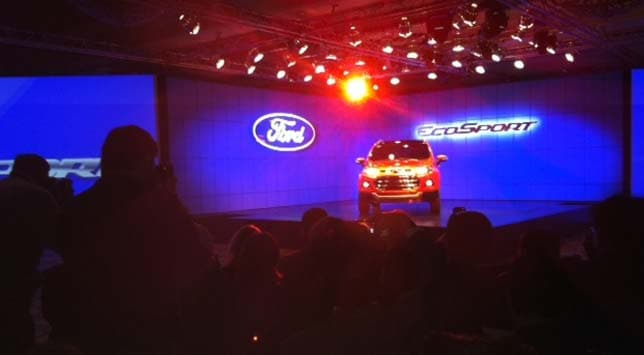
Ford's new EcoSport compact SUV will be built at the Chengalpattu plant with production for the local market and exports to begin after the company completes $142 million of factory enhancements. Ford will also make EcoSports in Brazil.
"All the vehicles that will be coming here will be global platforms," said Boneham, "designed and engineered...with a global market in mind.
"The countries that we are exporting to are looking for an entry-level vehicle from Ford and we are able to supply that thanks to the efficiencies we have here...and the localization, which of course brings down costs," Boneham said.
Ford employs 5,000 workers at the plant in an industrial belt dubbed "India's Detroit," fuelled by government incentives and a young, well-educated labour force. Ford's workers have an average age of 27 and 80 percent boast engineering diplomas.
Small groups, clad in safety goggles and navy blue overalls work with precision on tidy, humming production lines, wielding large overhead robotic drills through showers of sparks or fitting gear-sticks to cars bound for Mumbai or Mexico City.
Ford imported steel panels from Thailand before opening a local facility in 2007 to make them. Indian steel saves around $100 per car. Local products make up 85 per cent of the Figo.
"I think there is scope to increase localization," said Boneham, who has led Ford's Indian operations since 2008. "I would like to see us at 90 to 95 percent."
NEW FOCUS
Ford will open a new $1 billion, 240,000 cars-a-year plant in northwest India in 2014, part of an investment spree by the Detriot-headquartered automaker to treble its India-produced roster to 12 models. The majority of the new models will be small passenger cars, Boneham said, without providing details.
While car sales growth in India slowed last year as high interest rates and fuel costs deterred buyers, Ford expects passenger and commercial vehicle sales to hit 9 million by 2020, from less than 3.5 million in 2011.
Carmakers such as Volkswagen and General Motors have spent billions on plants to grab a share of the market. Even luxury brands like BMW AG and Daimler's Mercedes-Benz plan to bring compact cars to India.
Ford's Chengalpattu plant should be close to full production by the end of 2012. The new plant in Sanand, Gujarat, will take the company's capacity in India to almost 450,000 cars. That may not be enough to satisfy local and export demand, Boneham said.
"I'll be in the happy position of having to look for more capacity here in the short term," said Boneham.
Copyright @ Thomson Reuters 2012

-
Indians Are Travelling, But Not Every Journey Is A Holiday | The Week In Whys

Pilgrims, patients and working women are the real travellers, and the system hasn't quite caught up with them.
-
Getting To Work Costs Women More | The Reason Why
It is not just about women paying more than men. It is about women paying much more in cities than in villages.
-
AI Bias In Investing Cannot Be Eliminated, But It Can Be Governed
Framing is a particularly important example as identical financial information presented in terms of gains rather than losses can lead an LLM to reach a different assessment.
-
Joining The Dots | Dark Skies, Steady Diya: Why Hope Holds This Diwali
With war, a weak rupee and foreign outflows weighing on sentiment, policymakers at the NDTV World Summit and market veterans at NDTV Profit Ignite: Diwali Edition offered the same advice: stay invested and filter out the noise.
-
The Curious Case of Equitas Small Finance Bank And A CEO Who Quit For Stock
PN Vasudevan believes persistent investor concerns over a perceived conflict of interest had become a governance overhang on Equitas Small Finance Bank's stock, even as the lender improved profitability and asset quality.
-
Talking Points This Week: AI Cash Burn, A Tiger Comeback And An India That Still Finds Its Own Path
India is not immune to higher oil or tighter global liquidity, yet its earnings base is broader, its domestic policy levers are still available.
-
Foreign Investors Own Half Of HDFC Bank and ICICI Bank. An LTCG Cut Could Matter Most Here
Foreign portfolio investors have US$115 billion parked in HDFC Bank, ICICI Bank. If the government cuts long-term capital gains tax, Jefferies says returning foreign money could land here first.
-
'Never Seen This Level Of Negativity': Sandeep Tandon Says The Next Rally May Be Closer Than You Think
Veteran investor Sandeep Tandon says foreign selling is easing, large-caps are due a comeback and mid-caps are crowded, while he turns positive on gold, power and pharma this Diwali.
-
Indians Stay With Family, Not In Hotels | The Reason Why
India still lacks enough clean, reliable and affordable hotels for budget-conscious travellers.
-
The Economic Imperative: Analysing The Material Driving Force Behind India-Canada Strategic Reset
This economic complementarity is further reinforced by deep institutional investment ties and talent mobility, which form the bedrock of the bilateral framework.










