Singapore Unveils Long-Term Work Visas To End Talent Crunch
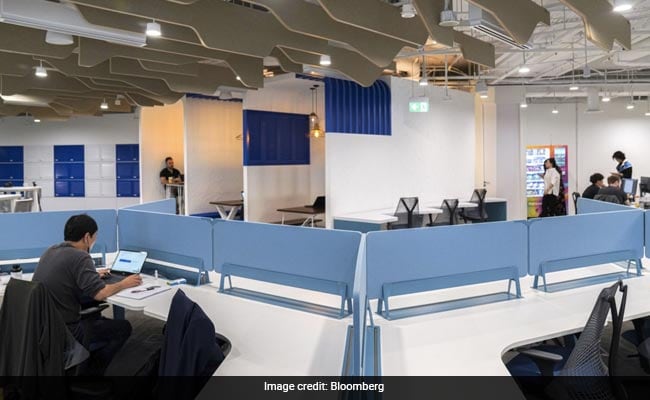
Singapore is overhauling visa rules to attract foreign workers and ease a tight labor market that's contributing to wage and price pressures.
The new rules will allow foreigners earning a minimum S$30,000 ($21,431) per month to secure a five-year work pass, with a provision to allow their dependents to seek employment, according to the Ministry of Manpower. Exceptional candidates in sports, arts, science and academia who don't meet the salary criteria are also eligible for the long-term visa under the so-called Overseas Networks and Expertise (ONE) pass that will take effect Jan. 1.
"Both businesses and talent are searching for safe and stable places to invest, live and work in. Singapore is such a place," Manpower Minister Tan See Leng told reporters on Monday. "It is therefore timely to leverage on this opportunity to cement Singapore's position as a global hub for talent."
The announcement is the latest in a string of decisions this year that are meant to address a still-tight labor market, as well as attract international business to drive the city-state's ambitions as a global financial hub, after a pandemic-era slump in white-collar workers from abroad. Many parts of the economy have seen pay increases this year to lure talent, stoking fears wage-cost escalation will add to headline inflation that's touched a 14-year-high and force the central bank to tighten monetary policy further.
Effective Sept. 1 next year, Singapore plans to exempt jobs, comparable to those held by top 10% of Employment Pass holders, from the need to be advertised locally before hiring foreigners under a system called Fair Consideration Framework. The duration of FCF advertisements, where applicable, will be halved to 14 days, the ministry said, adding that processing time for all EP applications will be cut to 10 business days from the current maximum three weeks.
The rule change will help the city-state better compete with rival business hubs like Hong Kong and the United Arab Emirates and catch up to Australia and the UK, which have similar global talent visas. More than 700 finance professionals moved to Singapore from Hong Kong last year, according to recruitment firm Robert Walters.
The UAE this year made it easier for expatriates to work without being sponsored by an employer, as well as switched to a Saturday-Sunday weekend to align the country with global markets as it seeks to win more businesses, with Dubai positioning itself as a crypto hub.
Singapore has had to grapple with especially challenging labor-market dilemmas as the nation lives with Covid and the need to recharge sectors like hospitality and food and beverage that suffered disproportionately amid social mobility restrictions that are finally all but canceled.
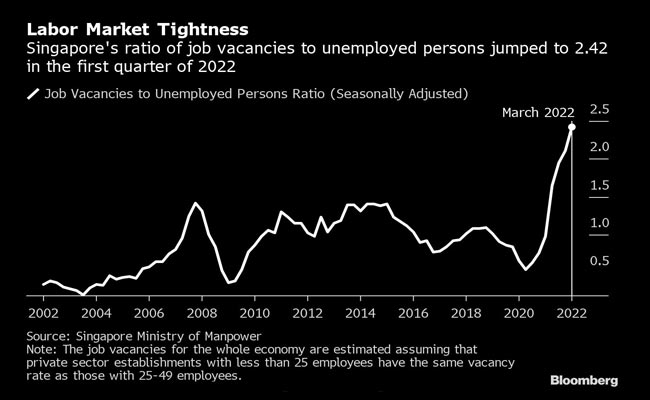
A key gauge that measures the imbalance between demand and supply of workers rose earlier this year to the highest level since 1998. That trend is a risk to productivity in the economy, which officials expect will grow by 3%-4% this year, narrower than the 3%-5% seen before -- a pace that will be among the slowest in Southeast Asia.
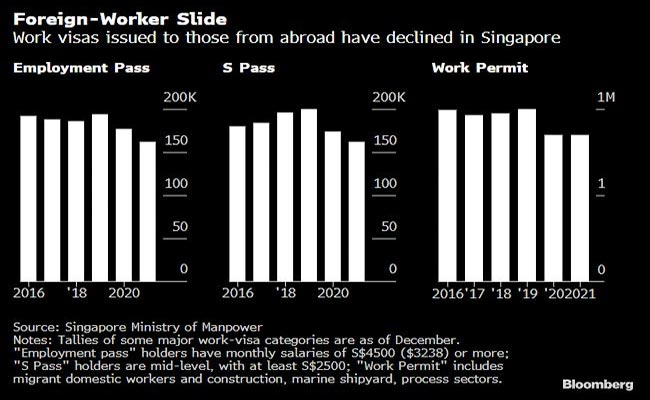
The country is witnessing an easing of labor market tightness, Minister Tan said, adding that labor supply in manufacturing and construction, among others, have gone back almost to pre Covid levels.
The problems are at the high end of the income ladder -- where Singapore wants to attract top global talent particularly in next-generation, technology-heavy industries -- as well as the lower end. The government fielded criticism during the pandemic that treatment and broader policies for migrant workers primarily employed in the construction industry needed a reboot.
"This is an age where talent makes all the difference to a nation's success," Prime Minister Lee Hsien Loong said in his Aug. 21 National Day Rally speech. "We need to focus on attracting and retaining top talent, in the same way we focus on attracting and retaining investments."
(This story has not been edited by NDTV staff and is auto-generated from a syndicated feed.)

-
India's Troika Of Good Luck | Joining The Dots

A weaker Trump, a cooling AI trade and resilient earnings have put Indian markets back in favour. Rising inflation could spoil the party.
-
Talking Points This Week: Leadership Shock At Nvidia, Earnings Strength, And The Fog Over Hormuz
The Anthropic IPO pricing and first trading day, Nvidia's upcoming earnings, and any fresh signals from Iran will set the tone for the following week.
-
Signature Play: The Classic Cocktail Is Dead. Or Is It?
Classic cocktails are disappearing from India's cocktail menus. But they're still being ordered, taught to bartenders and borrowed from. So, who's really having the last drink?
-
A New Samvat Wishlist: Inclusive Prosperity And Human Development
India has strengthened its economic foundations through infrastructure, digital access and enterprise. Its next growth chapter must deepen productivity, create better livelihoods and widen participation in prosperity.
-
Love, Sex Aur Dhokha: The Audacious Plot To Spy On Jensen Huang
A Taipei dinner, a Singapore chip buyer and a suspected Chinese asset: inside the alleged spy operation that got close to NVIDIA's Jensen Huang.
-
Ten Things I Learnt This Samvat
Patience can be a trap. Cheap stocks can stay cheap. Leverage can wipe you out. What did Samvat 2082 teach us? Niraj Shah writes on 10 lessons from the year gone by.
-
Talking Points This Week: Tech Nerves, FII Buying, And A Faraway Banking Shock
The global markets are not shining this Diwali. The exception in the large markets is, India.
-
Midterm Rally Lasted A Day. The Hard Reality Of A Divided US May Last Two Years | Opinion
Between a contested AI boom, a debt ceiling that arrives in 2027 and a president with every incentive to act alone, the next two years may prove more volatile than the first day's rally suggests.
-
Blue Wave Will Derail the AI Trade but Won't Dismantle the AI Era | Unhedged Position
The Democrats' sweep of the US Congress will see politics collide with economic forces both over the long and short term.
-
It's Time To Take The GST Council's Bet On Trust Global
Payment records can prove India's services exports, and clear, proportionate rules can bring foreign digital sellers into the tax net.