Singapore’s Sky-High Rents Show First Signs Of Cooling
(Bloomberg) -- Singapore's rental price growth slowed in the second quarter, cooling a years-long boom that has sapped affordability and threatened to dent the city-state's appeal as a finance hub.
An index of private residential prices rose 2.8% from the previous three months, the smallest gain since 2021, Urban Redevelopment Authority figures show.
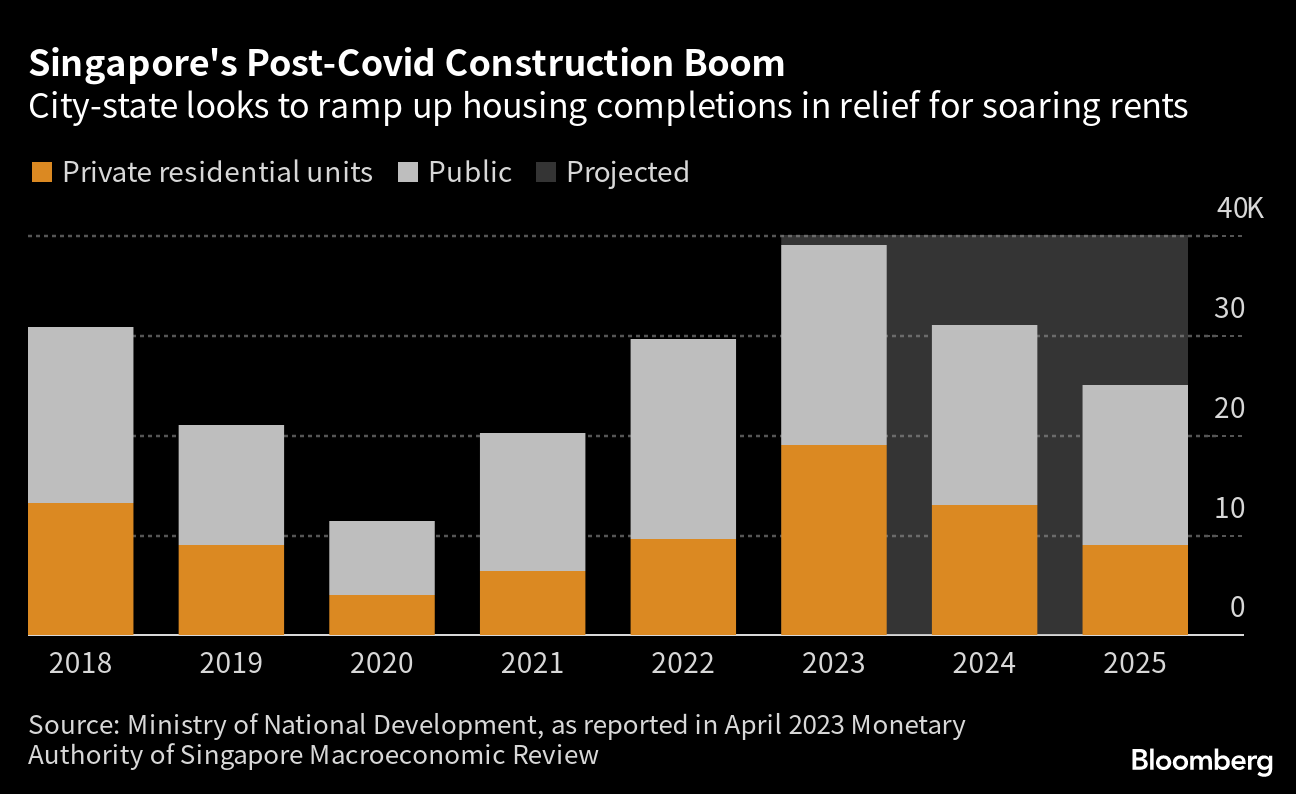
The growth in rental costs is expected to ease further as new units become available, with about 20,000 private housing completions due this year alone — the highest annual supply since 2017. Government measures have also helped relieve the spike in rents that has rattled tenants.
“Even expatriates with accommodation allowances were reconsidering their leasing options, as the cost of living in Singapore had grown exceptionally,” said Nicholas Keong, head of residential and private office at Knight Frank Singapore. He expects rental prices to further ease in the remainder of 2023 with “the steady completion of new inventory.”
Read More: Singapore Home Prices Fell for the First Time in Three Years
Island-wide leasing contracts for private apartments over the past three months were at the lowest since the start of the pandemic, with April and May volumes down 9.2% from a year ago, according to Knight Frank.
The high-end market, in particular, has seen the biggest reversal. Rents in the ultra-luxury segment slumped almost 4% in the second quarter, against the 9% gain in the previous quarter, according to Knight Frank's analysis of Urban Redevelopment Authority data.
Property agents have been feeling the pinch. Sunita Gill, co-founder of real estate consultancy Singapore Luxury Homes, has seen some of her expat clients relocate to Dubai. The government's latest cooling measures — doubling stamp duties for foreigners to 60% — has also deterred potential investors, leading to lower demand for luxury rentals, she said.
“We're personally witnessing a 10-15% reduction for properties listed for more than two months,” said Gill, who is also group director at PropNex Realty. “The luxury real estate market in Singapore may have become saturated recently with an abundance of high-end properties available for rent.”
Since the pandemic, the city-state has largely defied a global property slowdown as an influx of wealth from China and other countries fanned the market. Singapore tied with New York for the city with the fastest pace of rental growth at one point last year, and recently slid to second spot.
Meanwhile, discontent over renting costs has become a political problem. Although rental hikes have impacted expats more acutely since they are less likely to own homes, a survey last year showed that two in three Singaporeans between the ages of 22 to 29 are choosing to rent due to insufficient savings. In July, a YouGov poll found that over half of respondents think the government needs do more to regulate rents and provide additional support based on income.
Rents for private apartments rose 0.3% in June from a month earlier, according to a report by real estate portal SRX. Mark Yip, chief executive officer of property agency Huttons Group, expects rents of private apartments to increase between 10% to 15% this year, moderating from the almost 30% increase in 2022.
“For renters in Singapore, relief is in the air,” said Alan Cheong, executive director of research at Savills Plc.
More stories like this are available on bloomberg.com
©2023 Bloomberg L.P.

-
Signature Play: The Classic Cocktail Is Dead. Or Is It?

Classic cocktails are disappearing from India's cocktail menus. But they're still being ordered, taught to bartenders and borrowed from. So, who's really having the last drink?
-
A New Samvat Wishlist: Inclusive Prosperity And Human Development
India has strengthened its economic foundations through infrastructure, digital access and enterprise. Its next growth chapter must deepen productivity, create better livelihoods and widen participation in prosperity.
-
Love, Sex Aur Dhokha: The Audacious Plot To Spy On Jensen Huang
A Taipei dinner, a Singapore chip buyer and a suspected Chinese asset: inside the alleged spy operation that got close to NVIDIA's Jensen Huang.
-
Ten Things I Learnt This Samvat
Patience can be a trap. Cheap stocks can stay cheap. Leverage can wipe you out. What did Samvat 2082 teach us? Niraj Shah writes on 10 lessons from the year gone by.
-
Talking Points This Week: Tech Nerves, FII Buying, And A Faraway Banking Shock
The global markets are not shining this Diwali. The exception in the large markets is, India.
-
Midterm Rally Lasted A Day. The Hard Reality Of A Divided US May Last Two Years | Opinion
Between a contested AI boom, a debt ceiling that arrives in 2027 and a president with every incentive to act alone, the next two years may prove more volatile than the first day's rally suggests.
-
Blue Wave Will Derail the AI Trade but Won't Dismantle the AI Era | Unhedged Position
The Democrats' sweep of the US Congress will see politics collide with economic forces both over the long and short term.
-
It's Time To Take The GST Council's Bet On Trust Global
Payment records can prove India's services exports, and clear, proportionate rules can bring foreign digital sellers into the tax net.
-
Opinion | India at 38: From Innovation Overperformer to Innovation Powerhouse
India now has 453 VC-backed deep science startups, 18 of them late-stage, after 117 percent growth since 2020. Laurus Labs, at USD 9.3 billion, is the most valuable deep science company in any middle-income economy outside China.









