Should Have 5 To 7 Large Banks Ideally, Says Arvind Subramanian
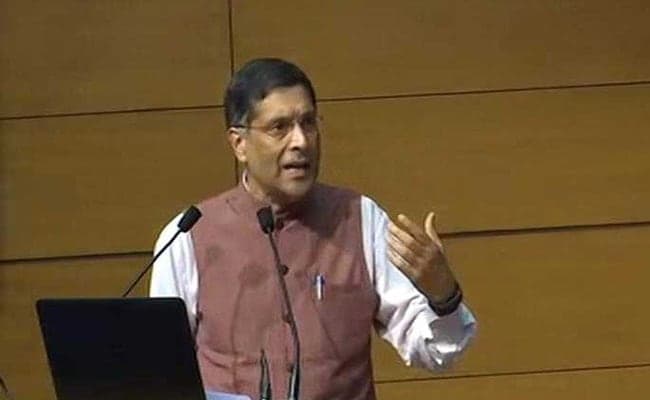
New Delhi: A day after government announced a massive Rs 2.11 lakh crore capital support initiative, Chief Economic Adviser Arvind Subramanian today made a case for consolidation in the banking space saying the country ideally should have 5-7 large lenders.
In an ideal banking world of tomorrow, India needs to have both large public sector and private sector banks, competing domestically and being competitive internationally, he said in a lecture at SGTB Khalsa College here.
Citing example of China, he said, there are four big banks which are now amongst biggest in the world.
"The big question also going forward is should there be more majority private sector ownership in the banking system? What is a good banking structure for India 5-10 years from now and...basically India needs...we need about 5,6,7 reasonably big banks both public and private sector and to be able to
compete domestically and to be competitive intentionally," he said.
Quoting former RBI Governor Y V Reddy, Subramanian said the aim must be to shrink or narrow the scope of the unviable banks.
Talking about the recapitalisation, he said it must be selective and incentive based, directing it to those banks where the bank for buck in terms of new credit creation will be maximum.
"Since all banks must maintain a minimum capital adequacy, one possibility would be to recapitalise the unviable banks only to the extent necessary to finance their current balance sheet size while explicitly not providing for their growth," he said.
Yesterday, Finance Minister Arun Jaitley unveiled an unprecedented Rs 2.11 lakh crore two-year road map to bolster NPA-hit public sector banks, which includes re-capitalisation bonds, budgetary support, and equity dilution.
Such bonds were first introduced by the government in the 1990s to recapitalise PSU banks.
Responding to a query on the Goods and Services Tax (GST), Subramanian said there is a strong preference for having low rates, few slabs and put as many products in and leave few products out.
"Finance Minister also said that we need to move towards rationalising it and I am very encouraged that over the last month or so and going forward the GST Council will take up this matter and over time reduce the rate," he said.
He also expressed hope that eventually both rates and slabs would come down.
"Ideally we should have one rate like Singapore does but even if we get down to two plus luxury goods or demerit goods, I think that would not be a bad outcome at all...I think we will get there sooner rather than later," he said.
To a question on Direct Tax Code, he said the government would be looking at it at some stage.
On emphasis on digital payments, he said it would lead to formalisation of the economy.
(Except for the headline, this story has not been edited by NDTV staff and is published from a syndicated feed.)

-
The Curious Case of Equitas Small Finance Bank And A CEO Who Quit For Stock

PN Vasudevan believes persistent investor concerns over a perceived conflict of interest had become a governance overhang on Equitas Small Finance Bank's stock, even as the lender improved profitability and asset quality.
-
Talking Points This Week: AI Cash Burn, A Tiger Comeback And An India That Still Finds Its Own Path
India is not immune to higher oil or tighter global liquidity, yet its earnings base is broader, its domestic policy levers are still available.
-
Foreign Investors Own Half Of HDFC Bank and ICICI Bank. An LTCG Cut Could Matter Most Here
Foreign portfolio investors have US$115 billion parked in HDFC Bank, ICICI Bank. If the government cuts long-term capital gains tax, Jefferies says returning foreign money could land here first.
-
'Never Seen This Level Of Negativity': Sandeep Tandon Says The Next Rally May Be Closer Than You Think
Veteran investor Sandeep Tandon says foreign selling is easing, large-caps are due a comeback and mid-caps are crowded, while he turns positive on gold, power and pharma this Diwali.
-
Indians Stay With Family, Not In Hotels | The Reason Why
India still lacks enough clean, reliable and affordable hotels for budget-conscious travellers.
-
The Economic Imperative: Analysing The Material Driving Force Behind India-Canada Strategic Reset
This economic complementarity is further reinforced by deep institutional investment ties and talent mobility, which form the bedrock of the bilateral framework.
-
Medicine Pricing: Where Must Profit Stop?
India must confront excessive margins, hidden incentives and regulatory gaps that threaten the integrity of medicine.
-
Why Amazon And Flipkart Are Struggling To Beat Meesho In India's Smaller Cities
With 274 million users and lowest-cost logistics, Meesho is defending its value commerce crown against giants like Amazon and Flipkart.
-
High US Salaries, No Green Card Certainty: The Financial Calculation Facing Indian H-1B Families
The suspension of PERM processing at eight technology employers does not cancel existing H-1B visas. What it does is force a question many Indian families have been avoiding: is the US salary worth tying your career and family plans to one employer?
-
Swiggy vs Eternal: Food Delivery's Two Rivals Are No Longer In The Same Race
Eternal is building a private AI assistant, dark.ai. Swiggy is still working out how to make Instamart pay, with an operating loss of Rs 895 crore in the July-September quarter while Blinkit stayed profitable.










